
Indexed In
- Open J Gate
- Genamics JournalSeek
- Academic Keys
- ResearchBible
- Cosmos IF
- Access to Global Online Research in Agriculture (AGORA)
- Electronic Journals Library
- RefSeek
- Directory of Research Journal Indexing (DRJI)
- Hamdard University
- EBSCO A-Z
- OCLC- WorldCat
- Scholarsteer
- SWB online catalog
- Virtual Library of Biology (vifabio)
- Publons
- Geneva Foundation for Medical Education and Research
- Euro Pub
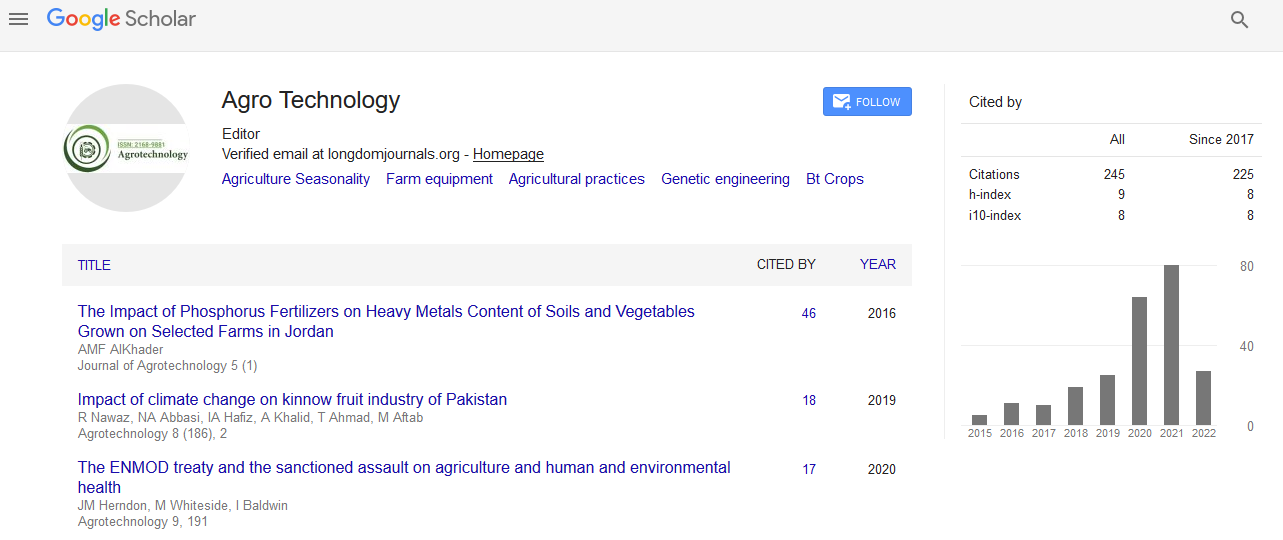
- Google Scholar
Useful Links
Share This Page
Journal Flyer
Open Access Journals
- Agri and Aquaculture
- Biochemistry
- Bioinformatics & Systems Biology
- Business & Management
- Chemistry
- Clinical Sciences
- Engineering
- Food & Nutrition
- General Science
- Genetics & Molecular Biology
- Immunology & Microbiology
- Medical Sciences
- Neuroscience & Psychology
- Nursing & Health Care
- Pharmaceutical Sciences
Perspective - (2026) Volume 15, Issue 1
Sustainable Crop Production Systems Balancing Agricultural Productivity, Resource Conservation and Ecological Stability
Chingwen Hsien*Received: 25-Feb-2026, Manuscript No. AGT-26-31957; Editor assigned: 27-Feb-2026, Pre QC No. AGT-26-31957 (PQ); Reviewed: 10-Mar-2026, QC No. AGT-26-31957; Revised: 17-Mar-2026, Manuscript No. AGT-26-31957 (R); Published: 24-Mar-2026, DOI: 10.35248/2168-9881.26.15.411
Abstract
Description
Crop production forms the foundation of global food systems and plays an important role in supporting human livelihoods, economic development and food security. However, increasing population growth, environmental degradation, climate change and resource scarcity have created significant challenges for agricultural production. Traditional farming practices often rely heavily on chemical inputs, intensive land use and resourceintensive management strategies that may contribute to soil degradation, biodiversity loss and environmental pollution. Sustainable crop production has emerged as an essential approach for maintaining agricultural productivity while protecting natural resources and ecosystem health.
Sustainable crop production refers to farming systems that meet current food and fiber demands without compromising the ability of future generations to meet their own needs. This approach emphasizes efficient resource utilization, environmental stewardship, economic viability and social responsibility. Sustainable crop production seeks to optimize agricultural outputs while minimizing negative impacts on soil, water, air and biodiversity.
Soil health is a fundamental component of sustainable crop production systems. Healthy soils provide essential nutrients, retain water, support beneficial microorganisms and contribute to overall crop productivity. Practices such as crop rotation, cover cropping, conservation tillage and organic matter incorporation help maintain soil fertility and improve long-term agricultural sustainability. These methods also reduce erosion and enhance soil structure.
Efficient water management is equally important in sustainable agriculture. Water scarcity has become a growing concern in many agricultural regions due to climate variability and increasing demand. Sustainable crop production promotes water conservation through technologies such as drip irrigation, sprinkler systems, soil moisture monitoring and rainwater harvesting. These practices improve water-use efficiency while maintaining crop yields.
Nutrient management plays an essential role in balancing productivity and environmental protection. Excessive fertilizer application can contribute to water pollution, greenhouse gas emissions and soil degradation. Sustainable nutrient management strategies involve soil testing, precision application techniques, integrated nutrient management and the use of organic amendments. Such approaches ensure crops receive adequate nutrients while reducing environmental risks.
Integrated pest management represents another key aspect of sustainable crop production. Rather than relying solely on chemical pesticides, integrated pest management combines biological control, cultural practices, resistant crop varieties and targeted pesticide applications. This approach minimizes pestrelated losses while reducing chemical inputs and protecting beneficial organisms.
Crop diversification contributes significantly to agricultural sustainability. Diverse cropping systems improve resilience to pests, diseases and climatic stresses while enhancing soil fertility and ecosystem functions. Intercropping, mixed farming systems and diversified crop rotations support biodiversity and reduce production risks associated with monoculture farming.
Technological innovations continue to strengthen sustainable crop production practices. Precision agriculture, remote sensing, digital farming platforms and data analytics enable farmers to optimize resource use and improve management decisions. These technologies support site-specific interventions that increase efficiency while reducing environmental impacts.
Climate change adaptation is becoming increasingly important for sustainable crop production. Rising temperatures, changing rainfall patterns and extreme weather events can affect crop growth and productivity.
Economic sustainability is another essential consideration. Sustainable farming systems must remain profitable to ensure long-term adoption. Efficient resource use, reduced input costs, improved productivity and access to premium markets for sustainably produced crops can enhance farm profitability while supporting environmental objectives.
Several challenges continue to affect the implementation of sustainable crop production practices. Limited access to technology, insufficient knowledge, financial constraints and market barriers may hinder adoption among some farming communities. Strengthening extension services, research programs and policy support can help overcome these obstacles and promote wider implementation.
Conclusion
Sustainable crop production represents a comprehensive approach to agricultural development that integrates productivity, environmental protection and resource conservation. Through improved soil management, efficient water use, responsible nutrient application, crop diversification and technological innovation, sustainable farming systems contribute to long-term agricultural resilience and food security. As global agricultural demands continue to increase, sustainable crop production will remain essential for ensuring productive and environmentally responsible farming landscapes.
Citation: Citation: Hsien C (2026). Sustainable Crop Production Systems Balancing Agricultural Productivity, Resource Conservation and Ecological Stability. Agrotechnology.15.411.
Copyright: Copyright: © 2026 Hsien C. This is an open-access article distributed under the terms of the Creative Commons Attribution License, which permits unrestricted use, distribution and reproduction in any medium, provided the original author and source are credited