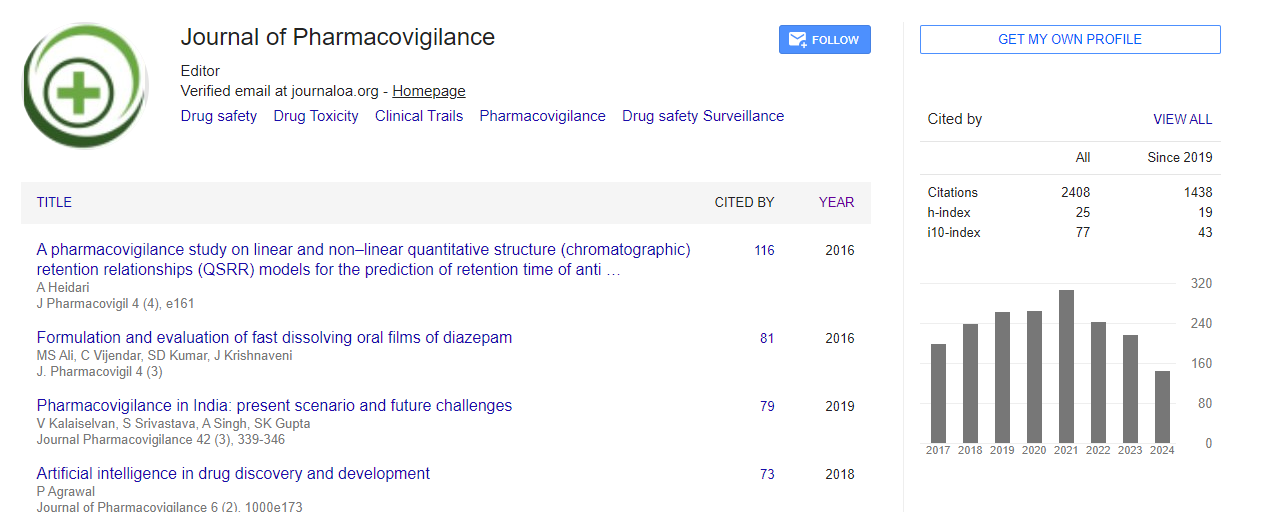

Indexed In
- Open J Gate
- JournalTOCs
- The Global Impact Factor (GIF)
- RefSeek
- Hamdard University
- EBSCO A-Z
- OCLC- WorldCat
- Publons
- Euro Pub
- Google Scholar
Useful Links
Share This Page
Journal Flyer
Open Access Journals
- Agri and Aquaculture
- Biochemistry
- Bioinformatics & Systems Biology
- Business & Management
- Chemistry
- Clinical Sciences
- Engineering
- Food & Nutrition
- General Science
- Genetics & Molecular Biology
- Immunology & Microbiology
- Medical Sciences
- Neuroscience & Psychology
- Nursing & Health Care
- Pharmaceutical Sciences
Commentary - (2026) Volume 14, Issue 1
Structured Approaches in Pharmaceutical Risk Management for Patient Safety
Julien Moreau*Received: 10-Feb-2026, Manuscript No. JP-26-31403; Editor assigned: 12-Feb-2026, Pre QC No. JP-26-31403; Reviewed: 26-Feb-2026, QC No. JP-26-31403; Revised: 05-Mar-2026, Manuscript No. JP-26-31403; Published: 12-Mar-2026, DOI: 10.35248/2329-6887.26.14.548
Description
Pharmaceutical risk management refers to the systematic process of identifying, evaluating, controlling, and continuously reviewing risks associated with medicinal products throughout their lifecycle. It is an essential component of modern drug development and post-marketing surveillance, ensuring that medicines are used in a way that maintains an acceptable balance between benefits and potential harm. This process begins during early development and continues even after a product reaches widespread clinical use.
Risk identification is the first stage of the process and involves collecting information from multiple sources. These sources include preclinical studies, clinical trials, published medical literature, spontaneous adverse event reports, and observational studies. Each of these contributes different types of safety information. Clinical trials provide controlled data on common reactions, while post-marketing reports often reveal less frequent or delayed effects that may not have been observed earlier. By combining these sources, a more complete understanding of a medicine’s safety profile can be developed.
Once risks are identified, they are evaluated in terms of their severity, frequency, and clinical significance. This evaluation considers how likely an adverse outcome is to occur and the potential impact on patients if it does. Some risks may be manageable with routine clinical monitoring, while others may require additional restrictions or safety measures. The evaluation process also considers the patient population, as certain groups such as older adults, children, or individuals with chronic illnesses may be more vulnerable to specific effects.
Risk control strategies are then developed to reduce the likelihood or impact of identified risks. These strategies may include changes to prescribing information, dosage recommendations, or contraindications. In some cases, additional monitoring requirements are introduced, such as regular laboratory testing or clinical assessments. Educational materials for healthcare professionals and patients may also be implemented to ensure proper understanding of safe medication use. These measures are designed to minimize harm while preserving therapeutic effectiveness.
A structured risk management plan is a key document in this process. It outlines known and potential risks associated with a medicinal product and describes the strategies used to address them. This plan is updated regularly as new information becomes available, ensuring that it reflects the most current understanding of the product’s safety profile. Regulatory authorities review these plans as part of the approval and ongoing monitoring process.
Post-marketing surveillance plays an important role in pharmaceutical risk management. After a medicine is approved and made available to the public, continuous monitoring is required to detect any new safety concerns. Real-world use often involves a more diverse patient population than clinical trials, which can reveal additional risks. Data collected during this phase is used to refine existing risk management strategies and implement new measures if necessary.
Communication is another essential element of effective risk management. Safety information must be clearly communicated to healthcare professionals, patients, and regulatory bodies. This ensures that all stakeholders are aware of potential risks and understand how to manage them appropriately. Timely communication is particularly important when new safety concerns emerge, as it allows for rapid implementation of protective measures.
Pharmaceutical companies are responsible for maintaining internal systems that support ongoing risk management activities. These systems include pharmacovigilance units that monitor adverse events, analyze safety data, and prepare regulatory submissions. They must ensure compliance with national and international guidelines governing drug safety. Regulatory agencies, in turn, evaluate this information and determine whether additional actions are required to protect public health.
Conclusion
Pharmaceutical risk management is a comprehensive and dynamic process that supports the safe use of medicines from development through post-marketing stages. Education and training are important for ensuring that healthcare professionals can effectively apply risk management principles in clinical practice. Understanding how to interpret safety information and implement recommended precautions helps reduce medicationrelated harm. Patients also play a role by following prescribed instructions and reporting any unusual symptoms during treatment. By systematically identifying and addressing potential risks, it helps maintain an appropriate balance between therapeutic benefit and safety. Continuous monitoring, effective communication, and adaptive strategies ensure that medicines remain safe and effective for diverse patient populations over time.
Citation: Moreau J (2026). Structured Approaches in Pharmaceutical Risk Management for Patient Safety. J Pharmacovigil. 14:548
Copyright: © 2026 Moreau J. This is an open-access article distributed under the terms of the Creative Commons Attribution License, which permits unrestricted use, distribution and reproduction in any medium, provided the original author and source are credited.