

Indexed In
- Open J Gate
- Genamics JournalSeek
- Academic Keys
- JournalTOCs
- CiteFactor
- Ulrich's Periodicals Directory
- Access to Global Online Research in Agriculture (AGORA)
- Electronic Journals Library
- Centre for Agriculture and Biosciences International (CABI)
- RefSeek
- Directory of Research Journal Indexing (DRJI)
- Hamdard University
- EBSCO A-Z
- OCLC- WorldCat
- Scholarsteer
- SWB online catalog
- Virtual Library of Biology (vifabio)
- Publons
- Geneva Foundation for Medical Education and Research
- Euro Pub
- Google Scholar
Useful Links
Share This Page
Journal Flyer
Open Access Journals
- Agri and Aquaculture
- Biochemistry
- Bioinformatics & Systems Biology
- Business & Management
- Chemistry
- Clinical Sciences
- Engineering
- Food & Nutrition
- General Science
- Genetics & Molecular Biology
- Immunology & Microbiology
- Medical Sciences
- Neuroscience & Psychology
- Nursing & Health Care
- Pharmaceutical Sciences
Research Article - (2025) Volume 15, Issue 3
Slow Varietal Turnover in Soybean a Challenge to Climate Change Adaptation and Disease Control: Pathways to Circumvent
Received: 18-Sep-2024, Manuscript No. JPPM-24-26953; Editor assigned: 20-Sep-2024, Pre QC No. JPPM-24-26953 (PQ); Reviewed: 04-Oct-2024, QC No. JPPM-24-26953; Revised: 15-Jun-2025, Manuscript No. JPPM-24-26953 (R); Published: 22-Jun-2025
Abstract
The ongoing cultivar transformation of crops termed ‘varietal turnover’ manifests in transition from the existing improved varieties to the new improved varieties, as farmers in most of the world replaced landraces during the Green Revolution and subsequent decades. Younger varieties significantly enhance yield through genetic gains and protection against climate change and associated changes that lead to changing crop cycles and multiple disease and insect challenges. Studies documented significant yield increases with frequent varietal change and vice versa. However, long varietal age in developing countries, especially in climate change-vulnerable countries of Africa and South Asia, poses challenges for climate adaptation, crop protection, yields, and consequently, poverty reduction and food and nutrition security. Farmers continuing with older varieties face a ‘technology treadmill’ of higher average production costs than those harnessing younger ones. New literature deals with the shift to new improved varieties, the rate of change or turnover of varieties, and the determinants and pathways for accelerating the desired change. The present study is a part of the new strand of literature and employs a dynamic framework using duration analysis to examine macroeconomic adoption patterns and farm-level varietal change simultaneously.
Keywords
Green revolution; Farm-level varietal; Varietal turnover
Introduction
Soybean, as the fourth leading crop, plays a critical role in achieving SDG2 of zero hunger through its high and superior protein content. It also contributes to SDG13 associated with climate resilience through nitrogen fixation. However, research studies have found challenges in soybean crop development with rising temperatures, irregular distribution of rainfall, dry spells, and frequent extreme events. Studies in India, the USA, and Brazil have found delays in sowing time and associated issues. Furthermore, climate change is expected to change geographical pest patterns and intensify some. The stagnation of soybean yields in India at one ton per hectare for the past three decades highlights ongoing challenges in crop improvement, which are crucial for achieving food security and sustainable agriculture [1].
We leverage a large primary dataset of 1410 smallholder soybean farms in central and western India to analyze demand-side and supply-side varietal acceleration pathways employing duration analysis. The study identifies a slow rate of varietal turnover, with the Area-Weighted Average Age (AWAA) of varieties being 15.6 years, much higher than the desirable limit documented in Atlin et al. of 10 years. Factors such as the lack of varieties with desirable traits and poor information flow contribute to yield stagnation, which has significant implications for crop resistance to diseases and pests. The policymaking needs quicker course correction with quicker release of new varieties with desired traits, including long juvenility and higher genetic yield potential, by leveraging modern molecular methods, including genetic engineering and gene editing, and the private sector in crop breeding and seed supply [2].
Materials and Methods
Limited varietal choices and long average age of varieties: The sampled soybean farmers were smallholders with an average landholding of 4.63 acres. They had poor education and infrastructure facilities, and a significant proportion of them came from disadvantaged social groups. Their range of variety choices was limited, with only nine varieties in the seed chain and a mean yield of 976 kilograms per hectare. Two of those varieties (JS-335 and JS-95-60) developed in ‘selection cycle 2’ of breeding after 1990 occupy more than 80% of the sown area. It is noteworthy that none of the varieties in the seed chain are developed by the private sector [3,4]. We show their adoption pattern employing the non-parametric survival functions in Figure 1. At time 0, before any farmer shifts to a new variety, the function takes the value of 1. Both the leading varieties reached the saturation stage and need replacement.
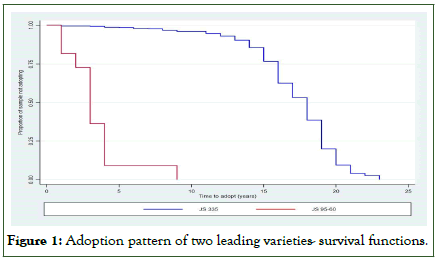
Figure 1: Adoption pattern of two leading varieties- survival functions.
Drivers for accelerating varietal turnover: We analyzed the determinants of varietal turnover leveraging the less restrictive and dynamic hazard functions to give the rate of change with Gompertz distribution as the survival functions increase over time and have lower AIC and BIC values for the Gompertz distribution. The analysis employed frailty models to control for unobserved heterogeneity arising from differences in farmers’ skills in learning about new varieties, risk-taking attitudes in early adoption, and motivation levels. The significant nested loglikelihood demonstrated heterogeneous regional drivers, so we fit hazard functions separately for the two regions.
The foremost pathway for varietal turnover is the release of new varieties as seen from the highly significant hazard ratios of the dummy variables for the JS-335 and JS-95-60 fitted in the model as regime changes (Table 1). The significant gamma in the hazard functions indicates positive duration dependence and means that replacing old soybean varieties is initially slow and gathers momentum with time [5]. This implies a higher need for information flow and social networks for faster varietal change. The farmers who obtain information from media and input dealers rapidly shift to new varieties. Some of the farmers’ perceived characteristics of the varieties, like fodder palatability and drought tolerance, influence varietal turnover, albeit differently [6]. While the former accelerates, the latter drags down. The farmers with more years of education adopt new soybean varieties slowly, probably because of the alternative farm or non-farm opportunities for them. Even higher price fails to drive soybean farmers to newer varieties with secular yield stagnation.
Results and Discussion
Diverse regional drivers: The hazard functions in Table 1 reveal the diversity of varietal change drivers in the two soybeancultivating regions. While the release of new varieties propels faster varietal change in both regions, we find heterogeneity in the impacts of information sources, perceived varietal characteristics, and some of the farmer attributes (Columns 3 and 4 of Table 1). Disease and insect resistance profoundly drive varietal change in the Western region because of the historical record of damage. Drought tolerance also mattered in that region because of the light soils with low water retention, 30% lower rainfall relative to Central India, and drought susceptibility of the leading variety of the region, viz., JS-335. On the other hand, farmers in Central India considered the fodder palatability while shifting to new varieties, while the same was not a determinant in Western region as they have other pulse crops to feed the cattle. Information flow about the varieties in the western region through government extension agencies drags down new variety adoption, probably because of poor quality. Larger family size and being a forward community in the central region and education in the western region slow down varietal change. As argued earlier, they may enable farmers to harness other opportunities to grow more crops and pursue non-farm opportunities. Age in the western region drags down varietal turnover because older farmers face shorter time horizons.
| Variables | Total sample | Central India | Western India |
| Age (Years) | 0.994 | 0.999 | 0.979*** |
| Family size (Number) | 0.974 | 0.948* | 1.045 |
| Education (years) | 0.975** | 0.983 | 0.948** |
| General (1=Yes) | 0.780** | 0.651** | 0.993 |
| OBC (1=Yes) | 1.251** | 1.313** | 0.862 |
| Extension officers (1=Yes) | 1.183 | 1.23 | 0.377* |
| Media (1=Yes) | 1.976*** | 1.865** | 0.645 |
| Input dealers (1=Yes) | 1.291** | 1.383*** | 0.333** |
| Own saved seed (1=Yes) | 1.127 | 0.998 | 1.630** |
| Pest resistance (1=Yes) | 0.926 | 0.883 | 2.308* |
| Drought tolerance (1=Yes) | 0.793** | 0.784** | 2.576** |
| Palatability as fodder (1=Yes) | 1.415** | 1.401** | 2.229 |
| Release of JS-335 | 139.204*** | 95.079*** | 6,852.337*** |
| Release of JS-9560 | 17.645*** | - | 179.240*** |
| Soybean price (Rs/Quintal) | 0.998*** | 0.998*** | 0.997*** |
| Gamma | 1.822*** | 1.701*** | 2.983*** |
| Theta | 0.963 | 1.046 | 1.264 |
| LR test of theta (H0=0) | χ2=163.7*** | χ2=86.92*** | χ2=72.38*** |
| Constant | 0.001*** | 0.002*** | 0.000*** |
| AIC | -171.087 | 397.26 | -763.733 |
| BIC | 67.512 | 579.96 | -617.559 |
| District fixed effects | Yes | Yes | Yes |
|
Log pseudo likelihood |
132.543 |
-159.63 |
418.866 |
|
Observations |
1,184 |
800 |
384 |
|
Note: *, **, and *** indicate statistical significance at the p<0.1, p<0.05, and p<0.01 levels based on robust standard errors (Not presented in the table). Other variables used in the duration model and found insignificant were gender of head of household, landholding size, smart phone possession, credit availed, soil type, off-farm income, group membership, extension officers’ advice, neighboring farmer’s advice, owned seed use, higher yield of variety, marketability of variety, and good cooking quality. |
|||
Table 1: Accelerators for soybean varietal turnover from duration analysis.
Contextualizing the findings: The continued cultivation of older varieties like JS-335 (Released in 1994) and JS-95-60, with an average age of 15.6 years, poses a serious challenge to soybean cultivation in breaking yield barriers, adapting to climate and disease and insects. JS-335 is susceptible to phytopthora root rot and powdery mildew, which are widespread diseases of soybean in India affecting all plant parts. Further, JS-95-60 is susceptible to the devastating charcoal rot, and yellow mosaic virus. The findings of duration analysis point to the underlying causes of slow varietal turnover. They are the slow breeding cycles, inability to break yield barriers, lack of yield stability, and bringing out desirable characteristics like long juvenility, drought tolerance, and livestock fodder palatability [7].
The slow pace of pedigree breeding in India translates to a long breeding cycle of 10-15 years in the absence of speed breeding or molecular approaches. The breeding cycle can be significantly shorter by utilizing doubled-haploid technology, genomic selection, Genetic Modification (GM), and other gene editing technologies. The soybean revolution in Brazil, the USA, and Argentina owes largely to genetic engineering technologies. The Indian policymakers relied heavily on a GM-free tag to export soya meals with the obsolete assumption that the country has a significant export surplus, which no longer holds with rising domestic consumption [8]. Introducing HT soybean varieties could result in efficient weed control and conservation tillage. Modern molecular methods are critical to ushering long juvenility, drought tolerance, and fodder palatability traits. Highly day-length sensitive soybeans originating from higher latitudes of China necessitate breeding for long juvenility in lower altitudes of India, much like Brazil and the southern states of the USA [9]. GM drought-tolerant (HaHb4) soybeans developed in Argentina reduce yield penalties in moisture stress conditions. Gene-edited DT soybeans developed by GDM Seeds are also relevant to India.
The complete lack of private-sector involvement in soybean crop breeding means private companies are confined to multiplying public-sector open-pollinated varieties. They find it difficult to compete with the heavily subsidized public seed agencies to supply quality seed. Moreover, the seed system could provide only half of the required seed, limiting the farmers’ options for changing the existing varieties [10]. The low Seed Replacement Rate (SRR) at 35% in the sample farmers hinders varietal turnover, as Singh et al. argue. Seed sector liberalization can activate private players to develop and aggressively push new varieties, as in the case of corn in Kenya.
Conclusion
This article’s analysis of farmers’ varietal choices and turnover among 1410 smallholder household’s points to several pathways to accelerate varietal turnover that apply to smallholder soybean cultivation in developing countries, most notably climate change-vulnerable countries of Africa and South Asia. Foremost among them is stepping up investments in the public sector to shorten the breeding cycle by leveraging modern molecular methods. The new molecular methods will also be critical in developing varieties suitable to lower latitudes, shorter production cycles, moisture stress conditions, enhancing genetic diversity, and multiple uses. Biotechnologies, including genetic modification and gene editing technologies, hold considerable promise in this regard, besides other technologies.
Further, policymakers must develop business models to actively involve the private sector in crop breeding and seed systems by liberalizing institutions and technologies. A competitive seed system can only push recent varieties into farmer fields with promotional strategies and information flows. Assessing the farmers’ demands beyond yield in choosing a variety is crucial for varietal turnover as we find preferences for traits like fodder palatability. The present study’s findings also highlight regional variations in the farmers’ preferences. It also accentuates the accumulated evidence that shifting from established varieties is a complex process for all the stakeholders in the seed system, while at the same time, crucial to adapt to the rigors of climate change and changing disease and pest dynamics.
References
- Abate TM, Mekie TM, Dessie AB. Analysis of speed of improved maize (BHâ??540) variety adoption among smallholder farmers in Northwestern Ethiopia: count outcome model. Heliyon. 2022;8(10).
[Crossref] [Google Scholar]â?¯[PubMed]
- Amrate PK, Shrivastava MK, Bhale MS, Agrawal N, Kumawat G, Shivakumar M, et al. Identification and genetic diversity analysis of highâ??yielding charcoal rot resistant soybean genotypes. Sci Rep. 2023;13:8905.
[Crossref]â?¯[Google Scholar]
- Atlin GN, Cairns JE, Das B. Rapid breeding and varietal replacement are critical to adaptation of cropping systems in the developing world to climate change. Glob Food Sec. 2017;12:31–37.
[Crossref] [Google Scholar]â?¯[PubMed]
- Bigolin T, Talamini E. Impacts of Climate Change Scenarios on the Corn and soybean: Doubleâ??Cropping System in Brazil. Climate. 2024;12:42.
[Crossref]â?¯[Google Scholar]
- Chivasa W, Worku M. Maize varietal replacement in Eastern and Southern Africa: Bottlenecks, drivers and strategies for improvement. Glob Food Secur. 2022;32:100589.
[Crossref]â?¯[Google Scholar]
- de Groote H, Omondi LB. Varietal turnâ??over and their effect on yield and food security—Evidence from 20 years of household surveys in Kenya. Glob Food Secur. 2023;36:110676.
[Crossref]â?¯[Google Scholar]
- Dupare BU, Sharma P, Billore SD. Impact of Climate Change on Soybean Cultivation in Malwa and Nimar Region of Madhya Pradesh: Farmers’ Perspective. Soybean Res. 2020;18(1):87–97.
- Goyal OP. The Status of the Indian Soybean Industry and its Future. 2014.
- Lin F, Chhapekar SS, Vieira CC, da Silva MP, Rojas A, Lee D, et al. Breeding for disease resistance in soybean: a global perspective. Theor Appl Genet. 2022;135:3773–3872.
- Nazli H, Smale M. Dynamics of variety change on wheat farms in Pakistan: a duration analysis. Food Policy. 2016;59:24–33.
[Crossref]â?¯[Google Scholar]
Citation: Nuthalapati CS (2025) Slow Varietal Turnover in Soybean a Challenge to Climate Change Adaptation and Disease Control: Pathways to Circumvent. J Plant Pathol Microbiol. 16:763.
Copyright: © 2025 Nuthalapati CS. This is an open-access article distributed under the terms of the Creative Commons Attribution License, which permits unrestricted use, distribution, and reproduction in any medium, provided the original author and source are credited.