
Indexed In
- Open J Gate
- JournalTOCs
- The Global Impact Factor (GIF)
- RefSeek
- Hamdard University
- EBSCO A-Z
- OCLC- WorldCat
- Publons
- Euro Pub
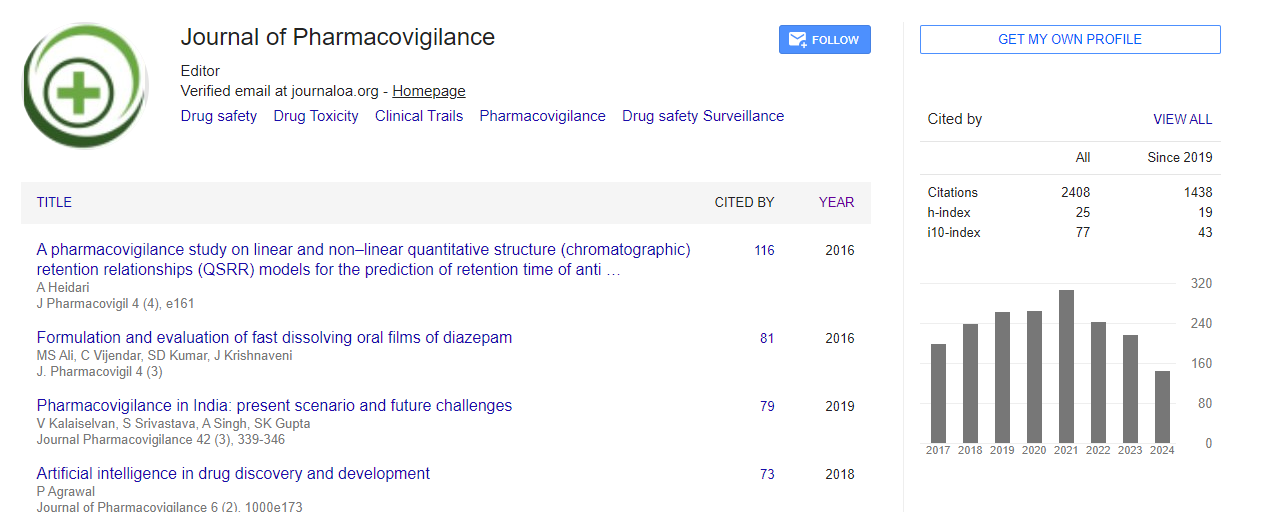
- Google Scholar
Useful Links
Share This Page
Journal Flyer
Open Access Journals
- Agri and Aquaculture
- Biochemistry
- Bioinformatics & Systems Biology
- Business & Management
- Chemistry
- Clinical Sciences
- Engineering
- Food & Nutrition
- General Science
- Genetics & Molecular Biology
- Immunology & Microbiology
- Medical Sciences
- Neuroscience & Psychology
- Nursing & Health Care
- Pharmaceutical Sciences
Opinion Article - (2025) Volume 13, Issue 4
Role of Pharmacovigilance in Monitoring Vaccine Safety After Market Authorization
Laura Schmidt*Received: 10-Nov-2025, Manuscript No. JP-26-31015; Editor assigned: 12-Nov-2025, Pre QC No. JP-26-31015 (PQ); Reviewed: 26-Nov-2025, QC No. JP-26-31015; Revised: 03-Dec-2025, Manuscript No. JP-26-31015 (R); Published: 10-Dec-2025, DOI: 10.35248/2329-6887.25.13.534
Description
Vaccines play an essential role in preventing infectious diseases and reducing public health burden worldwide. Although vaccines undergo extensive evaluation before approval, continuous safety monitoring remains necessary once they are administered to large and diverse populations. Pharmacovigilance systems provide structured mechanisms for detecting, assessing, and managing adverse events following immunization. These systems support public confidence by ensuring that vaccine benefits continue to outweigh potential risks throughout widespread use.
Pre-authorization studies for vaccines are designed to assess safety and immune response in controlled environments. However, these trials may not detect very rare adverse events or effects that occur only in specific populations. After market authorization, vaccines are administered to millions of individuals with varying ages, health conditions, and genetic backgrounds. Pharmacovigilance activities capture safety data from real-world use, enabling detection of events that may not have been observed during clinical development.
Adverse events following immunization may range from mild and temporary reactions to more serious conditions. Common reactions such as injection-site discomfort or low-grade fever are typically identified during trials. Less frequent events, including allergic responses or neurological symptoms, may only become apparent through post-marketing surveillance. Accurate reporting and careful evaluation are required to distinguish coincidental events from those plausibly linked to vaccination.
Spontaneous reporting systems form a primary component of vaccine pharmacovigilance. Healthcare professionals and patients are encouraged to report suspected adverse events following immunization, regardless of certainty regarding causation. These reports contribute to national and international databases that allow detection of patterns over time. A rise in reports associated with a specific vaccine may prompt further investigation and targeted studies.
Active surveillance methods complement spontaneous reporting by providing structured data collection. These methods include cohort studies, registries, and electronic health record analysis. Active surveillance supports estimation of incidence rates and comparison between vaccinated and unvaccinated populations. Such approaches help clarify whether observed events occur more frequently than expected based on background rates.
Risk communication is a critical aspect of vaccine pharmacovigilance. Clear and timely communication about safety findings supports informed decision-making among healthcare professionals and the public. When potential safety concerns arise, transparent explanation of the evidence and planned evaluation steps helps prevent misinformation and unnecessary alarm. Trust in vaccination programs depends on open dialogue and responsible communication.
Regulatory authorities play a central role in coordinating vaccine safety monitoring. They review pharmacovigilance data, assess benefit–risk balance, and implement appropriate actions when needed. These actions may include updates to product information, recommendations for specific populations, or enhanced monitoring. Continuous evaluation ensures that vaccination policies remain aligned with current evidence. Healthcare professionals contribute to vaccine safety monitoring through observation, documentation, and reporting. Their clinical expertise supports accurate identification of adverse events and appropriate management. Training on recognition and reporting procedures enhances the quality of pharmacovigilance data and strengthens surveillance systems.
Conclusion
Pharmacovigilance plays a vital role in monitoring vaccine safety after the market authorization. Through a combination of spontaneous reporting, active surveillance, and transparent communication, pharmacovigilance systems support ongoing evaluation of vaccine safety. These efforts help maintain public confidence and ensure that vaccination programs continue to protect population health effectively. Public participation also influences vaccine pharmacovigilance effectiveness. Patients and caregivers often observe reactions outside clinical settings and may provide valuable information through reporting systems. Educational initiatives that explain how and why to report adverse events encourage engagement and improve data completeness.Citation: Schmidt L (2025). Role of Pharmacovigilance in Monitoring Vaccine Safety After Market Authorization. J Pharmacovigil. 13:534
Copyright: © 2025 Schmidt L. This is an open-access article distributed under the terms of the Creative Commons Attribution License, which permits unrestricted use, distribution and reproduction in any medium, provided the original author and source are credited.