
Indexed In
- Academic Journals Database
- Open J Gate
- Genamics JournalSeek
- JournalTOCs
- China National Knowledge Infrastructure (CNKI)
- Scimago
- Ulrich's Periodicals Directory
- RefSeek
- Hamdard University
- EBSCO A-Z
- OCLC- WorldCat
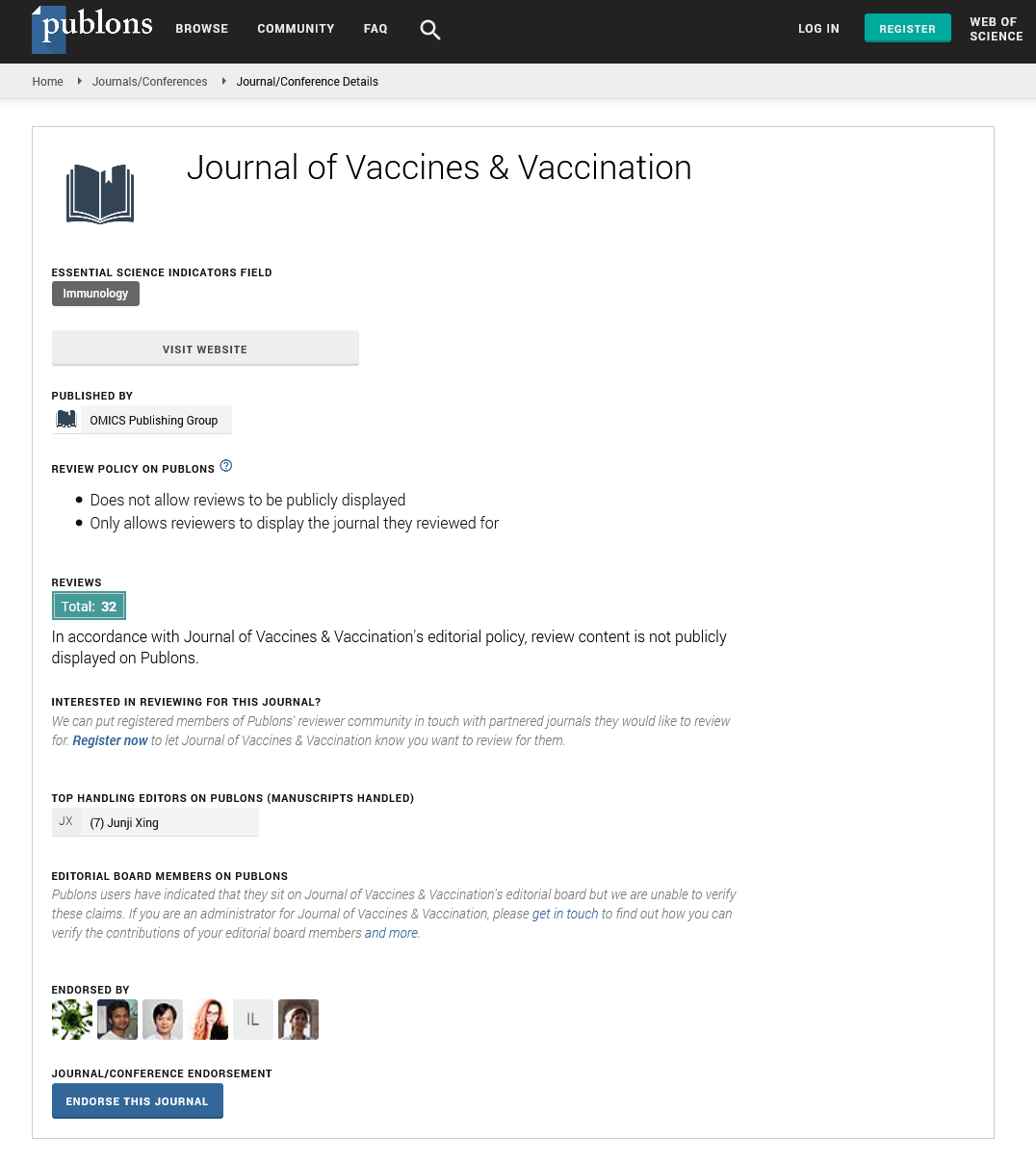
- Publons
- MIAR
- University Grants Commission
- Geneva Foundation for Medical Education and Research
- Euro Pub
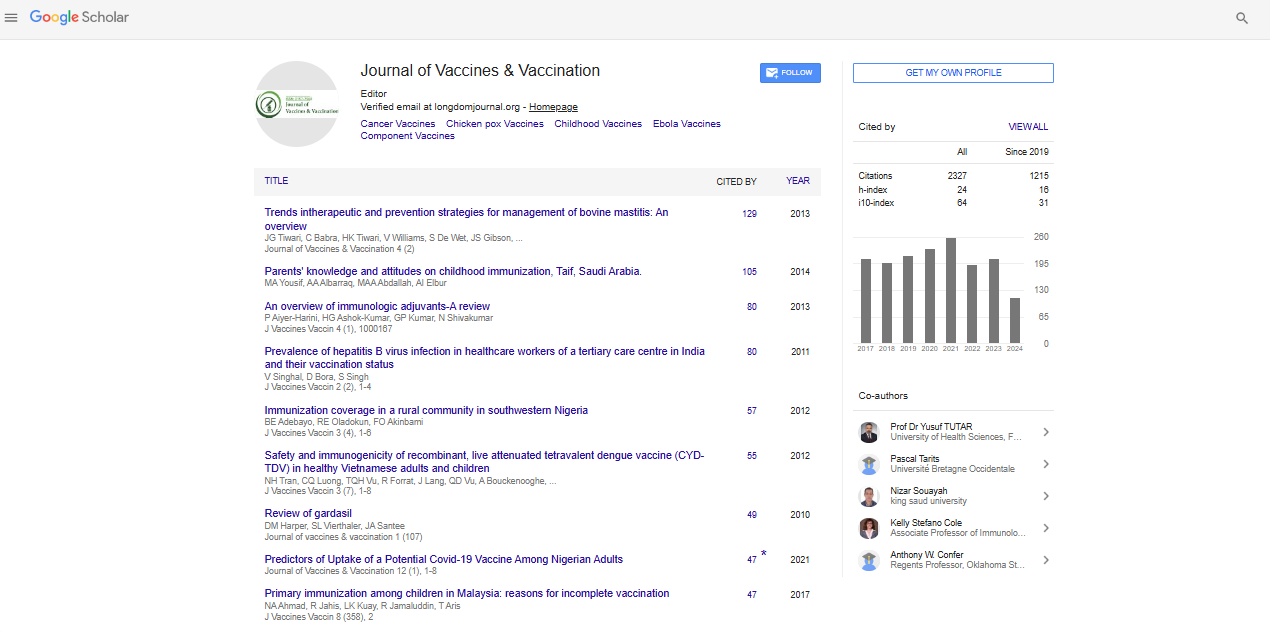
- Google Scholar
Useful Links
Share This Page
Open Access Journals
- Agri and Aquaculture
- Biochemistry
- Bioinformatics & Systems Biology
- Business & Management
- Chemistry
- Clinical Sciences
- Engineering
- Food & Nutrition
- General Science
- Genetics & Molecular Biology
- Immunology & Microbiology
- Medical Sciences
- Neuroscience & Psychology
- Nursing & Health Care
- Pharmaceutical Sciences
Perspective - (2025) Volume 16, Issue 9
Reverse Vaccinology: Transforming Antigen Discovery through Genome-Based Analysis
Einar Borud*Received: 29-Aug-2025, Manuscript No. JVV-25-31766; Editor assigned: 01-Sep-2025, Pre QC No. JVV-25-31766 (PQ); Reviewed: 15-Sep-2025, QC No. JVV-25-31766; Revised: 15-Sep-2025, Manuscript No. JVV-25-31766 (R); Published: 29-Sep-2025, DOI: 10.35248/2157-7560.25.16.624
Description
Vaccination has contributed significantly to the reduction of infectious diseases across the world. Traditional vaccine development commonly relied on cultivating microorganisms in laboratory settings, isolating components from pathogens, and evaluating their ability to stimulate protective immune responses. Although this approach produced many successful vaccines, it often required extensive laboratory work and lengthy periods of investigation. Certain microorganisms also proved difficult to culture or presented complex biological characteristics that limited the identification of suitable vaccine targets. The introduction of reverse vaccinology has altered the manner in which vaccine candidates are identified by placing genomic information at the centre of the discovery process.
Reverse vaccinology emerged following advances in genome sequencing technologies. Instead of beginning with cultured microorganisms and laboratory isolation of antigens, researchers start with the complete genetic sequence of a pathogen. Computer-based analyses are then used to examine thousands of genes and predict which proteins may serve as useful vaccine candidates. This approach allows scientists to evaluate a large number of potential antigens in a relatively short period and focus experimental efforts on the most suitable targets.
The process generally begins with sequencing the genome of a bacterial, viral, or parasitic organism. Once the genetic information becomes available, bioinformatics tools examine gene sequences and identify proteins that are likely to be expressed on the surface of the pathogen or secreted into the surrounding environment. Surface-exposed proteins are of particular interest because they can be recognized by the immune system during infection. Computational screening can also evaluate factors such as protein conservation among strains, structural characteristics, and potential immunogenic properties.
After candidate antigens are identified through computational methods, laboratory studies are conducted to verify the predictions. Genes encoding selected proteins are cloned and expressed in suitable systems to produce purified antigens. These proteins are then tested in experimental models to determine whether they induce antibody production or cellular immune responses capable of preventing infection. Candidates demonstrating favorable results proceed to additional stages of evaluation, including safety assessments and clinical development.
One of the most notable applications of reverse vaccinology encountered difficulties because the bacterial capsule closely resembled molecules naturally present in human tissues, raising concerns regarding safety and effectiveness. By analyzing the bacterial genome, researchers identified several surface proteins that were not previously recognized as vaccine targets. These discoveries contributed to the creation of vaccine formulations capable of providing protection against multiple strains of the pathogen.
The advantages associated with reverse vaccinology extend beyond speed and efficiency. The approach enables the examination of entire genomes rather than a limited subset of proteins identified through laboratory cultivation. As a result, antigens that may be present in small quantities or expressed under specific conditions can still be detected through genomic analysis. This broad perspective increases the likelihood of identifying vaccine candidates that might otherwise remain undiscovered.
Advances in computational biology have expanded the scope of reverse vaccinology. Machine learning algorithms, structural modelling techniques, and protein prediction platforms now contribute to more accurate antigen selection. Researchers can evaluate protein localization, antigenic regions, and immune recognition patterns before initiating laboratory experiments. Such analyses improve efficiency by reducing the number of unsuitable candidates entering experimental stages.
Reverse vaccinology has also influenced vaccine research directed toward viral infections. Genome-based investigations have identified proteins associated with viral entry, replication, and immune recognition. These findings support the design of vaccine formulations aimed at generating protective responses against important viral components. Similar strategies are being explored for parasitic diseases, where traditional antigen discovery methods may face additional challenges due to complex life cycles and extensive genetic variability.
Reverse vaccinology represents a significant advancement in modern biomedical research. By shifting the starting point of antigen discovery from laboratory cultivation to genomic analysis, this method has expanded opportunities for identifying protective vaccine targets. Through the combination of computational prediction and experimental validation, researchers can investigate pathogens with greater precision and efficiency. Continued innovation in genomics and bioinformatics is expected to strengthen this approach and contribute to the development of future vaccines designed to address diverse infectious diseases across global populations.
Citation: Borud E (2025) Reverse Vaccinology: Transforming Antigen Discovery through Genome-Based Analysis. J Vaccines Vaccin. 16:624.
Copyright: © 2025 Borud E. This is an open access article distributed under the terms of the Creative Commons Attribution License, which permits unrestricted use, distribution and reproduction in any medium, provided the original author and source are credited.