
Indexed In
- Open J Gate
- RefSeek
- Hamdard University
- EBSCO A-Z
- OCLC- WorldCat
- Publons
- International Scientific Indexing
- Euro Pub
- Google Scholar
Useful Links
Share This Page
Journal Flyer

Open Access Journals
- Agri and Aquaculture
- Biochemistry
- Bioinformatics & Systems Biology
- Business & Management
- Chemistry
- Clinical Sciences
- Engineering
- Food & Nutrition
- General Science
- Genetics & Molecular Biology
- Immunology & Microbiology
- Medical Sciences
- Neuroscience & Psychology
- Nursing & Health Care
- Pharmaceutical Sciences
Research Article - (2026) Volume 15, Issue 1
Remote Sensing and Geographic Information Systems for High-Precision Municipal Digital Twin Mapping in Korea
Gi-Woong Jo*Received: 22-May-2026, Manuscript No. JGRS-26-31671; Editor assigned: 27-May-2026, Pre QC No. JGRS-26-31671 (PQ); Reviewed: 27-May-2026, QC No. JGRS-26-31671; Revised: 28-May-2026, Manuscript No. JGRS-26-31671 (R); Published: 03-Jun-2026, DOI: 10.35248/2469-4134.26.15.408
Abstract
Urban digital twin development increasingly depends on authoritative, updateable, and interoperable geospatial data infrastructure. In South Korea, high-precision digital maps have often been discussed in relation to road-centered high-definition maps for autonomous driving. This study shifts the focus toward local government requirements for land administration, urban planning, disaster and safety management, environmental monitoring, public asset management, and service delivery. Using documentary analysis and structured coding of official policy and program documents from the national geographic information institute high-precision digital map challenge program, the study conceptualizes these requirements through four dimensions: 1:1,000 base mapping, three-dimensional expansion, updating systems, and servitization. The 2024 cases show that base mapping remains a common foundation, while local requirements extend toward three-dimensional city models, elevation and surface-height data, change-detection-based updating, geospatial artificial intelligence-supported updating, cloud-based platforms, and public-facing or administrative services. The findings do not demonstrate administrative performance effects; rather, they show how local requirements are structured around operational fitness, timeliness, interoperability, and service readiness. The study proposes evaluation criteria for mapping programs that seek to move from accuracycentered production toward operational geospatial infrastructure for urban digital twins.
Keywords
High-precision digital map; Remote sensing; Geographic information systems; Urban digital twin; Geospatial data integration; Three-dimensional city model; Updating system; Geospatial artificial intelligence; Interoperability
Abbreviations
B-3D-U-S: Base mapping, three-dimensional expansion, updating systems, and servitization; DEM: Digital Elevation Model; DSM: Digital Surface Model; GeoAI: Geospatial Artificial Intelligence; HD map: Highdefinition map; LiDAR: Light Detection and Ranging; MMS: Mobile Mapping System; NGII: National Geographic Information Institute; OGC: Open Geospatial Consortium; UAM: Urban Air Mobility; UDT: Urban Digital Twin
Introduction
Urban digital twins require more than three-dimensional visualization or isolated smart-city applications. They depend on authoritative base geospatial data, interoperable data models, updateable data pipelines, and service-oriented delivery mechanisms that allow urban objects, facilities, infrastructure, risk areas, and administrative assets to be represented, linked, maintained, and used in operational systems. In this context, high-precision digital maps can be understood as geospatial infrastructure for urban digital twin development because they provide the spatial reference through which heterogeneous urban data can be integrated and operationalized.
In the Korean context, the term high-precision digital map has often been associated with high-definition road maps for autonomous driving and advanced driver-assistance systems. This road-centered interpretation is important but narrow. Local governments operate cities through multiple domains, such as disaster management, environmental policy, tourism, land and building administration, public facility management, and infrastructure maintenance. For these tasks, high precision cannot be reduced to centimeter-level positional accuracy alone. It also includes whether the data product is fit for an administrative or operational purpose, whether it can be updated, whether it can be combined with three-dimensional information, whether it follows interoperable data specifications, and whether it can be delivered through usable services.
South Korea’s NGII has promoted the High-Precision Digital Map Challenge Program to support local government demand for advanced geospatial data. The program provides a policy-document basis for examining how local governments articulate requirements for high-precision digital maps as operational geospatial infrastructure. The 2024 program involved ten local governments and retained 1:1,000 digital topographic mapping as a common foundation while extending the scope toward three-dimensional city models, orthophotos, surface-height grid maps, annual updating based on change detection, geospatial artificial intelligence-based updating systems, tourism content, safety routing, and cloud-based three-dimensional platforms [1].
This study addresses a research gap between road-centered highdefinition-map literature and local-government urban operations. Existing discussions on high-definition maps are highly relevant to autonomous mobility, but they do not fully explain why local governments require high-precision geospatial assets for broader administrative operations. Likewise, urban digital twin studies emphasize three-dimensional models, simulations, and decisionsupport environments, but the demand structure behind base mapping, updating, and service delivery remains under-specified in policy program contexts.
The study asks three research questions: RQ1: In what operational contexts do local governments articulate demands for highprecision digital maps? RQ2: Beyond positional accuracy, how are these demands structured across base mapping, three-dimensional expansion, updating systems, and servitization? RQ3: What implications do these demand structures have for central-local geospatial data governance and future program design?
The contribution of this study is deliberately limited and practical. It does not claim to measure the administrative performance effects of high-precision digital maps. Instead, it provides a structured case analysis of policy and project documents and proposes a B-3D-U-S framework for interpreting local government demands.
Digital government and urban operations
Digital government frameworks emphasize that public-sector transformation requires more than online service provision. The Organisation for Economic Co-operation and Development (OECD) Digital Government Policy Framework (DGPF) identifies digital-by-design, data-driven, government-as-a-platform, open-bydefault, user-driven, and proactiveness as dimensions of digital maturity [2]. These dimensions are relevant to urban operations because local governments must organize data, platforms, capacities, and services in ways that allow information to be reused across administrative functions.
For geospatial policy, this view is consistent with the United Nations Integrated Geospatial Information Framework (UNIGIF), which stresses the importance of governance, standards, data, innovation, partnerships, and capacity in strengthening national geospatial information management [3]. High-precision digital maps can therefore be interpreted as operational data assets within a broader public-sector data governance framework, rather than as isolated mapping products.
Urban digital twins and three-dimensional city models
Urban digital twins are often described as digital representations of urban systems that can support visualization, simulation, monitoring, and decision support [4-6]. However, recent literature also warns that urban digital twins face technical and nontechnical challenges, including interoperability, data governance, organizational coordination, and legal or social constraints [7].
Three-dimensional city models form an important component of urban digital twin environments. Eriksson and Harrie [8] show that municipal use of three-dimensional city models is moving from visualization to more complex applications in which three-dimensional models operate as base maps linked to registers and continuous updating. This transition is especially relevant for local governments because building, road, infrastructure, environmental, and disaster-related operations require both spatial representation and temporal maintenance.
Geospatial data quality and data product specification
The concept of precision should be interpreted through geospatial data quality and product specification rather than through positional accuracy alone. ISO 19157-1:2023 provides principles for describing and evaluating the quality of geographic data, including quality components and evaluation procedures [9]. ISO 19131:2022 provides requirements and guidance for geographic data product specifications, including the intended purpose of data products [10].
In this perspective, local government demands for high-precision digital maps are not simply demands for more accurate coordinates. They are demands for data products that are suitable for intended administrative, operational, analytical, and service-delivery purposes. This supports the interpretation of high precision as operational fitness-for-use.
Updating systems and change detection
High-precision mapping also depends on updating and maintenance. High-definition map research emphasizes that highly detailed maps are valuable for autonomous vehicles only when they can be generated, maintained, and kept up to date [11]. The same logic applies to urban operations: Local governments require geospatial data that can reflect current conditions and be updated through institutional or technological processes.
Change detection, versioning, and geospatial artificial intelligence are therefore central to operational high-precision mapping. Geospatial artificial intelligence links geospatial data and artificial intelligence methods for knowledge discovery, prediction, and feature extraction [12]. In the local-government context, it may support the identification of building changes, road changes, landuse changes, or other objects requiring map updates, although the effectiveness of such systems must be evaluated separately.
Geospatial service platforms and interoperability
The value of high-precision geospatial data depends partly on whether it can be delivered through interoperable platforms. OGC City Geography Markup Language (CityGML) defines a conceptual model and exchange format for representing, storing, and exchanging virtual three-dimensional city models [13]. OGC 3D Tiles is designed for streaming and rendering massive three-dimensional geospatial content such as photogrammetry, three-dimensional buildings, building information modeling, computeraided design, instanced features, and point clouds [14]. OGC Application Programming Interface (API) standards provide resource-centered web application programming interfaces that support the provision and use of geospatial data through modern web development patterns [15].
These standards help explain why local government demands extend from data construction to service operation. A high-precision map that cannot be updated, queried, delivered, visualized, or connected to administrative systems remains limited as an operational asset. Servitization is therefore treated in this study as a distinct dimension of high-precision digital map demand.
Materials and Methods
This study uses documentary analysis and structured coding. The primary source is the 2023-2024 High-Precision Digital Map Challenge Program White Paper published by the National Geographic Information Institute [1]. The white paper includes program objectives, participating local governments, project scopes, data acquisition and production items, and utilization or service plans. The study treats this document as a publicly available policy and program material and uses it to analyze articulated local government requirements, rather than implementation outcomes.
The case scope is limited to the 2024 local governments participating in the Challenge Program: Ulsan, Incheon, Seoul, Asan, Jeju Phase 1, Yangsan, Jeongeup, Jeju Phase 2, Yeongcheon, and Yeoncheon. The study does not treat these cases as statistically representative of all Korean local governments. Instead, they are analyzed as policyprogram cases that reveal how selected local governments expressed operational demands for high-precision digital maps.
The analytical approach proceeded in five steps. First, local government project descriptions, requested data items, and utilization plans were extracted from the white paper. Second, each case was coded according to four dimensions: B, 3D, U, and S. Third, coded case profiles were compared to identify recurring demand patterns and combinations. Fourth, the cases were synthesized into preliminary demand types. Fifth, the policy implications of these demand structures were interpreted in relation to geospatial data governance, updating, and service delivery. Figure 1 summarizes the overall research framework of the study.
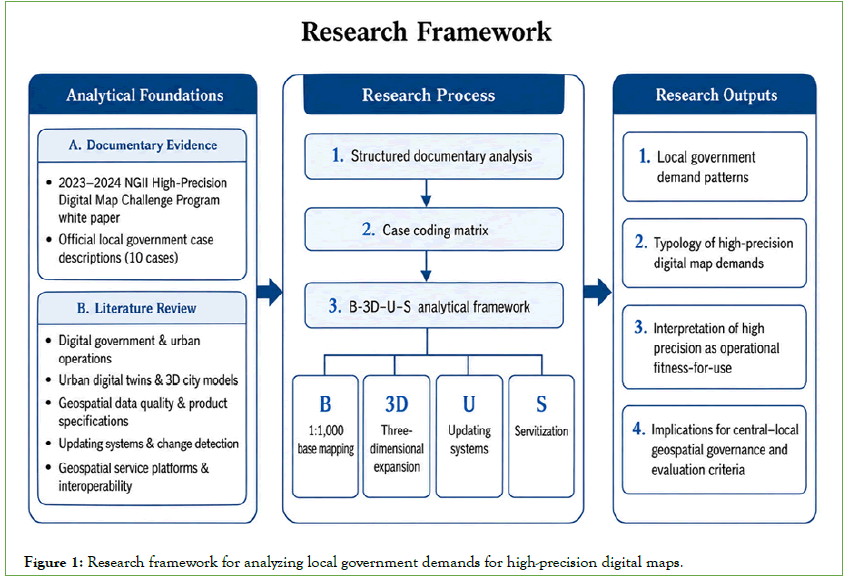
Figure 1: Research framework for analyzing local government demands for high-precision digital maps.
Because this is a document-based analysis, reliability and validity are addressed through transparent coding criteria rather than through inferential statistics. The coding framework is disclosed in Table 1. Future work should strengthen this preliminary coding through multiple coders, inter-coder agreement, additional interviews with local government officials, and access to raw project-level datasets where permitted.
| Dimension | Operational meaning | Coding indicators |
|---|---|---|
| B: 1:1,000 base mapping | Authoritative base production or updating of 1:1,000 digital topographic maps and foundational layers. | New or updated map sheets; topographic layers; Digital Elevation Model (DEM)/Digital Surface Model (DSM) for contour generation; orthophotos supporting map production. |
| 3D: Three-dimensional expansion | Extension from two-dimensional mapping into three-dimensional city models, meshes, objects, point clouds, elevation/surface models, or simulation-ready data. | Level-of-detail-based three-dimensional buildings; three-dimensional meshes or objects; LiDAR point clouds; surface-height grids; three-dimensional data for flood, environmental, infrastructure, or urban air mobility use cases. |
| U: Updating system | Processes, technologies, and institutional arrangements for keeping map data current. | Change detection; annual updating; geospatial artificial intelligence-assisted updating; versioning; administrative-system linkage; inter-agency update workflows. |
| S: Servitization | Delivery of data through operational platforms, application programming interfaces, cloud systems, access mechanisms, administrative services, or public services. | Cloud or three-dimensional platform; geographic information system portal; application programming interface or datasharing service; tourism content; evacuation routing; administrative dashboards. |
Table 1: Coding framework for B-3D-U-S dimensions.
Results
Overview of local government demands in the challenge program
Across the 2024 cases, 1:1,000 base mapping appears as the shared foundation. However, local government requirements were not limited to the production or updating of base topographic maps. The policy documents show that local governments requested a wide range of additional components, including three-dimensional city models, orthophotos, surface-height grids, light detection and ranging and mobile mapping system data, 360-degree imagery, change-detection methods, geospatial artificial intelligence-based updating, cloud-based three-dimensional platforms, tourism content, and safety services [1].
This pattern suggests that high-precision digital maps are being requested as operational geospatial assets. In other words, local governments appear to demand data products that can be constructed, updated, linked to administrative workflows, and provided through usable platforms or services.
Case profiles by local government
The case profiles show different combinations of the four dimensions. Ulsan emphasizes environmental and carbonneutrality-related spatial data requirements. Incheon’s demand is strongly connected to island-region three-dimensional modeling and tourism-oriented remote content. Seoul is a clear updatingsystem case, emphasizing change detection, map updating, and linkage with road management data. Asan combines base mapping with field-oriented data acquisition and three-dimensional spatial information. Jeju Phase 1 foregrounds urban air mobility-related surface-height grids and geospatial artificial intelligence-based updating. Yangsan combines three-dimensional urban models with environmental and disaster-related analysis requirements. Jeongeup links three-dimensional implementation to platform demand and public-facing tourism and safety services. Jeju Phase 2 strengthens the updating and domain-expansion logic. Yeongcheon shows a multi-sensor and multi-domain profile. Yeoncheon focuses on safetyoriented services, including evacuation-route-related use cases.
These profiles should be interpreted as documentary evidence of demand and project scope, not as evidence that the planned services generated measurable administrative outcomes. Table 2 therefore presents an evidence-based coding matrix rather than an outcome evaluation. The distinction is important for avoiding overstatement in journal submission.
| Case | Evidence from project scope | B-3D-U-S code | Demand type |
|---|---|---|---|
| Ulsan | 1:1,000 mapping; three-dimensional city model; DEM; precise road map | B:S; 3D:M; U:L; S:L | Base-environmental |
| Incheon | Island-region three-dimensional model; 360 imagery; tourism content | B:S; 3D:S; U:L; S:S | 3D-service |
| Seoul | Change detection; annual updating; road-management linkage | B:S; 3D:L; U:S; S:M | Updating-governance |
| Asan | Base mapping; field acquisition; three-dimensional spatial information | B:S; 3D:M; U:M; S:M | Base-field operation |
| Jeju Phase 1 | Urban air mobility surface-height grid; three-dimensional model; geospatial artificial intelligence updating | B:S; 3D:S; U:S; S:M | Domain-specific updating |
| Yangsan | Three-dimensional urban model; flooding risk map; environmental analysis | B:S; 3D:S; U:L; S:M | 3D-simulation |
| Jeongeup | Three-dimensional spatial platform; tourism content; safety evacuation route | B:S; 3D:S; U:M; S:S | Platform-service |
| Jeju Phase 2 | Automatic orthophoto; change detection; domain expansion | B:S; 3D:M; U:S; S:M | GeoAI-updating |
| Yeongcheon | Bathymetric/hyperspectral survey; river digital twin; road ledger | B:S; 3D:S; U:M; S:M | Multi-sensor domain |
| Yeoncheon | Drone orthophoto; precise road map; evacuation support | B:S; 3D:L; U:L; S:S | Safety-service |
Table 2: Project-scope evidence and compact B-3D-U-S coding profiles for the 2024 cases.
B-3D-U-S demand patterns
First, B is the common foundation. Each case is anchored in 1:1,000 topographic mapping, whether through new production, updating, or related base data. This confirms that high-precision digital maps remain connected to authoritative base mapping rather than replacing it.
Second, 3D is not limited to visualization. The cases connect three-dimensional data to operational domains such as urban air mobility, environmental monitoring, flood or disaster analysis, tourism, safety, and infrastructure management. This supports the interpretation that three-dimensional city models are increasingly expected to function as operational base data.
Third, U appears as a distinct and important dimension. Seoul and Jeju-related cases are especially relevant because the white paper identifies change detection, annual updating, geospatial artificial intelligence-based updating, and links between map updating and institutional workflows. This supports the interpretation that local governments increasingly require mechanisms for keeping high-precision geospatial data current, rather than treating map construction as a one-off deliverable.
Fourth, S indicates that local governments do not simply require data delivery. Several cases require platforms, cloud environments, tourism services, safety services, administrative-service discovery, or data-sharing environments. This service dimension is central to interpreting high-precision digital maps as operational assets.
Typology of high-precision digital map demands
The cases can be organized into five preliminary demand types. This typology is not a statistical clustering result; it is an interpretive synthesis based on the B-3D-U-S coding framework. Table 3 summarizes the demand types, representative cases, and evaluation focus for future program design.
| Demand type | Main feature | Representative cases | Evaluation focus |
|---|---|---|---|
| Base-enhancement | Authoritative 1:1,000 mapping and reuse readiness | Ulsan; Asan | Accuracy; completeness; reuse readiness |
| 3D-operational | Three-dimensional data for simulation, infrastructure operation, and domain analysis | Jeju Phase 1; Yangsan; Yeongcheon | Operational applicability; domain fit |
| Updating-system | Currentness, change detection, geospatial artificial intelligence, versioning, and workflows | Seoul; Jeju Phase 2 | Update cycle; quality assurance; governance roles |
| Service-platform | Cloud, public service, tourism, safety, dashboard, or platform delivery | Incheon; Jeongeup; Yeoncheon | Interoperability; security; service readiness |
| Multi-domain integration | Combined base, three-dimensional, updating, and service requirements across domains | Yeongcheon; Jeju-related cases | Reference architecture; domain-specific extensions |
Table 3: Demand typology and evaluation focus for high-precision digital map programs.
Discussion
Redefining high precision from accuracy to fitness-for-use
The results support a restrained but important reinterpretation of high precision. In local government urban operations, high precision is not limited to positional accuracy. It also means that geospatial data are suitable for the intended operational purpose. This interpretation aligns with data product specification and data quality standards, which emphasize intended purpose, quality description, and evaluation rather than a single accuracy measure [9,10].
This does not imply that positional accuracy is unimportant. Rather, it suggests that accuracy should be embedded in a broader quality and operations framework that includes completeness, timeliness, interoperability, maintainability, and service usability.
From map production to operational geospatial assets
The Challenge Program cases show a movement from map production toward operational geospatial assets. A conventional project logic would treat 1:1,000 map production as the final deliverable. The B-3D-U-S framework suggests a broader lifecycle: Base data are produced, extended into three-dimensional or domain-specific data structures, maintained through updating systems, and delivered through services or platforms (Table 4).
| Dimension | Transferability question | Evidence to examine | Risk if omitted |
|---|---|---|---|
| B: base mapping | Does the program provide an authoritative large-scale spatial foundation for land and urban management? | Map scale, coverage, topographic layers, orthophotos, Digital Elevation Model (DEM)/Digital Surface Model (DSM), and compatibility with cadastral or administrative data. | Three-dimensional or service components may be visually useful but lack a trusted reference frame. |
| 3D: expansion | Does the program extend beyond two-dimensional mapping into operational three-dimensional or surface information? | Level-of-detail specification, three-dimensional city models, point clouds, surface-height grids, and domain-specific simulation requirements. | Three-dimensional data may remain decorative and disconnected from planning or operational workflows. |
| U: updating | Can the program keep data current through repeatable institutional or technical workflows? | Change-detection process, update cycle, versioning, quality assurance, and roles of central and local agencies. | The digital twin becomes outdated soon after construction. |
| S: servitization | Can the data be accessed, queried, visualized, and reused through platforms or services? | Application programming interface availability, cloud/three-dimensional platform, geographic information system portal, dashboard, access control, and public-facing service cases. | Data remain as offline deliverables and fail to support day-to-day operations. |
Table 4: Transferability checklist for applying the B-3D-U-S framework to other urban digital twin mapping programs.
This interpretation is compatible with urban digital twin literature, in which three-dimensional models and geospatial platforms are useful only when they can support operational processes, data integration, and updating. However, this study does not verify whether the resulting platforms improved administrative decisions. It only identifies how the requirements are structured in policy and project documents.
Implications for central-local geospatial data governance
The multidimensional demand structure implies that central-local governance is necessary. Local governments can define operational needs and provide administrative context, while national mapping agencies can support standards, quality control, interoperability, and long-term update frameworks. This is consistent with the United Nations Integrated Geospatial Information Framework perspective that geospatial information management requires governance, standards, partnerships, and capacity building [3].
For South Korea’s high-precision mapping programs, the key governance issue is not whether local governments need more precise maps. It is how base mapping, three-dimensional modeling, updating, and service delivery can be coordinated across central and local responsibilities without fragmenting standards or duplicating investments.
Implications for evaluation criteria of national mapping programs
A production-centered evaluation system would focus mainly on accuracy, map-sheet completion, and deliverable inspection. The B-3D-U-S structure suggests that future evaluation criteria should also include updateability, version management, platform readiness, service integration, and reuse across departments. For example, three-dimensional model construction could be evaluated not only by level of detail or geometric quality, but also by whether it supports intended simulation or operational use cases. Updating systems could be evaluated by change-detection workflows, update-cycle feasibility, quality assurance, and institutional roles.
These evaluation criteria should be introduced carefully. It would be inappropriate to judge early-stage local government projects by full operational outcomes when systems are still being constructed. A staged maturity model may be more suitable: Production readiness, update readiness, platform readiness, service readiness, and operational reuse.
Transferability to urban digital twin and land management programs
Although the empirical material is drawn from Korea, the B-3D-U-S framework is transferable to other national and municipal mapping programs that seek to integrate authoritative base mapping, three-dimensional geospatial data, updating systems, and service platforms. Many urban digital twin and land management initiatives face similar implementation questions: Whether mapping programs remain accuracy-centered production projects, whether they evolve into updateable geospatial data infrastructures, and whether they can support interoperable services for planning, safety, environmental monitoring, infrastructure management, and public communication. The framework can therefore be used as a diagnostic tool for assessing the maturity of geospatial data integration in urban digital twin programs, even when institutional arrangements, mapping scales, and technology choices differ across countries.
Limitations and future research
This study has several limitations. First, it is based on policy and project documents, not on direct observation of administrative work processes. Second, the coding was conducted as a structured interpretive analysis, not as a multi-coder content analysis with inter-coder reliability statistics. Third, the study does not measure administrative performance, decision quality, cost-effectiveness, or user satisfaction. Fourth, the 2024 cases represent selected local governments in one national program and should not be generalized without caution.
Future research should include interviews with local government officials, comparison with actual platform operation logs, maturity assessment of updating systems, and evaluation of how three-dimensional and service-platform components are used in administrative workflows. Quantitative studies could also test whether specific combinations of B, 3D, U, and S are associated with greater data reuse or service adoption.
Conclusion
This study analyzed local government demands for high-precision digital maps using documentary evidence from South Korea’s High- Precision Digital Map Challenge Program. It conceptualized the demand structure through four dimensions: 1:1,000 base mapping, three-dimensional expansion, updating systems, and servitization.
The findings indicate that 1:1,000 base mapping remains the common foundation, but local government requirements extend toward three-dimensional models, surface-height information, light detection and ranging and mobile mapping system data, change detection, geospatial artificial intelligence-supported updating, cloud-based platforms, tourism content, safety services, and administrative data-sharing environments. Therefore, high precision in urban operations should be interpreted as operational fitness, not merely positional accuracy.
The study provides a cautious basis for redesigning national mapping programs and evaluation frameworks. Future programs should consider not only whether accurate data have been produced, but also whether they can be updated, connected to three-dimensional and domain-specific applications, delivered through interoperable services, and governed through central-local collaboration. These conclusions remain limited to demand structure and policy implications; they do not claim verified administrative performance effects.
Acknowledgment
The author acknowledges the publicly documented materials related to the High-Precision Digital Map Challenge Program and the administrative context of municipal geospatial data development in Korea. The author reviewed all content and takes full responsibility for the manuscript.
Funding
This research received no external funding.
Data Availability Statement
No new datasets were generated in this study. The documentary material analyzed in this article is the 2023-2024 High-Precision Digital Map Challenge Program White Paper published by the National Geographic Information Institute and cited in the reference list. Additional project-level data are described only in aggregated documentary form.
Conflicts of Interest
The author has professional experience in geospatial information systems and has been involved in local government high-precision digital mapping and digital-twin projects in Korea, including project management experience related to Goyang City. This potential interest is disclosed for transparency. The manuscript is based on documentary analysis of policy and program materials, and no confidential project data are used. The interpretations and conclusions are solely those of the author.
References
- National geographic information institute 2023-2024 high-precision digital map challenge program white paper. National geographic information institute, Suwon, Republic of Korea. 2024. [In Korean].
- OECD. The OECD digital government policy framework: Six dimensions of a digital government. OECD Public Governance Policy Papers, No. 02, OECD Publishing, Paris. 2020.
- UN-GGIM. Integrated Geospatial Information Framework (IGIF): Implementation guide. United Nations committee of experts on global geospatial information management, New York. 2020.
- Batty M. Digital twins. Environment and Planning B: Urban Analytics and City Science. 2018;45:817-820.
[Crossref]
- Dembski F, Woessner U, Letzgus M, Ruddat M, Yamu C. Urban digital twins for smart cities and citizens: The case study of Herrenberg, Germany. Sustainability. 2020;12(6):2307.
- Shahat E, Hyun CT, Yeom C. City digital twin potentials: A review and research agenda. Sustainability. 2021;13(6):3386.
- Lei B, Janssen P, Stoter J, Biljecki F. Challenges of urban digital twins: A systematic review and a Delphi expert survey. Autom Constr. 2023;147:104716.
- Eriksson H, Harrie L. Versioning of 3D city models for municipality applications: Needs, obstacles and recommendations. ISPRS Int J Geo-Inf. 2021;10(2):55.
- International Organization for Standardization. ISO 19157-1:2023 geographic information-data quality-part 1: General requirements. ISO, Geneva, Switzerland. 2023.
- International Organization for Standardization. ISO 19131:2022 geographic information-data product specifications. ISO, Geneva, Switzerland. 2022.
- Asrat KT, Cho HJ. A comprehensive survey on high-definition map generation and maintenance. ISPRS Int J Geo-Inf 2024;13(7):232.
- Gao S. Geospatial Artificial Intelligence (GeoAI). New York: Oxford University Press. 2021.
- OGC (Open Geospatial Consortium) City Geography Markup Language (CityGML) Part 1: Conceptual model standard. OGC Document 20-010. 2021.
- OGC (Open Geospatial Consortium). 3D Tiles 1.1 Community standard. OGC Document 22-025r4. 2023.
- Open Geospatial Consortium. OGC API standards. Available at: https://ogcapi.ogc.org/ (accessed 12 May 2026). 2026.
Citation: Jo GW. (2026). Remote Sensing and Geographic Information Systems for High-Precision Municipal Digital Twin Mapping in Korea. J Remote Sens GIS. 15:408.
Copyright: © 2026 Jo GW. This is an open-access article distributed under the terms of the Creative Commons Attribution License, which permits unrestricted use, distribution, and reproduction in any medium, provided the original author and source are credited.