
Indexed In
- Open J Gate
- RefSeek
- Hamdard University
- EBSCO A-Z
- Scholarsteer
- Publons
- Euro Pub
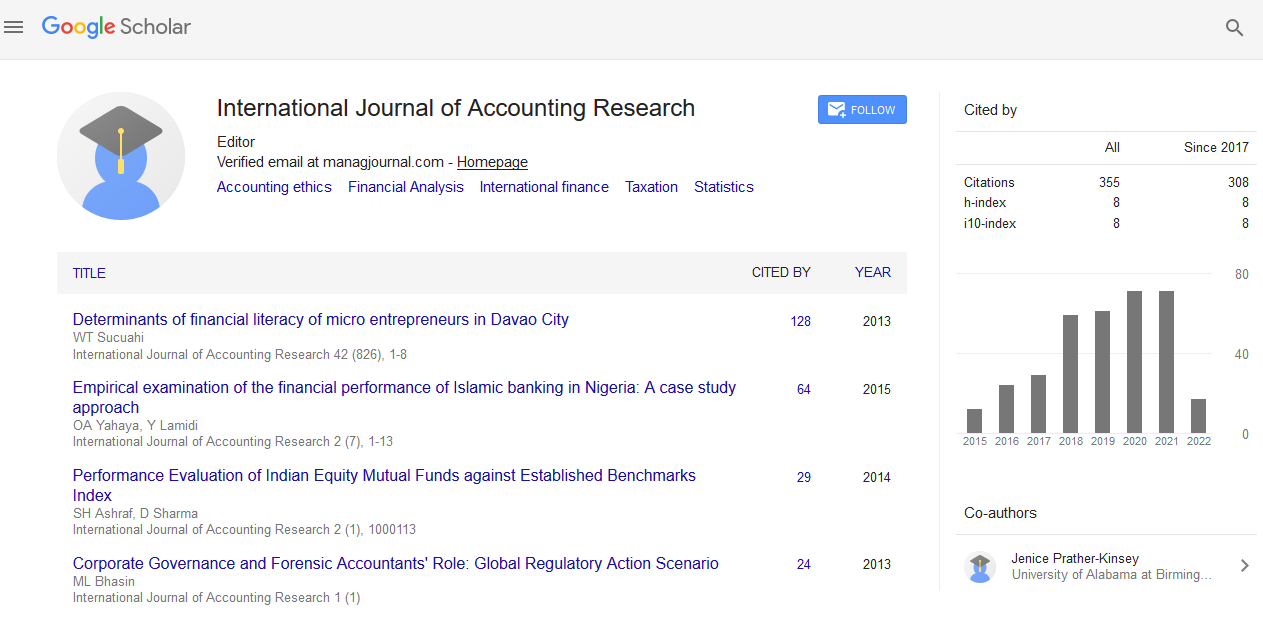
- Google Scholar
Useful Links
Share This Page
Journal Flyer
Open Access Journals
- Agri and Aquaculture
- Biochemistry
- Bioinformatics & Systems Biology
- Business & Management
- Chemistry
- Clinical Sciences
- Engineering
- Food & Nutrition
- General Science
- Genetics & Molecular Biology
- Immunology & Microbiology
- Medical Sciences
- Neuroscience & Psychology
- Nursing & Health Care
- Pharmaceutical Sciences
Commentary - (2025) Volume 13, Issue 3
Reimagining Financial Control: AI and Automation Reshaping Budgeting for Smarter Decision-Making
Adil Norst*Received: 27-Aug-2025, Manuscript No. IJAR-25-30106; Editor assigned: 29-Aug-2025, Pre QC No. IJAR-25-30106 (PQ); Reviewed: 12-Sep-2025, QC No. IJAR-25-30106; Revised: 19-Sep-2025, Manuscript No. IJAR-25-30106 (R); Published: 26-Sep-2025, DOI: 10.35248/2472-114X.25.13.425
Description
The adoption of artificial intelligence in financial management is redefining how organizations handle budgeting and forecasting. What was once a labor-intensive, time-consuming process dependent on historical data and static spreadsheets is now being redefined by intelligent systems capable of learning patterns, identifying inefficiencies, and improving responsiveness to change. In the context of management accounting, these changes are becoming more relevant as companies seek greater agility in a business climate that demands speed, accuracy, and adaptability.
Traditional budgeting methods typically rely on static annual plans developed through linear projections of past performance. These processes often suffer from inflexibility and outdated assumptions by the time they are implemented. With the introduction of automated tools, systems are now capable of running forecasts continuously, with updates that reflect realtime developments. These systems process diverse inputs such as market trends, supply chain metrics, and customer behavior to adjust financial models dynamically.
AI-powered tools don't simply replicate human analysis; they augment it. Unlike manual processes where biases and fixed assumptions can distort projections, intelligent algorithms evaluate vast quantities of data from various sources simultaneously, ensuring wider perspectives are considered. As a result, decision-makers gain access to forward-looking insights rather than just backward-looking summaries. This leads to better resource allocation, quicker response to risk, and stronger alignment with organizational priorities.
Machine learning algorithms also provide a learning loop where forecasting improves with each cycle. These systems assess the variance between projected and actual results, then adjust their internal models accordingly. Over time, this self-correcting process helps refine forecasting precision. In high-variance environments such as retail, logistics, or tech sectors, the benefits are particularly apparent, as rapid market changes can be factored into planning almost immediately.
Another notable development is scenario modeling. Managers can now run multiple budget simulations within minutes, testing assumptions such as price fluctuations, demand changes, or currency volatility. This allows for proactive evaluation of bestcase and worst-case situations and supports more confident decision-making. Where human planners might create two or three budget scenarios due to time and resource constraints, AI can generate and assess dozens or even hundreds in a fraction of the time.
From a governance perspective, automation enhances control and auditability. Transactions and budget revisions are tracked systematically, reducing the chance of manual errors and improving accountability. Moreover, real-time dashboards present performance metrics in formats that are visually intuitive, making financial data more accessible to non-financial managers and thereby improving communication across departments.
Despite these advantages, the introduction of automated systems also raises certain organizational considerations. There is often resistance due to fears of job displacement or overreliance on technology. However, rather than eliminating roles, AI is typically augmenting the work of financial professionals. Accountants and analysts are shifting focus from data preparation to strategic analysis. The human element remains essential for interpreting trends, asking the right questions, and applying judgment in areas where context matters.
Data quality remains a persistent concern. The efficiency of any automated system depends on the accuracy, completeness, and consistency of the data it receives. Therefore, before implementing these tools, companies must prioritize data management practices. Clean, well-structured datasets lead to more dependable forecasts and reduce the risk of misleading results. Inadequate preparation in this area can limit the benefits that automation offers.
Furthermore, ethical considerations around data privacy, algorithmic transparency, and bias must be addressed. For example, if an AI model uses data that unintentionally reflects past discriminatory practices, the forecasts may inherit these biases. To mitigate this, companies are increasingly developing internal frameworks for model validation and ethical review.
Implementation success also depends on how well the technology is integrated into existing workflows. Training staff to interact confidently with AI tools, interpret outputs, and question results when necessary is part of this transition. Organizations that treat the implementation as a strategic change initiative, rather than a purely technical upgrade, are more likely to realize meaningful improvements.
From mid-sized firms to multinational corporations, the transition to AI-enabled budgeting systems is no longer limited to early adopters. Cloud-based platforms and scalable solutions are making these tools more accessible. Finance teams that once required months to complete annual budgets are now shifting to rolling forecasts, continuously updating their assumptions as new data flows in.
In conclusion, the inclusion of AI and automation in budgeting and forecasting marks a significant departure from traditional practices. Management accountants are now better equipped to support strategic decisions with more accurate, timely, and flexible information. This transformation, while not without its challenges, offers considerable advantages in speed, efficiency, and insight. As the pace of change continues, those who adapt their processes and mindset will be better positioned to lead in environments where agility and informed judgment are becoming increasingly important.
Citation: Norst A (2025). Reimagining Financial Control: AI and Automation Reshaping Budgeting for Smarter Decision-Making. Int J Account Res.13:425.
Copyright: © 2025 Norst A. This is an open access article distributed under the terms of the Creative Commons Attribution License, which permits unrestricted use, distribution, and reproduction in any medium, provided the original author and source are credited.