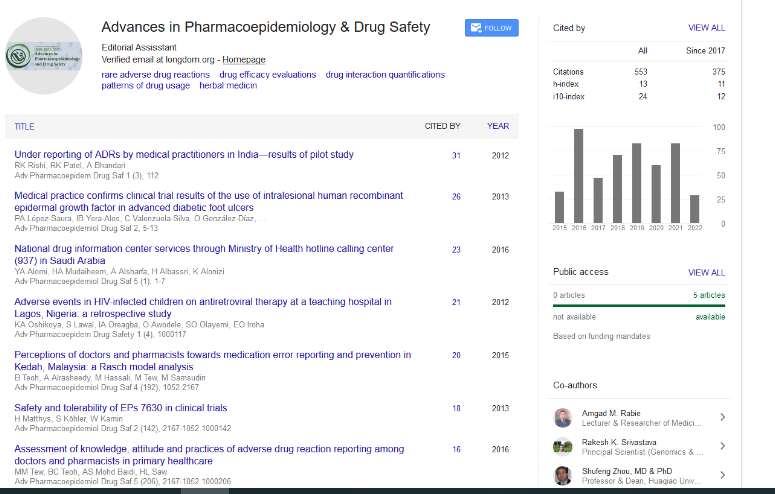

Indexed In
- Open J Gate
- Genamics JournalSeek
- Academic Keys
- JournalTOCs
- RefSeek
- Hamdard University
- EBSCO A-Z
- SWB online catalog
- Publons
- Geneva Foundation for Medical Education and Research
- Euro Pub
- Google Scholar
Useful Links
Share This Page
Journal Flyer
Open Access Journals
- Agri and Aquaculture
- Biochemistry
- Bioinformatics & Systems Biology
- Business & Management
- Chemistry
- Clinical Sciences
- Engineering
- Food & Nutrition
- General Science
- Genetics & Molecular Biology
- Immunology & Microbiology
- Medical Sciences
- Neuroscience & Psychology
- Nursing & Health Care
- Pharmaceutical Sciences
Perspective - (2025) Volume 14, Issue 3
Reducing Medication Errors Through Safe Clinical Practice and Effective Communication
Ethan Walker *Received: 11-Aug-2025 , Manuscript No. PDS-26-32294; Editor assigned: 13-Aug-2025 , Pre QC No. PDS-26-32294; Reviewed: 27-Aug-2025 , QC No. PDS-26-32294; Revised: 03-Sep-2025 , Manuscript No. PDS-26-32294; Published: 10-Sep-2025 , DOI: 10.35841/2167-1052.25.14.404
Abstract
Description
Medication errors remain an important patient safety concern across healthcare systems worldwide. They may occur during prescribing, dispensing, preparation, administration, monitoring, or documentation of medicines. Although many medication errors do not result in patient injury, others may lead to treatment failure, prolonged hospitalization, additional healthcare expenses, or serious health complications. Understanding how these errors occur and implementing practical prevention strategies are essential for improving the quality of healthcare services.
A medication error is generally defined as any preventable event that may cause inappropriate medication use or patient harm while the medicine is under the control of healthcare professionals, patients, or caregivers. These events may arise from human mistakes, communication failures, system-related problems, or environmental factors. Medication errors can occur in hospitals, community pharmacies, outpatient clinics, nursing homes, and even in home settings where patients manage their own treatment.
Prescribing errors are among the most frequently reported medication-related incidents. These errors include selecting an inappropriate medicine, prescribing an incorrect dose, writing incomplete prescriptions, overlooking allergies, or failing to consider existing medical conditions and concurrent medications. Inadequate review of patient records or insufficient clinical information may increase the possibility of incorrect prescribing decisions. Electronic prescribing systems with clinical decision support have reduced many handwriting-related problems, although careful review by healthcare professionals remains necessary.
Dispensing errors occur when the medicine supplied differs from the prescribed treatment. Examples include dispensing the wrong medication, incorrect strength, inaccurate dosage form, or improper labeling. Medicines with similar names or packaging may contribute to these mistakes, particularly in busy pharmacy environments. Verification procedures, barcode scanning, and independent double-checks have improved dispensing accuracy in many healthcare facilities.
Administration errors happen when medicines are given incorrectly despite an accurate prescription and proper dispensing. These may involve administering the wrong dose, using an incorrect route, delivering medication at the wrong time, or giving medicine to the wrong patient. Strict patient identification procedures, barcode medication administration systems, and adherence to standardized administration protocols reduce these risks significantly.
Calculation mistakes continue to present challenges, especially in pediatric and critical care settings where medicine doses are frequently based on body weight or body surface area. Small mathematical errors may produce substantial differences in administered doses. Standardized calculation tools, computerized dose calculators, and independent verification by another healthcare professional improve dosing accuracy and reduce preventable harm.
Communication failures contribute substantially to medication errors. Incomplete verbal orders, unclear documentation, abbreviations with multiple meanings, and inadequate transfer of patient information during shift changes may result in misunderstandings. Standardized communication methods encourage accurate exchange of clinical information between physicians, pharmacists, nurses, and other healthcare professionals. Clear documentation also improves continuity of care when patients move between healthcare facilities or departments.
Patients receiving multiple medicines face an increased possibility of medication-related problems. Polypharmacy is particularly common among older adults with several chronic illnesses. Complex treatment schedules increase the likelihood of missed doses, duplicate therapy, drug interactions, and confusion regarding medication instructions. Periodic medication reviews performed by healthcare professionals help identify unnecessary medicines and simplify treatment plans whenever clinically appropriate.
Conclusion
Medication errors remain preventable events that require continuous attention from healthcare professionals, patients, healthcare organizations, and policymakers. A comprehensive approach combining education, technology, standardized clinical practices, open communication, and systematic reporting can substantially reduce medication-related harm. Continued commitment to patient safety initiatives will improve treatment quality, enhance healthcare efficiency, and promote safer medication use across diverse clinical environments. Simulation-based education, interdisciplinary workshops, and competency assessments strengthen clinical decision-making and improve teamwork during medication-related activities.
Citation: Walker E (2025). Reducing Medication Errors Through Safe Clinical Practice and Effective Communication. J Adv Pharmacoepidemiol Drug Saf. 14:404.
Copyright: © 2025 Walker E. This is an open-access article distributed under the terms of the Creative Commons Attribution License, which permits unrestricted use, distribution and reproduction in any medium, provided the original author and source are credited.