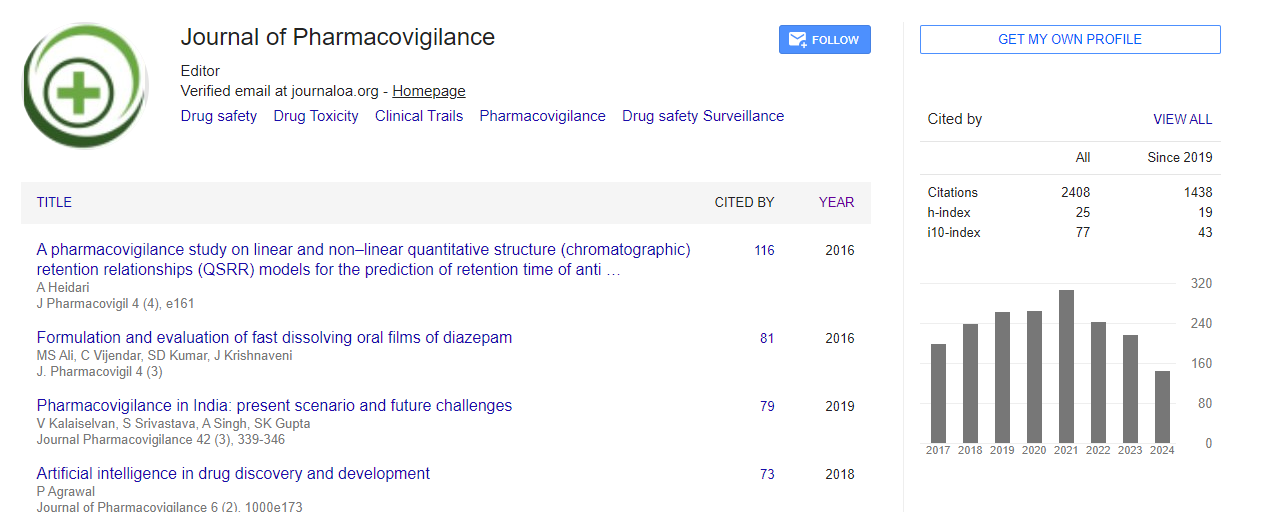

Indexed In
- Open J Gate
- JournalTOCs
- The Global Impact Factor (GIF)
- RefSeek
- Hamdard University
- EBSCO A-Z
- OCLC- WorldCat
- Publons
- Euro Pub
- Google Scholar
Useful Links
Share This Page
Journal Flyer
Open Access Journals
- Agri and Aquaculture
- Biochemistry
- Bioinformatics & Systems Biology
- Business & Management
- Chemistry
- Clinical Sciences
- Engineering
- Food & Nutrition
- General Science
- Genetics & Molecular Biology
- Immunology & Microbiology
- Medical Sciences
- Neuroscience & Psychology
- Nursing & Health Care
- Pharmaceutical Sciences
Perspective Article - (2025) Volume 13, Issue 4
Pharmacovigilance in Hospital Settings: Improving Medication Safety Through Active Monitoring
Thomas Nguyen*Received: 10-Nov-2025, Manuscript No. JP-26-31017; Editor assigned: 12-Nov-2025, Pre QC No. JP-26-31017 (PQ); Reviewed: 26-Nov-2025, QC No. JP-26-31017; Revised: 03-Dec-2025, Manuscript No. JP-26-31017 (R); Published: 10-Dec-2025, DOI: 10.35248/2329-6887.25.13.536
Description
Hospitals represent complex environments where patients are often exposed to multiple medications, increasing the likelihood of adverse drug reactions. Pharmacovigilance activities within hospital settings are therefore essential for identifying, managing, and preventing medication-related harm. Active monitoring strategies complement traditional reporting systems by systematically reviewing patient data to detect adverse reactions, supporting safer medication use and improved clinical outcomes.
Hospitalized patients often present with severe illness, multiple comorbidities, and altered physiological states that affect drug response. Polypharmacy is common, particularly among older adults and critically ill patients, raising the risk of drug interactions and cumulative toxicity. These factors make hospitals a valuable setting for pharmacovigilance, as adverse reactions may be more frequent and more easily observed through close clinical monitoring.
Active pharmacovigilance involves structured approaches such as chart review, trigger tools, and medication surveillance programs. Unlike spontaneous reporting, which depends on individual initiative, active methods systematically search for potential adverse reactions. For example, abnormal laboratory values, use of antidotes, or sudden medication discontinuation may indicate an adverse drug reaction. Identifying these signals allows for timely clinical intervention and documentation.
Clinical pharmacists play a central role in hospital pharmacovigilance programs. Their involvement in medication review, therapeutic drug monitoring, and participation in ward rounds positions them to identify suspected adverse reactions early. Collaboration between pharmacists, physicians, and nurses supports comprehensive assessment of patient symptoms and medication histories. This multidisciplinary approach enhances detection accuracy and promotes shared responsibility for medication safety.
Hospital pharmacovigilance activities also contribute to institutional learning. Analysis of adverse reaction data can reveal patterns related to specific medications, dosing practices, or patient groups. These insights inform updates to prescribing guidelines, formulary decisions, and clinical protocols. By translating pharmacovigilance findings into practice improvements, hospitals can reduce the likelihood of recurrent harm. Documentation and reporting of identified adverse drug reactions remain essential, even when active monitoring is in place. Submitting reports to national pharmacovigilance centers ensures that findings contribute to broader safety databases. Hospital-generated data are particularly valuable because they often involve detailed clinical information and confirmed diagnoses, strengthening signal evaluation at regional and global levels. Challenges in hospital pharmacovigilance include workload pressures, limited resources, and variability in documentation quality. Electronic health record systems can support monitoring by enabling data extraction and automated alerts. However, careful design is necessary to avoid excessive alerts that may contribute to fatigue among healthcare staff. Balanced implementation ensures that technology supports, rather than hinders, clinical practice.
Conclusion
Pharmacovigilance in hospital settings enhances medication safety through active monitoring and interdisciplinary collaboration. By systematically identifying and addressing adverse drug reactions, hospitals can improve patient outcomes and contribute valuable data to wider safety systems. Continued investment in training, technology, and collaboration will strengthen the role of hospitalbased pharmacovigilance in modern healthcare. Transparent communication with patients about identified adverse reactions supports trust and ethical practice. Pharmacovigilance should be viewed as an integral component of quality care rather than a regulatory obligation alone. Patient involvement in hospital pharmacovigilance isincreasingly recognized as valuable. Encouraging patients to report symptoms and concerns supports early identification of adverse reactions.
Citation: Nguyen T (2025). Pharmacovigilance in Hospital Settings: Improving Medication Safety Through Active Monitoring. J Pharmacovigil. 13:536
Copyright: © 2025 Nguyen T. This is an open-access article distributed under the terms of the Creative Commons Attribution License, which permits unrestricted use, distribution and reproduction in any medium, provided the original author and source are credited.