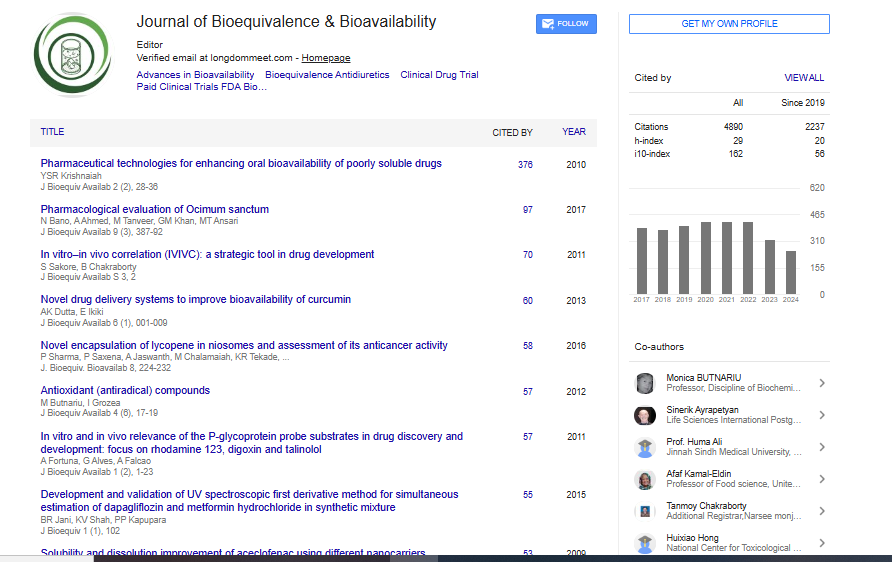


Indexed In
- Academic Journals Database
- Open J Gate
- Genamics JournalSeek
- Academic Keys
- JournalTOCs
- China National Knowledge Infrastructure (CNKI)
- CiteFactor
- Scimago
- Ulrich's Periodicals Directory
- Electronic Journals Library
- RefSeek
- Hamdard University
- EBSCO A-Z
- OCLC- WorldCat
- SWB online catalog
- Virtual Library of Biology (vifabio)
- Publons
- MIAR
- University Grants Commission
- Geneva Foundation for Medical Education and Research
- Euro Pub
- Google Scholar
Useful Links
Share This Page
Journal Flyer
Open Access Journals
- Agri and Aquaculture
- Biochemistry
- Bioinformatics & Systems Biology
- Business & Management
- Chemistry
- Clinical Sciences
- Engineering
- Food & Nutrition
- General Science
- Genetics & Molecular Biology
- Immunology & Microbiology
- Medical Sciences
- Neuroscience & Psychology
- Nursing & Health Care
- Pharmaceutical Sciences
Opinion Article - (2025) Volume 17, Issue 4
Pharmacodynamics Role in Drug Efficacy, Safety, and Implications for Bioequivalence Studies
Chunhui Divina*Received: 30-Jul-2025, Manuscript No. JBB-25-30437; Editor assigned: 01-Aug-2025, Pre QC No. JBB-25-30437 (PQ); Reviewed: 15-Aug-2025, QC No. JBB-25-30437; Revised: 22-Aug-2025, Manuscript No. JBB-25-30437 (R); Published: 29-Aug-2025, DOI: 10.35248/0975-0851.25.17.652
Description
Pharmacodynamics (PD) is the study of the biochemical, physiological, and molecular effects of drugs on the body, and how these effects relate to drug concentration at the site of action. While pharmacokinetics describes how the body affects a drug, pharmacodynamics explains how a drug affects the body. Together, pharmacokinetics and pharmacodynamics provide a comprehensive understanding of drug action, guiding dosage optimization, therapeutic efficacy, and safety assessments. In the context of bioequivalence and bioavailability studies, pharmacodynamic considerations are increasingly recognized as critical in establishing therapeutic equivalence between generic and reference formulations.
Pharmacodynamic effects are mediated through specific interactions of drugs with receptors, enzymes, ion channels, or other cellular targets. Drugs may act as agonists, producing a full response at the receptor, partial agonists with limited efficacy, antagonists that block receptor activity, or inverse agonists that reduce baseline receptor activity. The intensity and duration of these effects depend on the drug’s affinity for its target, receptor density, and the presence of endogenous ligands. Comparative studies of pharmacodynamic responses can reveal differences between drug formulations, particularly for drugs with narrow therapeutic indices.
A central concept in pharmacodynamics is the dose-response relationship, which illustrates the correlation between drug concentration and the magnitude of pharmacological effect. This relationship can be characterized as graded, describing continuous changes in effect, or quantal, describing all-or-none responses in a population. Parameters such as EC50 (the concentration producing 50% of maximal effect) and Emax (maximum effect achievable) are critical for understanding drug potency and efficacy. Comparative studies assessing these parameters across formulations or populations help in predicting therapeutic outcomes and guiding dose selection.
Pharmacodynamics also informs the therapeutic window the range of drug concentrations at which a drug is effective without causing unacceptable adverse effects. Drugs with a narrow therapeutic window require precise dosing and careful monitoring, as small deviations can result in sub therapeutic effects or toxicity. Evaluating pharmacodynamic profiles is essential in bioequivalence studies to ensure that generic formulations not only achieve similar plasma concentrations but also produce comparable therapeutic effects.
Variations in pharmacodynamic responses among individuals can arise from genetic differences, age, sex, disease state, or concurrent medications. Pharmacogenomic differences in receptor expression or signal transduction pathways can influence drug efficacy and safety. Comparative pharmacodynamic studies in diverse populations are vital to understand these differences and ensure consistent therapeutic outcomes, particularly when introducing generic or modified formulations into clinical practice.
While bioequivalence traditionally relies on pharmacokinetic parameters such as Cmax, Tmax, and AUC, pharmacodynamic assessments provide complementary information about a drug’s actual therapeutic effect. For drugs where plasma concentration does not directly correlate with effect, such as anticoagulants or CNS-active agents, pharmacodynamic endpoints can serve as surrogate markers of efficacy. Incorporating pharmacodynamic evaluations into bioavailability and bioequivalence studies helps ensure that generic formulations are not only pharmacokinetically similar but also therapeutically equivalent.
In Conclusion Pharmacodynamics plays a pivotal role in determining drug efficacy, safety, and therapeutic outcomes. Understanding the relationship between drug concentration and pharmacological effect enables clinicians and researchers to optimize dosing, anticipate adverse effects, and individualize therapy. In the context of bioequivalence and bioavailability studies, pharmacodynamic considerations complement pharmacokinetic data, ensuring that generic and reference formulations achieve comparable therapeutic effects. Integrating pharmacodynamic assessments into drug development and regulatory evaluation strengthens confidence in the safety and efficacy of generic products, ultimately supporting improved patient care and treatment outcomes.
Citation: Divina C (2025). Pharmacodynamics Role in Drug Efficacy, Safety, and Implications for Bioequivalence Studies. J Bioequiv Availab.17:652.
Copyright: © 2025 Divina C. This is an open-access article distributed under the terms of the Creative Commons Attribution License, which permits unrestricted use, distribution, and reproduction in any medium, provided the original author and source are credited.