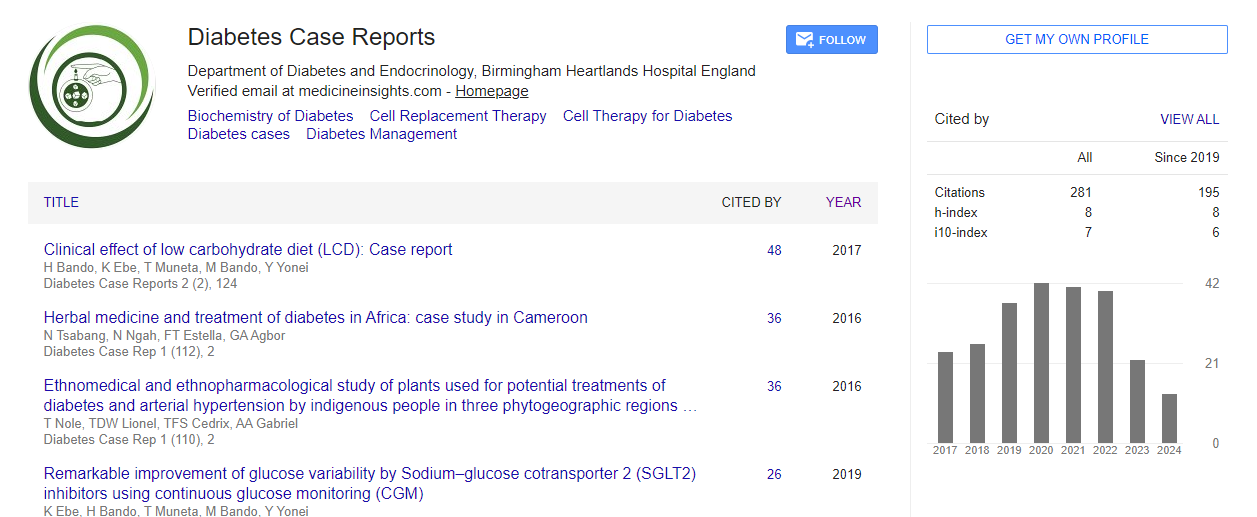

Indexed In
- RefSeek
- Hamdard University
- EBSCO A-Z
- Euro Pub
- Google Scholar
Useful Links
Share This Page
Journal Flyer
Open Access Journals
- Agri and Aquaculture
- Biochemistry
- Bioinformatics & Systems Biology
- Business & Management
- Chemistry
- Clinical Sciences
- Engineering
- Food & Nutrition
- General Science
- Genetics & Molecular Biology
- Immunology & Microbiology
- Medical Sciences
- Neuroscience & Psychology
- Nursing & Health Care
- Pharmaceutical Sciences
Perspective - (2025) Volume 10, Issue 3
Metabolic Dysregulation and the Development of Diabetes Resistance
Michael Ardent*Received: 19-Aug-2025, Manuscript No. DCRS-25-30748 ; Editor assigned: 21-Aug-2025, Pre QC No. DCRS-25-30748 ; Reviewed: 04-Sep-2025, QC No. DCRS-25-30748 ; Revised: 11-Sep-2025, Manuscript No. DCRS-25-30748 ; Published: 18-Sep-2025, DOI: 10.35841/2572-5629.25.10.254
Description
Diabetes resistance, more commonly described as insulin resistance, refers to a physiological condition in which body cells respond less effectively to insulin. Insulin is a hormone produced by the pancreas that enables glucose to move from the bloodstream into cells, where it is used for energy or stored for later use. When cells become resistant to insulin’s signal, glucose uptake is reduced, leading to elevated blood sugar levels despite normal or increased insulin production. This condition develops gradually and often precedes the onset of type 2 diabetes by many years. In healthy metabolism, insulin binds to receptors on the surface of muscle, fat and liver cells. This binding triggers a sequence of internal signals that allow glucose transporters to move to the cell membrane and carry glucose inside. In diabetes resistance, this signaling sequence becomes inefficient. The insulin receptor may function less effectively, or downstream signaling proteins may respond poorly. As a result, glucose remains in circulation rather than entering cells, creating an imbalance between energy availability and cellular demand. The pancreas initially compensates for this reduced sensitivity by producing more insulin. For a time, higher insulin levels may keep blood glucose within a near-normal range.
Several biological and lifestyle factors contribute to diabetes resistance. Excess body fat, particularly around the abdomen, plays a major role. Fat tissue is not simply an energy store; it actively releases chemical messengers that influence metabolism. When fat mass increases, these signals may interfere with insulin action in nearby and distant tissues. Fat accumulation within liver and muscle cells further disrupts insulin signaling by altering intracellular lipid balance. Physical inactivity also contributes significantly. Muscle tissue is a major site of glucose uptake, especially during movement. Regular muscle contraction enhances glucose transport through pathways that do not rely entirely on insulin. When activity levels are low, these alternative pathways are underused and muscles become less efficient at handling glucose. Over time, this reduced demand reinforces insulin resistance and limits metabolic flexibility. Dietary patterns influence insulin sensitivity through multiple mechanisms. Diets high in refined carbohydrates and excess calories promote repeated spikes in blood glucose and insulin release. Frequent overstimulation of insulin pathways may reduce receptor responsiveness. In contrast, diets that support stable glucose levels help preserve insulin signaling efficiency. Nutrient quality, meal timing and overall energy balance all shape how cells respond to insulin over the long term. Inflammation is another important contributor. Low-grade, persistent inflammatory signaling can interfere with insulin pathways at several points. Certain immune-related molecules alter receptor behavior and intracellular communication, reducing glucose uptake.
Genetic background influences susceptibility to diabetes resistance, though it rarely acts alone. Variations in genes related to insulin signaling, fat distribution and energy use can increase vulnerability. However, environmental factors often determine whether this vulnerability manifests clinically. Individuals with similar genetic profiles may show very different metabolic outcomes depending on activity level, diet and overall health. The liver plays a central role in diabetes resistance. Under normal conditions, insulin suppresses glucose production by the liver when blood sugar is sufficient. In insulin-resistant states, this suppression becomes incomplete. The liver continues releasing glucose into the bloodstream even when levels are already elevated. This inappropriate output contributes to fasting hyperglycemia and further strains insulin regulation. Early stages of diabetes resistance often produce no obvious symptoms. Blood glucose levels may remain near normal, masking underlying dysfunction. Subtle signs such as fatigue after meals or difficulty maintaining energy balance may appear but are easily overlooked.
Conclusion
Diabetes resistance illustrates how prolonged metabolic imbalance can quietly reshape physiological systems. It is not an abrupt disorder but a gradual shift in how cells interpret hormonal signals. Addressing this condition requires sustained attention to daily habits, metabolic health and early warning signs. With timely intervention, insulin responsiveness can often be improved, reducing the likelihood of progression to overt diabetes. Early detection allows intervention before irreversible damage to insulin-producing cells occurs. Management focuses on restoring cellular responsiveness to insulin. Regular physical movement is among the most effective strategies, as it directly improves glucose uptake and enhances insulin signaling.
Citation: Ardent M (2025). Metabolic Dysregulation and the Development of Diabetes Resistance. Diabetes Case Rep. 10:254.
Copyright: © 2025 Ardent M. This is an open-access article distributed under the terms of the Creative Commons Attribution License, which permits unrestricted use, distribution and reproduction in any medium, provided the original author and source are credited.