
Indexed In
- Academic Journals Database
- Open J Gate
- Genamics JournalSeek
- JournalTOCs
- China National Knowledge Infrastructure (CNKI)
- Scimago
- Ulrich's Periodicals Directory
- RefSeek
- Hamdard University
- EBSCO A-Z
- OCLC- WorldCat
- Publons
- MIAR
- University Grants Commission
- Geneva Foundation for Medical Education and Research
- Euro Pub
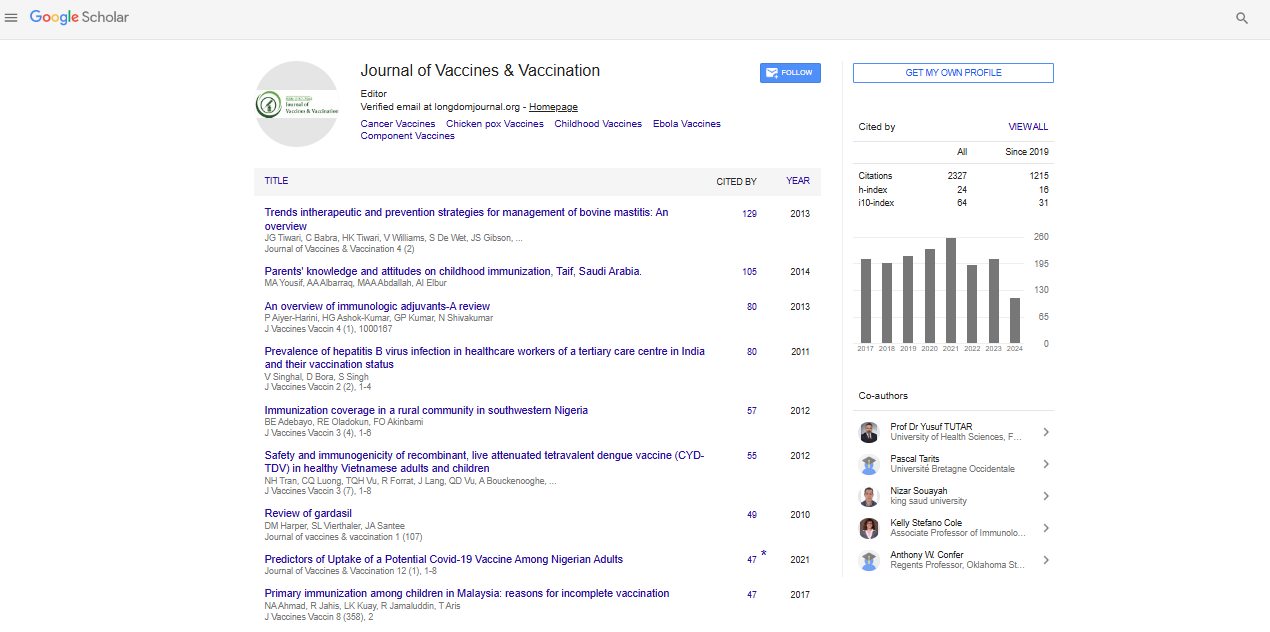
- Google Scholar
Useful Links
Share This Page
Open Access Journals
- Agri and Aquaculture
- Biochemistry
- Bioinformatics & Systems Biology
- Business & Management
- Chemistry
- Clinical Sciences
- Engineering
- Food & Nutrition
- General Science
- Genetics & Molecular Biology
- Immunology & Microbiology
- Medical Sciences
- Neuroscience & Psychology
- Nursing & Health Care
- Pharmaceutical Sciences
Short Communication - (2026) Volume 17, Issue 5
Measuring Vaccine Efficacy and Its Role in Preventing Infectious Disease
Claire Montrose *Received: 20-Apr-2026 , Manuscript No. JVV-26-32843; Editor assigned: 22-Apr-2026 , Pre QC No. JVV-26-32843; Reviewed: 06-May-2026 , QC No. JVV-26-32843; Revised: 13-May-2026 , Manuscript No. JVV-26-32843; Published: 20-May-2026 , DOI: 10.35248/2157-7560.26.17.666
Description
Vaccine efficacy refers to the level of protection a vaccine provides under controlled study conditions. It is commonly assessed by comparing disease outcomes among vaccinated individuals with those observed in an appropriate unvaccinated or control group. This measure is important because it helps researchers determine whether a vaccine can reduce the risk of infection, symptomatic illness, severe disease, hospitalization, or other defined outcomes [1]. Vaccine efficacy is usually expressed as a percentage and is calculated from the difference in disease risk between the vaccinated and comparison groups. Understanding this concept is essential for interpreting clinical trial findings and assessing how well a vaccine performs before it is introduced for broader public use [2].
The evaluation of vaccine efficacy generally begins during clinical development. Early studies primarily examine safety, tolerability, and immune responses, while later studies involve larger populations and provide information about protection against a specific disease outcome. Participants are commonly divided into groups according to vaccination status, and researchers monitor them for a defined period. The number of disease cases occurring in each group is then compared. If the vaccinated group experiences fewer cases than the comparison group, the difference can provide evidence that vaccination reduces disease risk [3].
For example, if a clinical study records disease in 20 percent of participants who did not receive the vaccine and in 5 percent of vaccinated participants, the vaccine has reduced the observed risk considerably. Vaccine efficacy can be calculated using relative risk reduction, expressed as one minus the ratio of disease risk in the vaccinated group to disease risk in the comparison group. In this example, the calculated efficacy would be 75 percent. This does not mean that 75 percent of vaccinated people can never develop the disease. Rather, it indicates a reduction in the measured disease risk under the conditions of the study [4].
The outcome selected for an efficacy trial has a major influence on the reported result. A vaccine may have different levels of protection against infection, mild symptoms, severe illness, hospitalization, and death. Some vaccines may provide limited protection against infection while offering substantially stronger protection against severe outcomes. Therefore, a single efficacy percentage does not fully describe every aspect of vaccine performance. Researchers need to specify the outcome being measured and the period during which participants were observed [5].
The population included in a study also matters. Age, previous exposure to a pathogen, immune status, geographic location, and other demographic characteristics can influence vaccine responses. A vaccine may produce different levels of protection in children, adults, or older populations. Differences may also occur because of variations in circulating pathogen strains or patterns of previous immunity. Large clinical trials can include diverse participants to provide a more representative assessment of vaccine performance [6].
Duration of follow-up is another important factor. Protection may change over time as antibody concentrations and other immune responses decline. Some vaccines require additional doses to maintain protection. Researchers therefore examine disease outcomes over extended periods and may compare protection at different intervals after vaccination. Booster doses can be evaluated to determine whether they restore or increase immune protection [7].
Vaccine efficacy should also be distinguished from vaccine effectiveness. Efficacy is generally measured under controlled clinical trial conditions, whereas effectiveness describes how well a vaccine performs in routine use among the broader population. Real-world settings involve factors that may not be fully represented in clinical trials, including differences in healthcare access, adherence to vaccination schedules, population characteristics, and exposure patterns. Effectiveness studies may use medical records, surveillance systems, cohort studies, or other sources of population-level information [8].
Statistical analysis is central to vaccine efficacy research. Investigators calculate estimates of disease risk and determine confidence intervals to describe the uncertainty surrounding the result. A reported efficacy value should therefore be considered together with its confidence interval, sample size, study design, and outcome definition [9]. Statistical significance alone does not establish the practical importance of a finding, so researchers also consider the magnitude of protection and the clinical relevance of the measured outcome. Vaccine efficacy can be influenced by the biological characteristics of the pathogen. Some microorganisms change over time, producing variants that differ from the strain represented in a vaccine. When this occurs, vaccine performance may vary depending on how closely the vaccine-induced immune response recognizes the circulating strain [10].
Conclusion
Vaccine efficacy research therefore provides a scientific basis for understanding the protective value of immunization. Careful study design, appropriate participant selection, accurate disease measurement, statistical analysis, and long-term monitoring are necessary for meaningful results. As vaccine technologies continue to develop, efficacy studies will remain important for evaluating new products, comparing vaccination schedules, assessing protection against changing pathogens, and informing decisions about disease prevention.
References
- Gross FL, Bai Y, Jefferson S, Holiday C, Levine MZ. Measuring influenza neutralizing antibody responses to A (H3N2) viruses in human sera by microneutralization assays using MDCK-SIAT1 cells. J Vis Exp. 2017;22(129):e56448.
[Google Scholar] [PubMed] [Crossref]
- Osterholm MT, Kelley NS, Sommer A, Belongia EA. Efficacy and effectiveness of influenza vaccines: a systematic review and meta-analysis. Lancet Infect Dis. 2012;12(1):36-44.
[Google Scholar] [PubMed] [Crossref]
- Jester B, Schwerzmann J, Mustaquim D, Aden T, Brammer L, Humes R, et al. Mapping of the US domestic influenza virologic surveillance landscape. Emerg Infect Dis. 2018;24(7):1300.
[Google Scholar] [PubMed] [Crossref]
- McCarron M, Kondor R, Zureick K, Griffin C, Fuster C, Hammond A, et al. United States Centers for Disease Control and Prevention support for influenza surveillance, 2013–2021. Bull World Health Organ. 2022;100(6):366.
[Google Scholar] [PubMed] [Crossref]
- Okomo-Adhiambo M, Mishin VP, Sleeman K, Saguar E, Guevara H, Reisdorf E, et al. Standardizing the influenza neuraminidase inhibition assay among United States public health laboratories conducting virological surveillance. Antiviral Res. 2016;128:28-35.
[Google Scholar] [PubMed] [Crossref]
- Gao H, Wang Y, Gao L, Zheng SJ. Genetic insight into the interaction of IBDV with host—a clue to the development of novel IBDV vaccines. Int J Mol Sci. 2023;24(9):8255.
[Google Scholar] [PubMed] [Crossref]
- Chen HY, Yang MF, Cui BA, Cui P, Sheng M, Chen G, et al. Construction and immunogenicity of a recombinant fowlpox vaccine coexpressing S1 glycoprotein of infectious bronchitis virus and chicken IL-18. Vaccine. 2010;28(51):8112-8119.
[Google Scholar] [PubMed] [Crossref]
- Chen HY, Shang YH, Yao HX, Cui BA, Zhang HY, Wang ZX, et al. Immune responses of chickens inoculated with a recombinant fowlpox vaccine coexpressing HA of H9N2 avain influenza virus and chicken IL-18. Antiviral Res. 2011;91(1):50-56.
[Google Scholar] [PubMed] [Crossref]
- Shi WenYan SW, Liu Qing LQ, Zhang Jie ZJ, Sun JingJing SJ, Jiang XiYue JX, Geng Jing GJ ,et al. Co-expression of EtMic2 protein and chicken interleukin-18 for DNA vaccine against chicken coccidiosis. Res Vet Sci. 2014;97(1):64-70.
[Google Scholar] [PubMed] [Crossref]
- Lee MS, Doong SR, Lai SY, Ho JY, Wang MY. Processing of Infectious Bursal Disease Virus (IBDV) Polyprotein and SelfâAssembly of IBDVâLike Particles in Hiâ5 Cells. Biotechnol Prog. 2006;22(3):763-769.
[Google Scholar] [PubMed] [Crossref]
Citation: Montrose C (2026). Measuring Vaccine Efficacy and Its Role in Preventing Infectious Disease. 17:666.
Copyright: © 2026 Montrose C. This is an open access article distributed under the terms of the Creative Commons Attribution License, which permits unrestricted use, distribution and reproduction in any medium, provided the original author and source are credited.