
Indexed In
- Academic Journals Database
- Open J Gate
- Genamics JournalSeek
- JournalTOCs
- China National Knowledge Infrastructure (CNKI)
- Scimago
- Ulrich's Periodicals Directory
- RefSeek
- Hamdard University
- EBSCO A-Z
- OCLC- WorldCat
- Publons
- MIAR
- University Grants Commission
- Geneva Foundation for Medical Education and Research
- Euro Pub
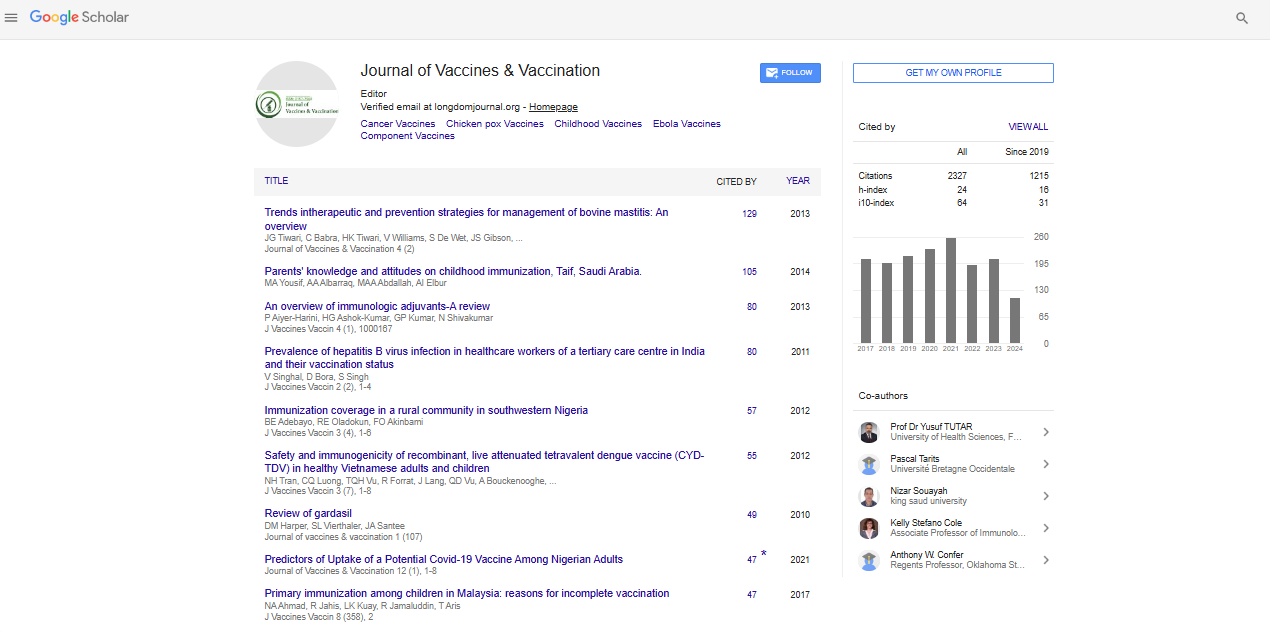
- Google Scholar
Useful Links
Share This Page
Open Access Journals
- Agri and Aquaculture
- Biochemistry
- Bioinformatics & Systems Biology
- Business & Management
- Chemistry
- Clinical Sciences
- Engineering
- Food & Nutrition
- General Science
- Genetics & Molecular Biology
- Immunology & Microbiology
- Medical Sciences
- Neuroscience & Psychology
- Nursing & Health Care
- Pharmaceutical Sciences
Commentary Article - (2025) Volume 16, Issue 12
Malaria Vaccines Advancing Immunization Strategies for Global Disease Prevention and Control
Sophia Caldwell*Received: 01-Dec-2025, Manuscript No. JVV-26-31826; Editor assigned: 03-Dec-2025, Pre QC No. JVV-26-31826; Reviewed: 17-Dec-2025, QC No. JVV-26-31826; Revised: 24-Dec-2025, Manuscript No. JVV-26-31826; Published: 31-Dec-2025, DOI: 10.35248/2157-7560.25.16.639
Description
Malaria remains one of the most significant infectious diseases affecting populations in tropical and subtropical regions, particularly in areas where transmission by infected mosquitoes continues throughout the year. The disease is caused by parasites belonging to the genus Plasmodium, with Plasmodium falciparum being responsible for a large proportion of severe cases and deaths. Despite progress in prevention, diagnosis, and treatment strategies, malaria continues to create substantial health challenges. The development of malaria vaccines represents an important advancement in reducing disease transmission, preventing severe illness, and supporting existing malaria control programs. The development of malaria vaccines has been complex due to the unique life cycle of the Plasmodium parasite. Unlike many viruses and bacteria, malaria parasites undergo multiple developmental stages within both mosquito vectors and human hosts.
Each stage presents different biological characteristics and immune targets. Researchers have focused on identifying parasite proteins that can stimulate protective immune responses, leading to the development of vaccine candidates designed to interrupt infection at different stages of the parasite life cycle. Malaria vaccines work by stimulating the immune system to recognize and respond to specific parasite components before infection progresses. Following vaccination, immune cells produce antibodies and activate cellular defense mechanisms that can limit parasite development. However, achieving strong and long-lasting immunity against malaria remains challenging because the parasite has evolved mechanisms to avoid immune detection. Continuous research aims to improve vaccine effectiveness by identifying additional parasite targets and developing improved vaccine platforms.
Safety surveillance continues after vaccine introduction to monitor effectiveness, identify uncommon reactions, and support evidence-based recommendations for use in different populations. Children represent a major focus of malaria vaccination efforts because they experience a high proportion of severe malaria cases worldwide. Young children have developing immune systems and limited natural immunity to malaria parasites, increasing their vulnerability to infection. Vaccination programs targeting children in high-risk regions aim to reduce severe disease, hospitalizations, and malaria-related deaths. The use of vaccines alongside other child health interventions may contribute to improved survival outcomes. Challenges remain in achieving widespread malaria vaccine coverage. Factors such as vaccine supply, delivery systems, healthcare infrastructure, and community acceptance influence successful implementation. Multiple-dose schedules require effective healthcare planning and follow-up to achieve maximum protection. In addition, differences in malaria transmission patterns across regions require careful evaluation to determine the most suitable vaccination strategies.
Research into next-generation malaria vaccines continues to explore new technologies, including multi-stage vaccines, viral vector platforms, and improved adjuvant systems. Scientists are investigating approaches that could provide stronger and longer-lasting immunity by targeting multiple parasite stages. Advances in immunology, genomics, and vaccine design are supporting the development of improved candidates that may contribute to future malaria elimination efforts. Community engagement and public awareness are important components of malaria vaccination programs. Understanding the purpose, benefits, and limitations of malaria vaccines can encourage acceptance and participation among affected communities. Collaboration between researchers, healthcare workers, governments, and international organizations supports the successful introduction and continued improvement of malaria immunization strategies.
The advancement of malaria vaccine research has also encouraged the development of innovative approaches aimed at overcoming the biological complexity of the parasite. Modern vaccine studies are focusing on improving antigen selection, enhancing immune memory, and developing formulations that provide broader protection against different parasite variants Computational biology and advanced laboratory techniques are being used to identify new vaccine targets and understand host parasite interactions. These efforts may support the creation of future vaccines with improved protective capacity and longer-lasting immunity. Continued investment in scientific research and global collaboration will help expand the role of vaccination in reducing malaria transmission and improving health outcomes in affected communities. Malaria vaccines represent an important advancement in the global effort to reduce the impact of malaria and protectvulnerable populations. Although challenges remain due to parasite complexity, vaccine effectiveness limitations, and implementation requirements, current vaccines have demonstrated the potential of immunization as an additional tool for malaria control. Continued research, improved vaccination strategies, and integration with existing prevention methods will contribute to reducing malaria-related illness and supporting long-term efforts toward disease elimination.
Citation: Caldwell S (2025). Malaria Vaccines Advancing Immunization Strategies for Global Disease Prevention and Control. J Vaccines Vaccin. 16:639
Copyright: © 2025 Caldwell S. This is an open access article distributed under the terms of the Creative Commons Attribution License, which permits unrestricted use, distribution and reproduction in any medium, provided the original author and source are credited