
Indexed In
- Genamics JournalSeek
- JournalTOCs
- CiteFactor
- RefSeek
- Hamdard University
- EBSCO A-Z
- OCLC- WorldCat
- Publons
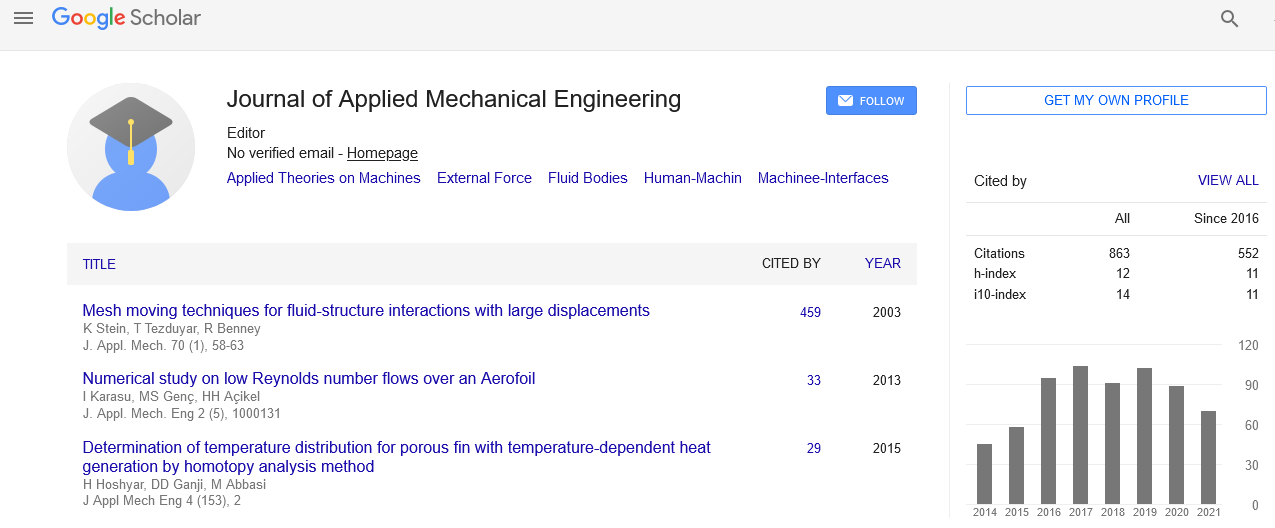
- Google Scholar
Useful Links
Share This Page
Journal Flyer
Open Access Journals
- Agri and Aquaculture
- Biochemistry
- Bioinformatics & Systems Biology
- Business & Management
- Chemistry
- Clinical Sciences
- Engineering
- Food & Nutrition
- General Science
- Genetics & Molecular Biology
- Immunology & Microbiology
- Medical Sciences
- Neuroscience & Psychology
- Nursing & Health Care
- Pharmaceutical Sciences
Perspective - (2026) Volume 15, Issue 1
Magnetocaloric Cooling Technology for Sustainable Refrigeration Applications
Victor Hayes *Received: 27-Jan-2026 , Manuscript No. JAME-26-31558; Editor assigned: 29-Jan-2026 , Pre QC No. JAME-26-31558; Reviewed: 12-Feb-2026 , QC No. JAME-26-31558; Revised: 19-Feb-2026 , Manuscript No. JAME-26-31558; Published: 26-Feb-2026 , DOI: 10.35248/2252-5211.26.15.535
Description
Cooling systems are essential in domestic appliances, industrial processing, food preservation, medical storage and climate control applications. Conventional refrigeration systems commonly depend on vapor compression cycles that use refrigerant gases to transfer heat from one location to another. Although these systems have supported industrial and household cooling for many decades, concerns related to energy consumption and environmental impact have encouraged engineers to investigate alternative cooling technologies. Magnetic refrigeration systems have gained increasing attention because they operate using magnetocaloric materials instead of traditional refrigerants. This method offers the possibility of quieter operation, improved energy efficiency and reduced environmental pollution.
Magnetic refrigeration works through a physical phenomenon known as the magnetocaloric effect. Certain magnetic materials experience temperature changes when exposed to a magnetic field. When a magnetic field is applied, the magnetic domains inside the material align more uniformly, reducing magnetic disorder and causing the material temperature to rise. When the magnetic field is removed, the domains return to a less ordered arrangement, lowering the material temperature. By controlling this heating and cooling process in a continuous cycle, thermal energy can be transferred from one location to another to create refrigeration.
The operating cycle of a magnetic refrigeration system differs significantly from conventional vapor compression systems. Instead of compressing and expanding refrigerant gases, magnetic refrigeration uses solid magnetocaloric materials combined with magnetic field variation and heat exchange systems. The cycle generally involves magnetization, heat transfer, demagnetization and cooling stages. During magnetization, the material temperature increases and heat is removed using a circulating fluid. During demagnetization, the material cools below its original temperature and absorbs heat from the target cooling space.
Gadolinium has historically been one of the most widely studied magnetocaloric materials because of its strong temperature response near room temperature. Researchers have also examined rare earth alloys, manganese compounds, iron-based materials and lanthanum alloys to improve cooling performance and reduce material cost. Material selection is highly important because cooling efficiency depends on magnetic response, thermal conductivity, mechanical durability and operating temperature range. Engineers continue to search for materials capable of producing larger temperature changes under lower magnetic field strength.
Permanent magnets are commonly used to create the magnetic fields required for system operation. Neodymium-based magnets are frequently selected because they provide strong magnetic intensity while maintaining compact dimensions. The arrangement and movement of magnets strongly influence refrigeration efficiency. Some systems rotate magnet assemblies around stationary cooling materials, while others move the magnetocaloric materials through fixed magnetic regions. Engineers examine different configurations to improve heat transfer and reduce energy consumption during operation.
Heat exchangers are important components in magnetic refrigeration systems because they transfer thermal energy between the magnetocaloric material and the cooling fluid. Efficient heat exchange improves temperature stability and overall system performance. Water and glycol mixtures are commonly used as heat transfer fluids because of their thermal properties and compatibility with system materials. Compact heat exchanger designs are often preferred to reduce system size and improve thermal response. One major advantage of magnetic refrigeration involves environmental safety. Conventional refrigeration systems may use hydrofluorocarbon refrigerants that contribute to global warming if released into the atmosphere. Magnetic refrigeration systems avoid many of these gases because the cooling process depends mainly on solid materials and fluid circulation.
Conclusion
Advances in material science, additive manufacturing and thermal engineering continue to improve magnetic refrigeration technology. Numerical simulation methods assist engineers in predicting magnetic field distribution, fluid flow behavior and thermal performance before physical prototype development. Intelligent control systems equipped with sensors may further improve operational efficiency by adjusting magnetic field cycles and fluid circulation according to cooling demand. Magnetic refrigeration systems represent an alternative approach to thermal management that may reduce environmental impact and improve energy efficiency in future cooling technologies. Through continued progress in magnetocaloric materials, heat exchanger design and magnetic field control methods, engineers aim to overcome current technical and economic limitations.
Citation: Hayes V (2026). Magnetocaloric Cooling Technology for Sustainable Refrigeration Applications. J Appl Mech Eng. 15:535.
Copyright: © 2026 Hayes V. This is an open-access article distributed under the terms of the Creative Commons Attribution License, which permits unrestricted use, distribution and reproduction in any medium, provided the original author and source are credited.