
Indexed In
- Open J Gate
- Genamics JournalSeek
- SafetyLit
- RefSeek
- Hamdard University
- EBSCO A-Z
- OCLC- WorldCat
- Publons
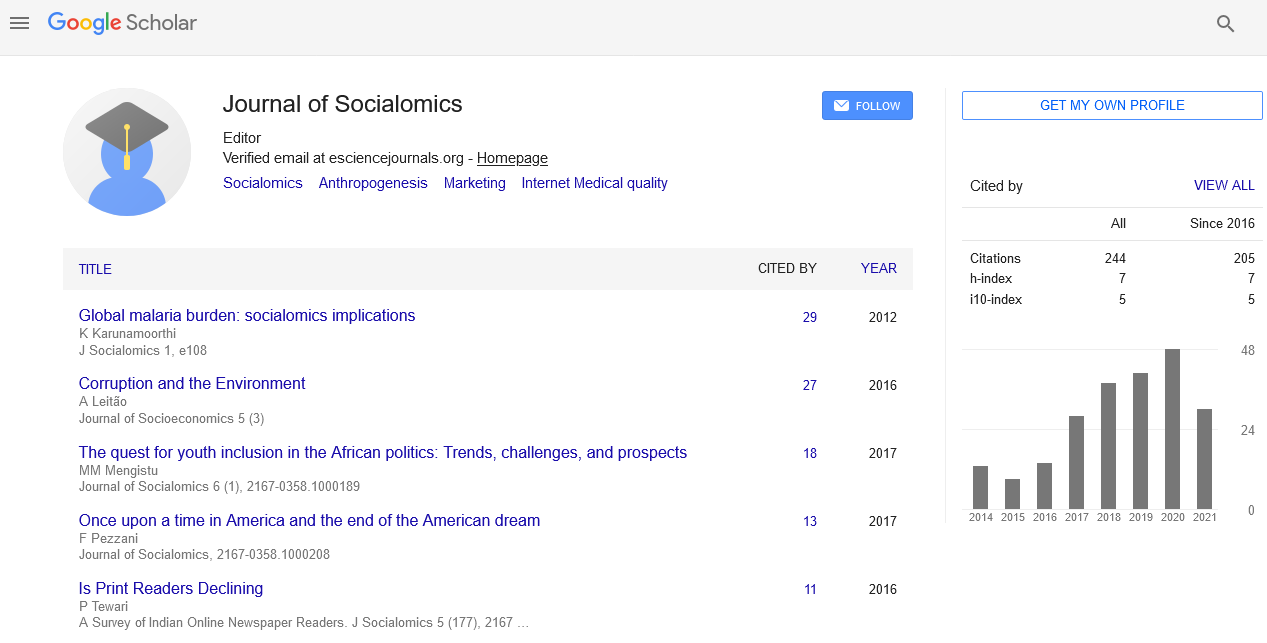
- Google Scholar
Useful Links
Share This Page
Journal Flyer

Open Access Journals
- Agri and Aquaculture
- Biochemistry
- Bioinformatics & Systems Biology
- Business & Management
- Chemistry
- Clinical Sciences
- Engineering
- Food & Nutrition
- General Science
- Genetics & Molecular Biology
- Immunology & Microbiology
- Medical Sciences
- Neuroscience & Psychology
- Nursing & Health Care
- Pharmaceutical Sciences
Perspective - (2026) Volume 15, Issue 1
Integrating Bioinformatics with Social Sciences for a Deeper Understanding of Human Behaviour and Health
Martin Hoffmann*Received: 17-Feb-2026, Manuscript No. JSC-26-31311; Editor assigned: 19-Feb-2026, Pre QC No. JSC-26-31311; Reviewed: 05-Mar-2026, QC No. JSC-26-31311; Revised: 12-Mar-2026, Manuscript No. JSC-26-31311; Published: 19-Mar-2026, DOI: 10.35248/2167-0358.26.15.299
Description
Bioinformatics, traditionally associated with the analysis of biological data such as Deoxyribo Nucleic Acid (DNA) sequences and protein structures, has expanded beyond its original boundaries and is increasingly being applied within the social sciences. This integration has created new opportunities to study human behavior, health patterns, and population dynamics through a combined lens of molecular data and social context. By linking computational biology with disciplines such as sociology, psychology, and public health, researchers can explore how biological systems interact with social environments in a more comprehensive manner.
The growth of this interdisciplinary approach has been supported by advancements in data collection and computational analysis. Large datasets containing genomic information, health records, and social indicators can now be processed using sophisticated algorithms. These datasets often include variables such as income, education, occupation, and living conditions alongside biological measurements. By analyzing these combined data sources, researchers can identify patterns that reveal how social factors influence biological processes and, in turn, affect health outcomes.
One of the primary applications of bioinformatics in the social sciences is the study of gene-environment interactions. Human traits and health conditions are rarely determined by genetic factors alone. Environmental influences, including social experiences, play a significant role in shaping biological responses. Bioinformatics tools allow researchers to examine how different environmental exposures affect gene expression across populations. For example, individuals living in high-stress environments may show changes in gene activity related to immune function or inflammation. These insights contribute to a more nuanced understanding of how social conditions influence biological systems. Another important area is the analysis of population health data. Bioinformatics techniques enable the processing of large-scale datasets to identify trends and correlations that may not be visible through traditional methods. For instance, researchers can analyze patterns of disease occurrence in relation to social determinants such as housing quality, access to healthcare, and community resources. This approach provides valuable information for designing public health interventions that address both biological and social factors.
The integration of bioinformatics with social sciences also supports the study of mental health. Conditions such as depression and anxiety are influenced by a combination of genetic predisposition and social experiences. By analyzing genetic data alongside information about social environments, researchers can identify biological markers associated with different mental health conditions. This can lead to improved diagnostic methods and more effective treatment strategies that consider the full range of influencing factors.
In addition to health-related applications, bioinformatics is being used to explore human behavior and social interactions. For example, studies have examined how genetic variations may be associated with behavioral traits such as risk-taking, social bonding, and decision-making. While these associations are complex and influenced by many factors, bioinformatics provides tools to analyze large datasets and identify potential links. It is important to interpret these findings carefully, as behavior is shaped by a wide range of influences beyond biology alone.
The use of computational models is central to this interdisciplinary field. Machine learning and statistical analysis techniques allow researchers to process vast amounts of data and identify meaningful patterns. These models can incorporate multiple variables, including genetic markers, environmental exposures, and social factors, to predict outcomes such as disease risk or behavioral tendencies. By combining these different types of data, researchers can develop more comprehensive models that reflect the complexity of human life.
Conclusion
The integration of bioinformatics with social sciences represents a significant advancement in the study of human behavior and health. By combining molecular data with social context, this approach provides a more comprehensive understanding of the factors that influence well-being. It highlights the importance of considering both biological and social dimensions in research and policy development. As this field continues to evolve, it offers valuable insights that can contribute to more effective health interventions and a deeper understanding of human society.
Citation: Hoffmann M (2026). Integrating Bioinformatics with Social Sciences for a Deeper Understanding of Human Behaviour and Health. J Socialomics. 15:299
Copyright: © 2026 Hoffmann M. This is an open-access article distributed under the terms of the Creative Commons Attribution License, which permits unrestricted use, distribution and reproduction in any medium, provided the original author and source are credited.