
Indexed In
- Open J Gate
- Genamics JournalSeek
- SafetyLit
- RefSeek
- Hamdard University
- EBSCO A-Z
- OCLC- WorldCat
- Publons
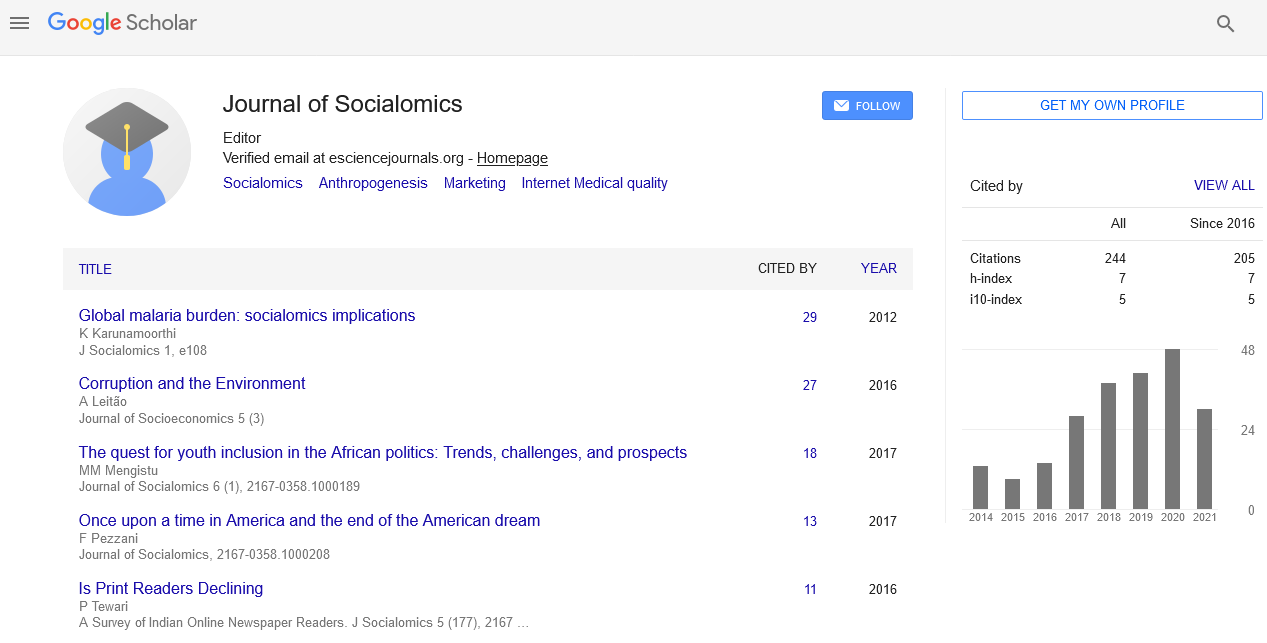
- Google Scholar
Useful Links
Share This Page
Journal Flyer
Open Access Journals
- Agri and Aquaculture
- Biochemistry
- Bioinformatics & Systems Biology
- Business & Management
- Chemistry
- Clinical Sciences
- Engineering
- Food & Nutrition
- General Science
- Genetics & Molecular Biology
- Immunology & Microbiology
- Medical Sciences
- Neuroscience & Psychology
- Nursing & Health Care
- Pharmaceutical Sciences
Commentary Article - (2025) Volume 14, Issue 4
Income Distribution and Social Structure in Modern Economies
Leonard Whitaker*Received: 10-Nov-2025, Manuscript No. JSC-26-31096; Editor assigned: 12-Nov-2025, Pre QC No. JSC-26-31096 (PQ); Reviewed: 26-Nov-2025, QC No. JSC-26-31096; Revised: 03-Dec-2025, Manuscript No. JSC-26-31096 (R); Published: 10-Dec-2025, DOI: 10.35248/2167-0358.25.14.287
Description
Social sustainability is shared within a society. It reflects the pattern through which earnings from employment, investments, and other sources are allocated among individuals and households. Economic sociology approaches income distribution not only as a matter of financial measurement but also as a social phenomenon shaped by institutions, cultural values, education systems, and historical conditions. By examining these social influences, scholars gain insight into how economic inequality emerges and how it affects the structure of communities.
In most societies, income is distributed unevenly among individuals. Some households possess greater financial resources due to high-paying occupations, successful enterprises, or accumulated assets. Others rely on wages from labor-intensive work that may offer limited financial rewards. This variation in earnings is influenced by several interconnected factors including education, professional training, labor market demand, and access to social networks. Individuals with specialized skills or advanced qualifications often receive higher compensation because their expertise is valued within particular industries.
Education remains one of the most influential elements shaping income distribution. Individuals who have access to quality education often gain opportunities to enter professional occupations that offer higher earnings and greater stability. Universities and training institutions provide knowledge and credentials that signal competence to employers. However, educational opportunities are not always distributed equally. Differences in school quality, family support, and financial resources may affect who can pursue higher education and professional training.
Family background also contributes to differences in income across generations. Children raised in households with stable economic resources may benefit from supportive learning environments, access to educational materials, and encouragement to pursue higher studies. These advantages can influence long-term career outcomes. In contrast, individuals from economically constrained households may encounter obstacles that limit educational attainment or restrict access to professional opportunities.
Labor market structures play a significant role in determining income patterns. Occupations requiring specialized expertise, such as medicine, engineering, or advanced technological work, tend to offer higher wages due to the extensive training required. At the same time, service-sector jobs and manual labor positions may provide lower earnings despite their essential contribution to economic activity. Wage differences across industries reflect both the demand for particular skills and the bargaining power of workers within those sectors.
Geographic location further influences income distribution. Urban regions often provide greater employment opportunities and higher wages due to the concentration of industries, institutions, and professional services. Rural areas may experience fewer employment options, leading to lower average incomes and limited opportunities for economic mobility. Regional development policies often attempt to address these disparities by encouraging investment and infrastructure development in underserved areas.
Global economic connections have also influenced income patterns within many countries. International trade, technological change, and capital mobility have altered labor demand across industries. While globalization can create new employment opportunities and increase economic growth, it may also shift certain types of production to regions with lower labor costs. These changes affect wage structures and employment opportunities in different sectors of the economy.
Conclusion
Income distribution therefore reflects the interaction of multiple social and economic forces. Education, labor market institutions, public policy, cultural attitudes, and technological change all contribute to shaping how financial resources are shared among populations. By examining these factors together, economic sociology provides a deeper understanding of inequality and the social conditions that influence economic opportunity. Through continued research and policy discussion, societies seek ways to manage income disparities while encouraging economic innovation and productivity. Understanding the social foundations of income distribution helps policymakers and communities develop strategies that support both economic vitality and social well-being.
```
Citation: Whitaker L (2025). Income Distribution and Social Structure in Modern Economies. J Socialomics. 14:287.
Copyright: © 2025 Whitaker L. This is an open-access article distributed under the terms of the Creative Commons Attribution License, which permits unrestricted use, distribution and reproduction in any medium, provided the original author and source are credited