
Indexed In
- Academic Journals Database
- Open J Gate
- Genamics JournalSeek
- JournalTOCs
- China National Knowledge Infrastructure (CNKI)
- Scimago
- Ulrich's Periodicals Directory
- RefSeek
- Hamdard University
- EBSCO A-Z
- OCLC- WorldCat
- Publons
- MIAR
- University Grants Commission
- Geneva Foundation for Medical Education and Research
- Euro Pub
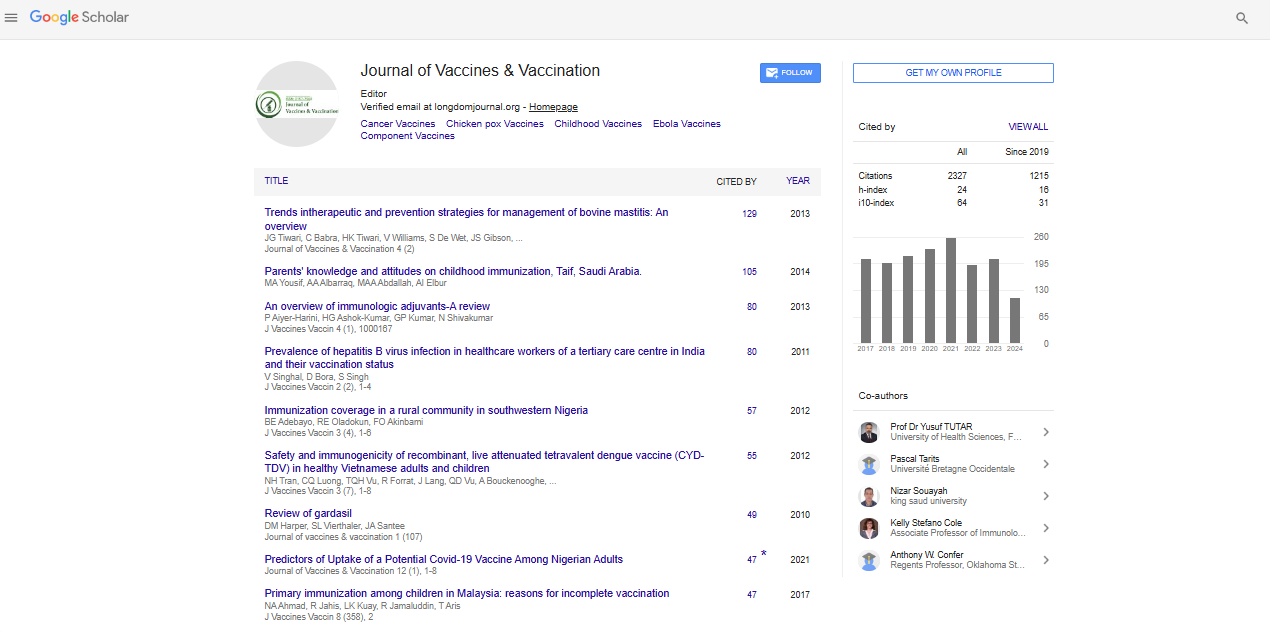
- Google Scholar
Useful Links
Share This Page
Open Access Journals
- Agri and Aquaculture
- Biochemistry
- Bioinformatics & Systems Biology
- Business & Management
- Chemistry
- Clinical Sciences
- Engineering
- Food & Nutrition
- General Science
- Genetics & Molecular Biology
- Immunology & Microbiology
- Medical Sciences
- Neuroscience & Psychology
- Nursing & Health Care
- Pharmaceutical Sciences
Commentary Article - (2025) Volume 16, Issue 11
Immunization: A Foundation of Vaccine Research and Infectious Disease Prevention
Eliana Whitmore*Received: 29-Oct-2025, Manuscript No. JVV-26-31819; Editor assigned: 31-Oct-2025, Pre QC No. JVV-26-31819; Reviewed: 14-Nov-2025, QC No. JVV-26-31819; Revised: 21-Nov-2025, Manuscript No. JVV-26-31819; Published: 28-Nov-2025, DOI: 10.35248/2157-7560.25.16.633
Description
Immunization is a major component of preventive medicine that protects individuals and communities from infectious diseases through the use of vaccines. It is a process in which the immune system is stimulated to recognize and fight specific pathogens before exposure occurs. Vaccines contain carefully selected components of microorganisms, such as weakened, inactive, or modified forms, which activate immune responses without causing the targeted disease. This process allows the body to develop protective antibodies and immune memory, helping to provide faster responses when future infections occur. In vaccine science, immunization continues to be an important area of research because of its contribution to disease control, health improvement, and prevention of infectious outbreaks. The mechanism of immunization is based on the natural function of the immune system. When a vaccine enters the body, immune cells identify the vaccine components as foreign substances and begin developing protective responses.
Antibodies are produced to target the specific pathogen, while memory cells remain available for future defense. If the individual encounters the actual infectious organism later, the immune system can respond more effectively. This biological process reduces the severity of infections and supports long-term protection against various diseases. The advancement of immunization has played an important role in the history of healthcare. Vaccination programs have helped control many infectious diseases that previously caused widespread illness and death. Diseases such as smallpox, polio, measles, and hepatitis have been reduced significantly through organized immunization efforts. These achievements have encouraged continued research in vaccine development, leading to improved vaccine formulations, better delivery methods, and expanded protection against different infectious agents.
Immunization programs are designed according to the health needs of different populations and age groups. Childhood vaccination provides early protection against infections that can affect growth, development, and overall health. Adult immunization helps maintain protection against diseases that may occur later in life. Certain groups, including healthcare workers, travellers, older adults, and individuals with specific health conditions, may require additional vaccines to reduce their risk of infection. A well-planned immunization schedule helps maintain continuous protection throughout life. The development of vaccines involves detailed scientific investigation and evaluation. Researchers study vaccine components, immune responses, and effectiveness through laboratory studies and clinical research. Before vaccines become available, they undergo careful assessment to ensure quality and safety. After approval, continuous monitoring helps evaluate vaccine performance and identify opportunities for improvement.
Modern immunization research has expanded through advances in biotechnology and medical science. New vaccine technologies have allowed researchers to explore innovative approaches for preventing infectious diseases. Genetic-based vaccines, recombinant technologies, and improved delivery systems have provided new possibilities for designing effective immunization strategies. These scientific developments contribute to faster vaccine development and improved responses to emerging health challenges. The benefits of immunization extend beyond individual protection. High levels of vaccination within communities can reduce the spread of infectious organisms and decrease the likelihood of outbreaks. This community protection is especially valuable for individuals who may have limited immune responses or medical reasons that prevent vaccination. Effective immunization programs support healthier communities by reducing disease transmission and lowering the burden on healthcare systems.
Understanding the purpose of vaccines, their benefits, and their safety evaluation helps individuals make informed healthcare choices. Healthcare professionals provide guidance on vaccination schedules and answer concerns related to vaccine use. Reliable information and effective communication help improve participation in immunization programs and support stronger public health outcomes. The future of immunization research focuses on developing vaccines that provide improved protection, wider accessibility, and better responses to changing infectious disease patterns. Scientists continue to investigate combination vaccines, advanced vaccine platforms, and improved storage and distribution methods. These efforts aim to strengthen global vaccination systems and ensure that effective prevention methods are available to diverse populations.
Conclusion
Immunization remains a fundamental part of vaccine research and preventive healthcare by providing protection against infectious diseases through targeted immune responses. Vaccines have contributed greatly to reducing disease transmission and improving health worldwide. Continued scientific innovation, research collaboration, and expansion of immunization programs will support future progress in disease prevention. The ongoing development of vaccine technologies will help protect communities and promote better health outcomes for generations to come. Immunization also strengthens healthcare systems by reducing the impact of preventable diseases and supporting healthier populations. Future advancements in vaccine research will continue to improve protection against existing and emerging infectious threats. Global commitment toward effective immunization strategies will remain important for achieving sustainable public health improvements.
Citation: Whitmore E (2025). Immunization: A Foundation of Vaccine Research and Infectious Disease Prevention. J Vaccines Vaccin. 16:633.
Copyright: © 2025 Whitmore E. This is an open access article distributed under the terms of the Creative Commons Attribution License, which permits unrestricted use, distribution and reproduction in any medium, provided the original author and source are credited.