
Indexed In
- RefSeek
- Hamdard University
- EBSCO A-Z
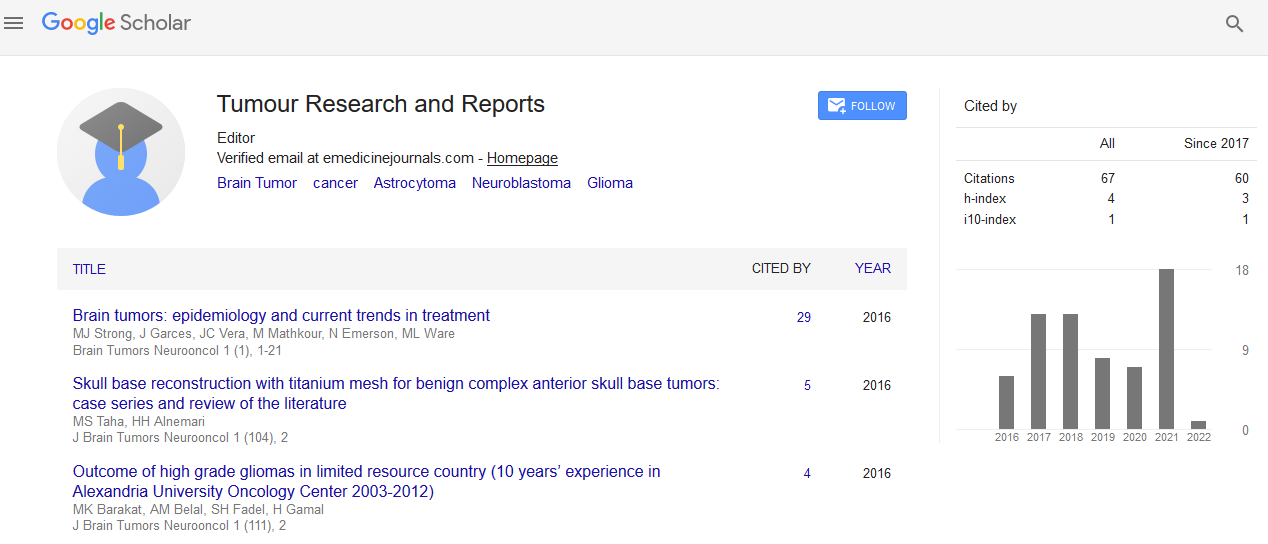
- Google Scholar
Useful Links
Share This Page
Journal Flyer

Open Access Journals
- Agri and Aquaculture
- Biochemistry
- Bioinformatics & Systems Biology
- Business & Management
- Chemistry
- Clinical Sciences
- Engineering
- Food & Nutrition
- General Science
- Genetics & Molecular Biology
- Immunology & Microbiology
- Medical Sciences
- Neuroscience & Psychology
- Nursing & Health Care
- Pharmaceutical Sciences
Opinion Article - (2025) Volume 10, Issue 4
Imaging-Based Evaluation of Intracranial Neoplasm in Clinical Practice
Davion L Kersh*Received: 17-Nov-2025, Manuscript No. JTRR-25-30695; Editor assigned: 20-Nov-2025, Pre QC No. JTRR-25-30695 (PQ); Reviewed: 04-Dec-2025, QC No. JTRR-25-30695; Revised: 11-Dec-2025, Manuscript No. JTRR-25-30695 (R); Published: 18-Dec-2025, DOI: 10.35248/2684-1614.25.10.277
Description
Imaging plays a central role in the identification, assessment and follow-up of intracranial neoplasm within clinical practice. Because the cranial cavity contains delicate and highly organized structures, direct examination is not possible without invasive procedures. Imaging techniques allow clinicians to visualize abnormal growths safely, assess their size and position and evaluate their effect on surrounding brain tissue. These methods support early detection, guide diagnostic decisions and assist in planning management strategies. Patients with intracranial neoplasm often present with symptoms that are non-specific, such as headaches, seizures, dizziness or changes in cognition. Imaging studies are frequently the first step in determining whether these symptoms are related to structural abnormalities. Magnetic resonance imaging is widely used due to its ability to provide detailed views of soft tissues. Different image sequences allow assessment of tissue composition, fluid content and contrast uptake, which helps in distinguishing abnormal growth from normal brain structures.
Computed Tomography (CT) remains a valuable tool, particularly in emergency settings. It allows rapid visualization of the cranial cavity and is effective in detecting bleeding, calcification or bone involvement. In patients presenting with sudden neurological decline, this method can quickly identify life-threatening conditions requiring urgent attention. Although its soft tissue contrast is more limited compared to magnetic resonance imaging, it continues to play an important supportive role in clinical evaluation. Advanced imaging techniques offer additional insight into the behavior of intracranial neoplasm. Perfusion imaging provides information about blood flow within a lesion, which may reflect cellular activity. Diffusion-based imaging evaluates how water molecules move through tissue, offering clues about cell density and organization. These techniques help clinicians form a more complete picture of the growth without the need for immediate tissue sampling. Imaging findings are also used to estimate the impact of a lesion on nearby brain structures. Swelling, compression of ventricles or displacement of neural pathways can often be visualized clearly. These observations assist clinicians in explaining symptoms and anticipating potential complications. In some cases, imaging may reveal incidental findings in individuals without symptoms, leading to careful monitoring rather than immediate intervention.
Accurate interpretation of imaging studies requires collaboration between radiologists and treating clinicians. Similar imaging appearances can sometimes represent different pathological processes, such as infection, inflammation or vascular abnormalities. Clinical history and laboratory findings are therefore considered alongside imaging results to reach a reliable diagnosis. When uncertainty remains, tissue sampling may be recommended to confirm the nature of the lesion. Imaging is also essential in treatment planning. Surgeons rely on detailed images to understand the relationship between the lesion and functional areas of the brain. This information helps minimize damage to healthy tissue during surgical procedures. In radiation-based treatment, imaging guides the selection of target areas and supports careful dose planning to reduce unintended exposure. Follow-up imaging plays a vital role in ongoing care. Repeated studies allow clinicians to monitor changes in lesion size and appearance over time. This is particularly important in assessing response to therapy or identifying early signs of progression. Consistent imaging protocols improve comparison between studies and support accurate long-term evaluation. Technological improvements have enhanced image quality, reduced scan time and expanded access to advanced techniques. These developments have strengthened the role of imaging in both routine care and research. By enabling detailed observation of intracranial neoplasm over time, imaging contributes to a better understanding of disease behavior and treatment effects. In clinical practice, imaging-based evaluation remains an indispensable component of intracranial neoplasm management. It supports diagnosis, guides intervention and informs follow-up care. Continued refinement of imaging methods and interpretive approaches will further improve patient assessment and contribute to more informed clinical decision-making.
Citation: Kersh DL (2025). Imaging-Based Evaluation of Intracranial Neoplasm in Clinical Practice. J Tum Res Reports.10:277.
Copyright: © 2025 Kersh DL. This is an open-access article distributed under the terms of the Creative Commons Attribution License, which permits unrestricted use, distribution and reproduction in any medium, provided the original author and source are credited.