
Indexed In
- Open J Gate
- Genamics JournalSeek
- SafetyLit
- RefSeek
- Hamdard University
- EBSCO A-Z
- OCLC- WorldCat
- Publons
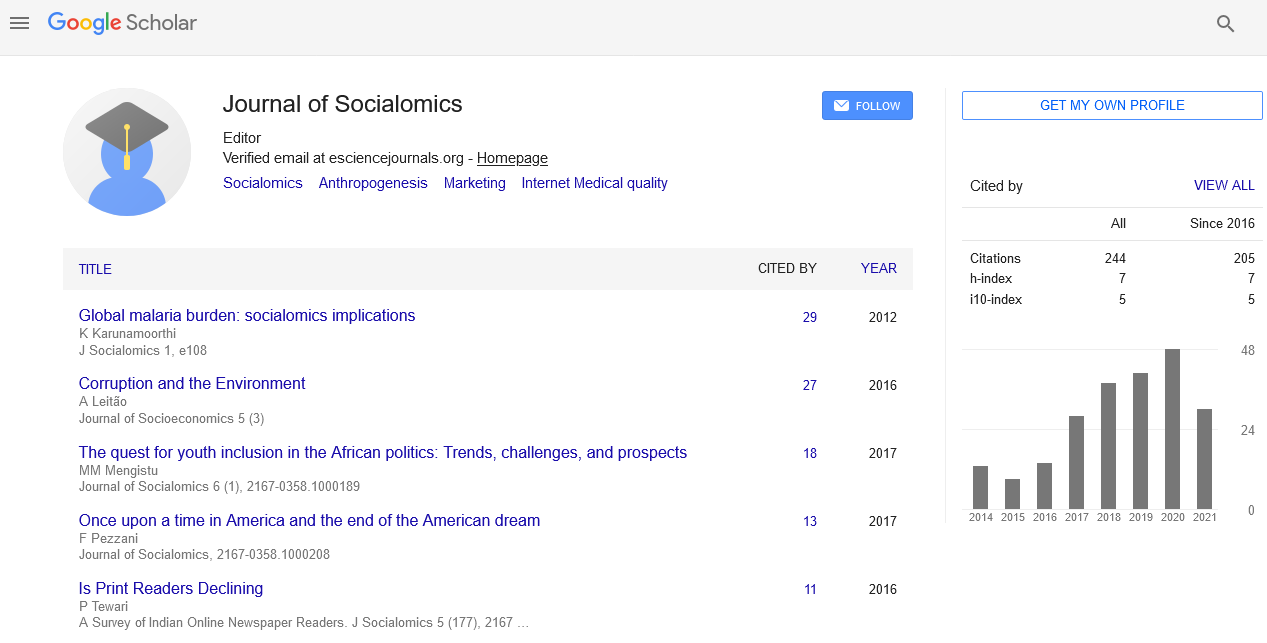
- Google Scholar
Useful Links
Share This Page
Journal Flyer
Open Access Journals
- Agri and Aquaculture
- Biochemistry
- Bioinformatics & Systems Biology
- Business & Management
- Chemistry
- Clinical Sciences
- Engineering
- Food & Nutrition
- General Science
- Genetics & Molecular Biology
- Immunology & Microbiology
- Medical Sciences
- Neuroscience & Psychology
- Nursing & Health Care
- Pharmaceutical Sciences
Commentary - (2025) Volume 14, Issue 3
Globalization and Its Influence on Modern Societies
Olivia Hartman*Received: 19-Aug-2025, Manuscript No. JSC-25-30732 ; Editor assigned: 21-Aug-2025, Pre QC No. JSC-25-30732 ; Reviewed: 04-Sep-2025, QC No. JSC-25-30732 ; Revised: 11-Sep-2025, Manuscript No. JSC-25-30732 ; Published: 18-Sep-2025, DOI: 10.35248/2167-0358.25.14.278
Description
Globalization refers to the increasing interaction and interdependence among countries, communities and economies. This process has accelerated in recent decades due to advancements in transportation, communication and technology. While the concept has multiple dimensions economic, cultural, social and political it essentially reflects the growing connectivity of human societies across geographical boundaries. The effects of globalization are visible in trade patterns, cultural exchange, migration and the spread of ideas, influencing both individual experiences and collective developments. Economically, globalization has expanded markets and investment opportunities. Businesses are no longer confined to domestic borders; multinational corporations operate on a global scale, sourcing raw materials, labor and technology from various countries. Trade agreements and international organizations facilitate these exchanges, creating networks of interdependent economies. Consumers benefit from access to a wider range of goods at competitive prices, while producers can reach broader markets. However, this interconnectedness also exposes economies to external shocks, such as financial crises or fluctuations in global commodity prices, highlighting the risks of dependency. Technological advancement has been a major driver of globalization. The proliferation of the internet, mobile communication and digital platforms allows for near-instantaneous exchange of information across continents. Businesses can coordinate production in multiple countries, researchers can collaborate internationally and social movements can spread awareness quickly. Technology also enables virtual work, connecting professionals across time zones and fostering cross-border collaboration. These innovations blur traditional geographic constraints, creating a more integrated global landscape.
Cultural aspects of globalization are equally significant. Exposure to different languages, traditions and media content fosters understanding and sometimes hybridization of cultural practices. Music, cuisine, fashion and entertainment often reflect global influences, creating shared experiences among distant communities. Simultaneously, cultural globalization can lead to debates over identity and the preservation of local traditions. While some argue that it promotes diversity and tolerance, others raise concerns about homogenization or dominance of certain cultural norms over others. Globalization also impacts human mobility. Migration for work, education or refuge contributes to demographic shifts and the exchange of skills and ideas. Diasporic communities often maintain connections to their countries of origin while integrating into new societies, enriching both contexts. Policies regulating migration and labor flows shape the benefits and challenges associated with these movements, influencing economic development and social cohesion. Environmental implications of globalization are increasingly apparent. Global supply chains, industrial activity and transportation contribute to climate change, resource depletion and ecological strain. International cooperation is necessary to address environmental challenges, as pollution and resource use in one region can have consequences worldwide. Efforts such as climate agreements and sustainability initiatives illustrate how globalization can both exacerbate and help manage ecological issues.
Political dimensions are intertwined with economic and social effects. International organizations, treaties and collaborations promote cooperation on issues such as trade regulation, security and public health. At the same time, globalization can challenge national sovereignty, as decisions made at international levels may influence domestic policies. Public debates often focus on finding a balance between participating in global networks and maintaining local control over resources, laws and cultural practices. Globalization has created both opportunities and inequalities. While access to global markets, technology and education can improve livelihoods, uneven distribution of benefits can exacerbate disparities. Wealth and resource concentration in certain regions or among multinational entities can leave other communities disadvantaged. Addressing these inequalities requires thoughtful governance, equitable policies and international cooperation to ensure that the advantages of interconnectedness are shared broadly.
Conclusion
In summary, globalization is a complex and multifaceted process shaping modern societies. Its influence spans economic growth, technological innovation, cultural exchange, migration, environmental sustainability and political structures. Understanding its dynamics requires careful consideration of benefits, challenges and the ways in which local and global forces interact. The study of globalization provides insight into how human societies evolve, adapt and connect in an increasingly interdependent world.
Citation: Citation: Hartman O (2025). Globalization and Its Influence on Modern Societies. J Socialomics. 14:278.
Copyright: Copyright: © 2025 Hartman O. This is an open-access article distributed under the terms of the Creative Commons Attribution License, which permits unrestricted use, distribution and reproduction in any medium, provided the original author and source are credited.