

Indexed In
- Open J Gate
- Genamics JournalSeek
- Academic Keys
- ResearchBible
- Cosmos IF
- Access to Global Online Research in Agriculture (AGORA)
- Electronic Journals Library
- RefSeek
- Directory of Research Journal Indexing (DRJI)
- Hamdard University
- EBSCO A-Z
- OCLC- WorldCat
- Scholarsteer
- SWB online catalog
- Virtual Library of Biology (vifabio)
- Publons
- Geneva Foundation for Medical Education and Research
- Euro Pub
- Google Scholar
Useful Links
Share This Page
Journal Flyer
Open Access Journals
- Agri and Aquaculture
- Biochemistry
- Bioinformatics & Systems Biology
- Business & Management
- Chemistry
- Clinical Sciences
- Engineering
- Food & Nutrition
- General Science
- Genetics & Molecular Biology
- Immunology & Microbiology
- Medical Sciences
- Neuroscience & Psychology
- Nursing & Health Care
- Pharmaceutical Sciences
Research Article - (2025) Volume 14, Issue 2
Genetic Study, Heritability and Genetic Advance in Chrysanthemum (Dendranthema grandiflora Tzvelve) during Kharif Season
Kavana GB1*, Seetharamu GK1, Rajiv Kumar2, Satish D3, Amreen Taj1, Amruta S Bhat4 and Venugopalan R52Department of Floriculture and Medicinal Plants, IIHR, Bengaluru, India
3Department of Biotech and Crop Improvement, College of Horticulture, Bagalkote, India
4Department of Plant Pathology, RHREC, Bengaluru, India
5Department of Statistics, IIHR, Bengaluru, India
Received: 01-Jun-2024, Manuscript No. AGT-24-25888; Editor assigned: 04-Jun-2024, Pre QC No. AGT-24-25888 (PQ); Reviewed: 18-Jun-2024, QC No. AGT-24-25888; Revised: 19-Jun-2025, Manuscript No. AGT-24-25888 (R); Published: 26-Jun-2025, DOI: 10.35248/2168-9891.25.14.408
Abstract
Fifty genotypes of chrysanthemum were evaluated in randomized complete block design during the year 2022 (Kharif) to determine genetic variability, heritability and genetic advance for different quantitative and qualitative traits, based on which selection may be made. It was conducted at research block of the Department of Floriculture and Landscape Architecture, College of Horticulture, UHS campus, Bengaluru. To determine genetic variability, heritability and genetic advance for different quantitative and qualitative traits, based on which selection may be made. Analysis of variance showed significant differences among genotypes for all the characters studied. Results revealed that magnitude of the Phenotypic Coefficient of Variation (PCV) was higher than Genotypic Coefficient of Variation (GCV) for all the traits viz., number of primary branches, number of secondary branches, duration of flowering, number of flowers per plant, weight of hundred flowers, yield per plant, flower diameter, total number of ray florets per flower head, petiole length, shelf life and disc diameter indicating genotype and environment interaction. Highest heritability coupled with genetic advance as percent mean was found for all the traits. The characters that endowed with high heritability with values high genetic advance as percent mean may be used as selection criteria in genetic improvement of yield.
Keywords
Genetic variability; Chrysanthemum; GCV; PCV and Heritability
Introduction
Floriculture is increasingly regarded as a viable diversification from the traditional field crops and other horticultural crops due to increased returns per unit and the increasing habit of saying it with flowers during all occasions. Flowers are symbol of beauty, love and tranquillity, they form the soul of the garden and convey the message of nature. Besides their aesthetic and religious value, flowers are also important for their economic use. One such flower, out valuing all utilities of the world through its magnificent beauty, varying hues and colors is the golden flower ‘Chrysanthemum’ [1].
Chrysanthemum (Dendranthema grandiflora Tzvelev) is one of the most beautiful flowering plant referred as “Queen of the East” and also known as “Autumn flower” belongs to family Asteraceae. It is derived from Greek words chryos means golden, anthos means flower and is the most important flower crop of commercial importance. It is having diploid chromosome number 2n=18. In the International cut flower trade, it ranks next to the rose. The genus of which, the present day florist chrysanthemum (Chrysanthemum morifolium Ramat) has been renamed as Dendranthema grandiflora Tzvelev [2].
The performance of any crop or genotype largely depends on interaction between genotype and environment. In all the species of Chrysanthemum, the phenotypic expression of a character is mainly governed by the genetic make-up of the plant, the environment in which it is grown and the interaction between the genotype and environment. As a result, genotypes which perform well in one region may not perform same in other regions of varying climatic conditions. Genotypeenvironment interactions pose a major problem in developing new genotype and choosing suitable genotype for specific location, making it difficult to identify the most desirable genotypes. The performance of genotypes depends on climatic conditions under which they are grown.
A huge variability exists in Chrysanthemum with respect to shape, size, growth habit, flowering behaviour, vase life etc. Various workers evaluated different genotypes/hybrids of Chrysanthemum under different regions. In spite of such variability, very few are having desirable characters for yield, shelf life and flower quality. So, there is a need for selection as well as maintenance of good germplasm. The interrelationship of various characters in the form of correlation is an important aspect in crop breeding. Knowledge of correlation studies helps the plant breeder to ascertain the components of yield and provide an effective basis of selection.
Genetic variability in a population can be partitioned into heritable and non-heritable variation with the aid of genetic parameters such as variance, genotypic coefficient of variation, heritability and genetic advance, which serves as basis for selection of some outstanding genotypes from existing ones. The study of genetic variability is the pre-requisite for any crop improvement programme. Success in recombination breeding depend on suitable exploitation of genotypes as parent of obtaining high heterotic crosses and transgressive segregants or the presence of genetic variability in base population is essential [3].
For effective breeding programme, knowledge of the mean performance, magnitude of genetic variability, heritability and genetic advance is essential. Heritability gives a measure of transmission of characters from one generation to the other, enabling a plant breeder in isolation of elite selection in the crop. Genotypic and phenotypic coefficient of variation, heritability and genetic advance constitute the important genetic parameters which frequently applied in plant breeding for crop improvement. Genetic parameters like Genotypic Coefficient of Variation (GCV), Phenotypic Coefficient of Variation (PCV), heritability and genetic advance are useful biometric tools for determination of genetic variability [4].
Materials and Methods
The experiment was conducted to study the genetic variability, heritability and genetic advance of different genotypes of Chrysanthemum (Dendranthema grandiflora Tzvelve) of kharif season (2022). The experimental material comprised of fifty Chrysanthemum genotypes such as Sapna, Arka Chandrika, Red Gold, White Star, Aishwarya-1, HCC-1, N-9, NBRI Little Pink, HYDC-7, Hossur, Winter Queen, Ruby Red, Scent White, Haldigatti, Aparajitha, Lalima, Rajat, Scent Yellow, Poornima White, Marigold, Poornima Yellow, Ratlam Selection, Dalore,Dolley Orange, Yellow Anemone, NBRI Little Orange, Corcum Small, Karnool Yellow, Thanu White, IIHR RC-1, Arka Kirti, Punjab Gold, Arka Pink Star, Vijay Kiran, Agnipath, Yellow Delight, Kaveri Orange, Bidhan Mum, Mallika Yellow, Co-1, B47/101, Airth-2, Jyostia, C6-11, Kalpana, Yellow Spoon, Yellow Gold, Thanu Yellow, Kaveri Pink and Cream White.
The genotypes were evaluated in randomized complete block design with two replications during kharif season at College of Horticulture, Bengaluru. The plants were planted at a spacing of 60 × 45 cm and all the recommended cultural practices were followed. Five competitive plants were tagged at random in each treatment in each replication for recording detailed observation and the data were recorded for all the 17 quantitative and qualitative characters viz., plant height (cm), number of primary branches, number of secondary branches, plant spread (E-W) (cm), plant spread (N-S) (cm), days to first flower bud initiation, days to 50 percent flowering, duration of flowering (days), number of flowers per plant, weight of 100 flowers per plant (g), yield/plant (g), flower yield per ha (g), flower diameter (cm), disc diameter(cm), total number of ray florets per flower head, petiole length of flower (cm), shelf life (days) and chlorophyll content (mg/g) were recorded. Mean values were subjected to analysis of variance, genotypic and phenotypic coefficient of variation were estimated based on estimate of genotypic and phenotypic variance broad sense heritability was calculated as ratio of genotypic variance to phenotypic variance and expressed in percentage, genetic advance, genetic advance as percent over mean was worked out and categorized as suggested by Johnson, et al. [5].
The range in the values reflect the amount of phenotypic variability, which is not very reliable since it includes genotypic, environmental and genotype × environmental interaction components and does not reveal as to which character showing higher degree of variability. Further, the phenotype of the crop is influenced by additive gene effect (heritable), dominance (nonheritable) and epitasis (non-allelic interaction). Hence, it becomes necessary to work out the observed variability into Phenotypic Coefficients of Variability (PCV) and Genotypic Coefficients of Variability (GCV), which ultimately indicate the extent of variability existing for various traits. However, even this does not give a true picture about the extent of inheritance of the character [6].
The effectiveness of selection for any character does not depend on the amount of variability alone but also with estimates of heritability. It is of great interest to the plant breeder to determine how much of the phenotypic variability which is present in a particular generation is heritable and the accuracy with which a genotype can be evaluated by its phenotypic expression. Therefore, the heritability (h2) of a character can be relied upon, as it enables them to decide the extent of selection pressure to be applied under particular environment, which separate out the environmental influence from the total variability. Nevertheless, its use would be limited as this is prone to changes in environment, material, etc. The estimation of heritability has a greater role to play in determining the effectiveness of selection of a character provided it is considered in conjunction with the predicted genetic advance as suggested by Johnson, et al., and Panse and Sukhatme. Since, heritability is influenced by bio-metrical method, generation of hybrid, sample size of experimental material and environment [7].
Heritability (h2) and Genetic Advance over percent Mean (GAM) varied for growth parameters. Higher heritability indicates the effectiveness of selection through phenotypic performance, but it does mean a high genetic gain. The magnitude of heritable variability is the most important aspect of the genetic constitution of breeding material. However, high heritability associated with high GAM proves more useful for efficient improvement of a character through simple selection [8].
Results
Assessment of genetic variability and genetic diversity based on morphological traits
The analysis of variance for different quantitative characters revealed significant (P=0.05) differences among the genotypes for all the growth parameters, flowering, yield and quality parameters [9].
To understand the extent of the observed variations due to genetic factors, viz., the Genotypic Coefficient of Variation (GCV), Phenotypic Coefficient of Variation (PCV), broad sense heritability (h2), Genetic Advance (GA) and Genetic Advance as percent of Mean (GAM) were studied (Figure 1). The Data revealed the existence of large amount of variability with respect to all characters studied as given in Table 1. Plant height exhibited wide variability during first season (kharif). It was which was ranging from 28.07 to 86.36 cm with the general mean of 43.37 cm. The Genotypic Variance (GV) and Phenotypic Variance (PV) values were 70.85 and 73.83 respectively. The General Combining Ability (GCV) and Phenotypic Combining Ability (PCV) values were 19.41 and 19.81 respectively. The estimates of broad sense heritability, genetic advance and genetic advance as percent of mean was 95.97%, 16.99% and 39.17% respectively for this trait [10].
The data given in the Table 1 presents that, number of primary branches per plant the wide variability among genotypes during kharif season which was ranging from 9.70 to 27.10 with the mean of 16.02. The genotypic variance and phenotypic variances values were 12.83 and 14.86 respectively. The genotypic coefficient of variation and phenotypic coefficient of variation values were 22.36% and 24.06% respectively. The estimates of broad sense heritability, genetic advance and genetic advance as percent of mean were 86.38%, 6.86% and 42.80% respectively for this trait. The data revealed that the number of secondary branches per plant varied significantly and recorded the wide range of variability during kharif season and it was ranged from 17.60 to 40.90 with the mean of 28.69, GV and PV values were 29.01 and 39.02 respectively. The genotypic coefficient of variation (18.77%), phenotypic coefficient of variation (21.77%), estimates of broad sense heritability (74.34%), genetic advance (9.57) and genetic advance as percent of mean was 33.35 % for this character [11].
Plant spread in East-West direction exhibited the wide variability among genotypes of Chrysanthemum's during kharif season (Table 1) which was ranging from 25.77 to 59.89 cm with the general mean of 39.92 cm. The GV and PV values were 36.26 and 51.13 respectively. The GCV and PCV values were 15.08 and 17.91 percent respectively. The estimates of broad sense heritability, genetic advance and genetic advance as percent of mean were 70.92%, 10.45% and 26.17% respectively for this trait. Plant spread (North-South) showed wide range of variability during kharif season and it was ranged from 30.73 to 57.07 cm with the mean of 42.40 cm and the GV and PV values were 33.22 and 39.16 respectively. The high GCV (13.59%), PCV (14.76%), estimates of broad sense heritability (84.81%), genetic advance (10.93) and genetic advance as percent of mean (25.79%) were recorded for this character. Days to flower bud initiation exhibited the wide variability among genotypes during kharif season which was ranging from 45.50 to 90.40 with the mean of 66.30, GV and PV values were 88.57 and 95.90 respectively. The GCV and PCV values were 14.20 and 14.77 percent respectively. The estimates of broad sense heritability, genetic advance and genetic advance as percent of mean were 92.36%, 18.63% and 28.10% respectively for this trait [12].
Wide range of variability exhibited for days to 50 percent flowering during kharif season (Table 1) and it was ranged from 69.20 to 111.40 with the mean of 86.20, GV and PV values were 89.86 and 96.19 respectively. The GCV (11.00%), PCV (11.38%), estimates of broad sense heritability (93.43%), genetic advance (18.88) and genetic advance as percent of mean was 21.90 % for this parameter. Duration of flowering exhibited the significant variation among the varieties which showed the wide range of variability during kharif season and it was ranged from 28.10 to 77.20 with the mean of 44.96, GV and PV values were 94.19 and 96.41 respectively. The GCV (21.59%), PCV (21.84%), estimates of broad sense heritability (97.70%), genetic advance (19.76) and genetic advance as percent of mean was 43.20% for this character. Number of flowers per plant exhibited the wide variability during kharif season which was ranging from 94.80 to 263.80 with the general mean of 183.00. The GV and PV values were 2500.14 and 2796.86 respectively. The GCV and PCV values were 27.26 and 28.84 respectively. The estimates of broad sense heritability, genetic advance and genetic advance as percent of mean was 89.39%, 97.39% and 53.10% respectively for this trait [13].
Weight of hundred flowers in different genotypes exhibited the wide variability during first season (kharif) (Table 1) which was ranging from 92.22 to 402.09 with the mean of 159.39, GV and PV values were 2798.09 and 3598.59 respectively. The GCV and PCV values were 33.19 and 37.64 percent respectively. The estimates of broad sense heritability, genetic advance and genetic advance as percent of mean were 77.76%, 96.09 % and 60.28% respectively for this trait. Flower yield per plant exhibited the wide variability among genotypes during kharif season which was ranging from 184.51 to 507.02 with the mean of 270.53, GV and PV values were 3443.88 and 4655.23 respectively. The GCV and PCV values were 21.69% and 25.22% respectively. The estimates of broad sense heritability, genetic advance and genetic advance as percent of mean were 73.98%, 103.98% and 38.43% respectively for this trait. Flower yield per hectare exhibited the wide variability among genotypes during kharif season which was ranging from 1.09 to 5.58 with the mean of 1.86, GV and PV values were 1.03 and 1.21 respectively. The GCV and PCV values were 54.54% and 58.96% respectively. The estimates of broad sense heritability, genetic advance and genetic advance as percent of mean were 85.56%, 1.94% and 103.92% respectively for this trait [14].
Flower diameter exhibited the wide range of variability during kharif season (Table 1), it was ranging from 1.98 to 7.53 with the general mean of 4.78. The GV and PV values were 1.29 and 1.67 respectively the GCV and PCV values were 23.75 and 27.07 respectively. The estimates of broad sense heritability, genetic advance and genetic advance as percent of mean were 76.97%, 2.05 and 42.92% respectively for flower diameter. Disc diameter exhibited the wide variability during kharif season which was ranging from 0.00 to 1.83 with the general mean of 0.58. The GV and PV values were 0.36 and 0.40 respectively. The GCV and PCV values were 103.49 and 108.67 respectively. The estimates of broad sense heritability, genetic advance and genetic advance as percent of mean was 90.68%, 1.18% and 203.01% respectively for this trait. Total number of ray florets per flower head recorded the wide range of variability during kharif season and it was ranged from 22.20 to 204.50 with the mean of 77.43, GV and PV values were 1642.08 and 1677.28 respectively. The GCV (52.33%), PCV (52.89%), estimates of broad sense heritability (97.90%), genetic advance (82.60) and genetic advance as percent of mean was 106.67% for this character [15].
Petiole length of the flower exhibited the wide variability during kharif season (Table 1) which was ranging from 1.53 to 15.10 cm with the general mean of 6.71 cm. The GV and PV values were 11.07 and 11.92 respectively. The GCV and PCV values were 49.62 and 51.48 respectively and the estimates of broad sense heritability, genetic advance and genetic advance as percent of mean were 92.90%, 6.61% and 98.52% respectively for this floral parameter. Shelf life of flowers after harvest exhibited the wide range of variability during kharif season which was ranging from 2.00 to 7.00 days with the general mean of 4.02. The GV and PV values were 1.01 and 1.21 respectively. The GCV and PCV values were 25.00% and 27.41% respectively. The estimates of broad sense heritability, genetic advance and genetic advance as percent of mean was 83.91%, 1.89% and 46.97% respectively. Chlorophyll content found in the leaves of chrysanthemum genotypes (Figure 1) exhibited the wide variability during kharif season which was ranging from 6.53 to 14.56 cm with the general mean of 10.47 cm. The GV and PV values were 3.96 and 4.40 respectively. The GCV and PCV values were 19.01 and 20.05 respectively. The estimates of broad sense heritability, genetic advance and genetic advance as percent of mean were 89.88%, 3.89% and 37.12% respectively [16].
| S. no. | Parameters | Range | Mean | GV | PV | GCV% | PCV % | h2% | GA | GAM % | |
| Min | Max | ||||||||||
| 1 | Plant height (cm) | 28.07 | 86.36 | 43.37 | 70.85 | 73.83 | 19.41 | 19.81 | 95.97 | 16.99 | 39.17 |
| 2 | Number of primary branches | 9.7 | 27.1 | 16.02 | 12.83 | 14.86 | 22.36 | 24.06 | 86.38 | 6.86 | 42.8 |
| 3 | Number of secondary branches | 17.6 | 40.9 | 28.69 | 29.01 | 39.02 | 18.77 | 21.77 | 74.34 | 9.57 | 33.35 |
| 4 | Plant spread (E-W) (cm) | 25.77 | 59.89 | 39.92 | 36.26 | 51.13 | 15.08 | 17.91 | 70.92 | 10.45 | 26.17 |
| 5 | Plant spread (N-S) (cm) | 30.73 | 57.07 | 42.4 | 33.22 | 39.16 | 13.59 | 14.76 | 84.81 | 10.93 | 25.79 |
| 6 | Days to first flower bud initiation | 45.5 | 90.4 | 66.3 | 88.57 | 95.9 | 14.2 | 14.77 | 92.36 | 18.63 | 28.1 |
| 7 | Days to 50 percent flowering | 69.2 | 111.4 | 86.2 | 89.86 | 96.19 | 11 | 11.38 | 93.43 | 18.88 | 21.9 |
| 8 | Duration of flowering (days) | 28.1 | 77.2 | 44.96 | 94.19 | 96.41 | 21.59 | 21.84 | 97.7 | 19.76 | 43.2 |
| 9 | Number of flowers per plant | 94.8 | 263.8 | 183 | 2500.14 | 2796.86 | 27.26 | 28.84 | 89.39 | 97.39 | 53.1 |
| 10 | Weight of 100 flowers per plant (g) | 92.22 | 402.09 | 159.39 | 2798.09 | 3598.59 | 33.19 | 37.64 | 77.76 | 96.09 | 60.28 |
| 11 | Yield/plant (g) | 184.51 | 507.02 | 270.53 | 3443.88 | 4655.23 | 21.69 | 25.22 | 73.98 | 103.98 | 38.43 |
| 12 | Flower yield per ha (g) | 1.09 | 5.58 | 1.86 | 1.03 | 1.21 | 54.54 | 58.96 | 85.56 | 1.94 | 103.92 |
| 13 | Flower diameter (cm) | 1.98 | 7.53 | 4.78 | 1.29 | 1.67 | 23.75 | 27.07 | 76.97 | 2.05 | 42.92 |
| 14 | Disc diameter(cm) | 0 | 1.83 | 0.58 | 0.36 | 0.4 | 103.49 | 108.67 | 90.68 | 1.18 | 203.01 |
| 15 | Total number of ray florets per flower head | 22.2 | 204.5 | 77.43 | 1642.08 | 1677.28 | 52.33 | 52.89 | 97.9 | 82.6 | 106.67 |
| 16 | Petiole length of flower (cm) | 1.53 | 15.1 | 6.71 | 11.07 | 11.92 | 49.62 | 51.48 | 92.9 | 6.61 | 98.52 |
| 17 | Shelf life (days) | 2 | 7 | 4.02 | 1.01 | 1.21 | 25 | 27.41 | 83.91 | 1.89 | 46.97 |
| Note: GV: Genotypic Variance, PV: Phenotypic Variance, GCV: Genotypic Co-efficient of Variation, PCV: Phenotypic Co-efficient of Variation, h2: Heritability, GA: Genetic Advance, GAM: Genetic Advance as percent Mean | |||||||||||
Table 1: Estimates of genetic parameters for different characters of Chrysanthemum of kharif season.
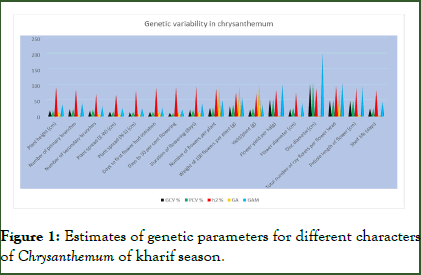
Figure 1: Estimates of genetic parameters for different characters of Chrysanthemum of kharif season.
Discussion
It was observed that phenotypic coefficient of variation was slightly higher than the Genotypic Coefficient of Variation (GCV) for plant height, number of primary branches, number of secondary branches, duration of flowering, number of flowers per plant, weight of hundred flowers, yield per plant, flower diameter, total number of ray florets per flower head, petiole length, shelf life and disc diameter. Similar findings were reported in Kalyani and Prasad, Henny, et al., Negi, et al., in Chrysanthemum; Rajiv, et al., Ramya, et al., in China aster; Arulmani, et al., in Gaillardia and Balaram and Janakiram in gladiolus. The results are consistent with the relatively low difference between PCV and GCV, which indicates that the environment has a very limited impact on how characteristics are expressed or that genotypes are less sensitive to the environment. The traits viz., plant height, plant spread (E-W) and (N-S), days to first flower bud initiation and days to 50 percent flowering had lower values of PCV and GCV indicated that such characters are highly susceptible for random environmental effects. It was observed that the genotypic coefficients of variation varied with the characters and this indicated the presence of genetic diversity for the different traits. This was in accordance with Telem, et al., and Prakash, et al. in Chrysanthemum; Ramya, et al. in China aster and Byadwal, et al. in Gaillardia. The value of PCV is higher than GCV indicating the influence of environmental factors on these traits. The PCV estimates were found to be higher than corresponding GCV estimates for all the characters under consideration, which suggests that there is an environmental effect influencing the expression of these characters. The traits which record the medium PCV and GCV indicating scope for their improvement through selection. This was in accordance with Chaugule; Prakash et al.; Kumar et al. and Kumar et al. in Chrysanthemum [17,18].
From kharif season, it was observed that, heritability ranged from 70.92 (Plant spread (E-W) (cm)) to 97.90 percent (total number of ray florets per flower head), highest heritability coupled with genetic advance as percent mean was found for all the traits. The characters that endowed with high heritability with values high genetic advance as percent mean may be used as selection criteria in genetic improvement of yield. These results are in close conformity with the findings of Sirohi and Behera.
Genetic Advance as a percentage of Mean (GAM) is a measure of how much gain a breeder may get from phenotypic selection for a trait. As GAM is directly proportional to heritability traits having high heritability as higher GAM. GAM ranged from 21.90 (Days to fifty percent flowering) to 203.01 (Disc diameter). These findings are similar to Ghimiray and Sarka. High heritability with moderate genetic advance as percent over mean indicating additive gene action conditioning their expression and phenotypic selection for their amenability can be brought about. The findings are in confirmity with the reports of Verma et al. [19,20].
Conclusion
In the present investigation, high heritability estimates associated with high genetic advance was noticed for plant height, number of primary branches, number of secondary branches, duration of flowering, number of flowers per plant, weight of hundred flowers, yield per plant, flower diameter, total number of ray florets per flower head, petiole length, shelf life and disc diameter indicating the role of additive gene action and can be used as selection criteria in genetic improvement of yield.
References
- Aditya JP, Bhartiya P, Bhartiya A. Genetic variability, heritability and character association for yield and component characters in soybean (Glycine max (L.) Merrill). J Central Europ Agric. 2011;12(1):27-34.
- Archana B, Patil AA, Hunje R, Patil VS. Studies on genetic variability analysis in gladiolus hybrids. J Ornam Hortic. 2011;11(2):121-126.
- Arulmani N, Chandrashekar SY, Geeta K, Rashmi R, Ravi CH, Praveen BY. Studies on genetic variability in Gaillardia (Gaillardia pulchella Foug.) genotypes. Res Environ Life Sci. 2016;9(4):466-469.
- Balaram MV, Janakiram T. Genetic variability studies in gladiolus genotypes. Karnataka J Hort. 2004;1(1):96-99.
- Baskaran V, Abirami K, Simhachalam P, Avinash N. Effect of nursery media on rooting and growth of terminal stem cuttings of Chrysanthemum (Dendranthema grandiflora Tzvelev.) in Andaman Isands. Int J Trop Agric. 2016;34(7):2179-2183.
- Burton GW, Devane EM. Estimation of heritability in tall fescue (Festica arundinaceae) from replicated clonal material. Agron J. 1953;45:478-481.
- Byadwal KR, Mishra A, Kumar AS. Studies on genetic variability, heritability and genetic advance in Gaillardia. J Agric Vet Sci. 2018;11(1):20-23.
- Chaudhuri S, Mahanta PJ, Paswan L, Talukdar MC. Studies on variability and heritability of some quantitative characters in Gerbera (Gerbera jamesonii L). South Ind Hort. 2015;46(1-2):43-46.
- Gaikwad SP, Chaskar DV, Bhagat AA. Investigation of genetic variability in annual chrysanthemum for yield and it’s contributing characters. Int J Chem Studies. 2010;8(3):1821-1823.
- Ghimiray TS. Studies on genetic variability in Gerbera (Gerbera jamesonii). Int J Bio Sci. 2015;2(2):81-86.
- Ghimiray TS, Indarjit S, Roy A. Variability studies in Chrysanthemum grown over two environments. Crop Res. 2005;6(3):514-516.
- Henny T, Palai SK, Chongloi L. Assessment of genetic variability, heritability and genetic advance in spray Chrysanthemum (Chrysanthemum morifolium Ramat). Crop Res. 2021;56(6):336-340.
- Johnson HW, Robinson HP, Comstoc RE. Estimation of genetic and environmental variability in soybeans. Breed J. 2010;47:314-318.
- Kalyani K, Prasad VM. Studies on performance of Chrysanthemum (Dendranthema grandiflora T.) varieties under Prayagraj agro climatic conditions. Int J Plt Soil Sci. 2013;34(21):857-864.
- Kumar S, Dewan N, Choupoo AS, Marak BS, Dohling D. Genetic variability and correlation in Chrysanthemum (Chrysanthemum morifolium Ramat) genotypes. Hort. Flora Res Spectrum. 2018;7(1): 33-40.
- Kumar S, Kumar M, Singh MK, Kumar S, Kumar S. Variability study in Chrysanthemum (Dendranthema grandiflora Tzvelev). Prog Agric. 2015;15 (1): 112-115.
- Latha S, Dharmatti PR. Genetic Variability Studies in Marigold. Int J Pure App Biosci. 2018;6(3): 525-528.
- Manoj N, Dwivedi VK. Genetic variability studies in Gladiolus (Gladiolus hybridus Hort.). J Asian Hortic. 2006;2(4): 235-238.
- Mishra HN, Das JN, Palai SK. Character association and path coefficient analysis in spray type Chrysanthemum. Orissa J Hort. 2005;34(2):13-17.
- Negi R, Dhiman SR, Dhiman MR. Assessment of genetic variability, heritability and genetic advance of newly evolved genotype of Chrysanthemum (Dendranthema grandiflora Tzvelev) for cut flower production. Int J Curr Microbiol App Sci. 2020;9(2): 2533-2536.
Citation: Kavana GB, Seetharamu GK, Kumar R, Satish D, Taj A, Bhat AS, et al. (2025) Genetic Study, Heritability and Genetic Advance in Chrysanthemum (Dendranthema grandiflora Tzvelve) during Kharif Season. Agrotechnology. 14:408.
Copyright: © 2025 Kavana GB, et al. This is an open-access article distributed under the terms of the Creative Commons Attribution License, which permits unrestricted use, distribution and reproduction in any medium, provided the original author and source are credited.