
Indexed In
- Open J Gate
- Genamics JournalSeek
- Academic Keys
- ResearchBible
- Cosmos IF
- Access to Global Online Research in Agriculture (AGORA)
- Electronic Journals Library
- RefSeek
- Directory of Research Journal Indexing (DRJI)
- Hamdard University
- EBSCO A-Z
- OCLC- WorldCat
- Scholarsteer
- SWB online catalog
- Virtual Library of Biology (vifabio)
- Publons
- Geneva Foundation for Medical Education and Research
- Euro Pub
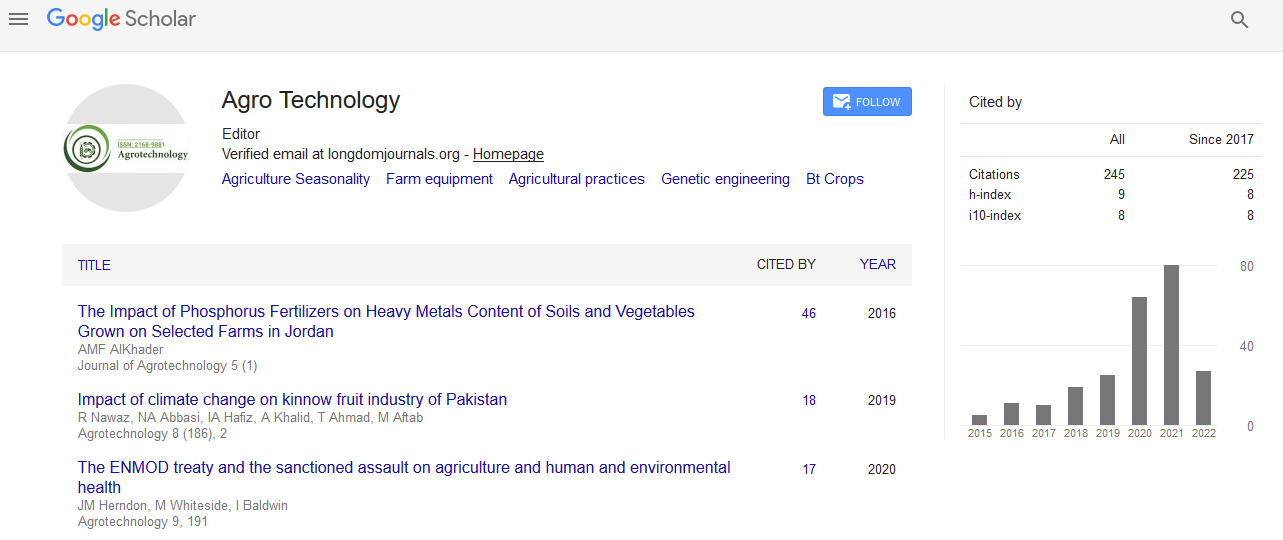
- Google Scholar
Useful Links
Share This Page
Journal Flyer
Open Access Journals
- Agri and Aquaculture
- Biochemistry
- Bioinformatics & Systems Biology
- Business & Management
- Chemistry
- Clinical Sciences
- Engineering
- Food & Nutrition
- General Science
- Genetics & Molecular Biology
- Immunology & Microbiology
- Medical Sciences
- Neuroscience & Psychology
- Nursing & Health Care
- Pharmaceutical Sciences
Commentary - (2025) Volume 14, Issue 2
Genetic and Biological Approaches to Modern Agricultural Production
Temesgen Gill *Received: 30-May-2025 , Manuscript No. AGT-25-32419; Editor assigned: 02-Jun-2025 , Pre QC No. AGT-25-32419 (PQ); Reviewed: 16-Jun-2025 , QC No. AGT-25-32419; Revised: 16-Jun-2026 , Manuscript No. AGT-25-32419 (R); Published: 30-Jun-2025 , DOI: 10.35248/2168-9891.25.14.407
Description
Agricultural biotechnology refers to the use of biological methods and scientific techniques to improve plants, animals, and microorganisms used in farming. Over the past few decades, this field has contributed significantly to food production by increasing crop yields, improving resistance to pests and diseases, and supporting efficient use of natural resources. As the global population continues to grow, agriculture faces increasing pressure to produce more food while reducing environmental impacts. Biotechnology provides practical tools that help address these challenges through scientific innovation and careful application.
Traditional plant breeding has long been used to select desirable traits in crops. Biotechnology expands these possibilities by allowing researchers to identify and transfer specific characteristics more accurately. Techniques such as tissue culture, marker-assisted selection, genetic engineering, and genome editing have become important components of modern agricultural research. These methods help scientists develop crop varieties with improved performance under diverse environmental conditions.
One important application of agricultural biotechnology is the development of crops that can tolerate adverse conditions such as drought, salinity, and temperature extremes. Climate variability affects agricultural productivity in many regions, reducing harvests and threatening food security. Through biotechnology, researchers have developed crop varieties capable of maintaining growth under limited water availability or poor soil conditions. Such improvements can support farming communities in areas where environmental stress limits agricultural output.
Biotechnology has also contributed to pest and disease management. Insects, fungi, bacteria, and viruses cause substantial losses in crop production each year. Conventional control methods often rely heavily on chemical pesticides, which may increase production costs and create environmental concerns. Biotechnology offers alternative approaches by introducing traits that improve a plant’s natural ability to resist specific pests or pathogens. These developments can reduce the need for repeated chemical applications and support more efficient farming practices.
Nutritional enhancement represents another important area of agricultural biotechnology. Scientists have worked to improve the nutrient content of crops by increasing levels of vitamins, minerals, proteins, and other beneficial compounds. Such efforts may help address nutritional deficiencies in regions where diets depend heavily on staple crops. Biofortified crops provide an additional source of essential nutrients and may contribute to improved public health outcomes, particularly in developing countries.
Microorganisms also play an important role in agricultural biotechnology. Beneficial bacteria and fungi support plant growth by improving nutrient availability, enhancing root development, and suppressing harmful organisms. Bio fertilizers and bio pesticides derived from these microorganisms offer alternatives to synthetic agricultural inputs. Their use can improve soil quality and support sustainable farming systems. Research in this area continues to identify microbial species with useful characteristics for crop production.
Agricultural biotechnology also contributes to livestock production. Genetic studies support the selection of animals with improved productivity, disease resistance, and adaptability. Biotechnology-based diagnostic tools help detect animal diseases at an early stage, allowing timely interventions and reducing economic losses. Reproductive technologies, including artificial insemination and embryo transfer, have further improved breeding programs in many livestock systems.
Education and research continue to drive progress in agricultural biotechnology. Universities, research institutions, and agricultural organizations contribute by developing new technologies and training future scientists. Collaboration between public and private sectors supports innovation and facilitates the transfer of scientific knowledge to farming communities. Investment in research infrastructure and technical expertise remains important for advancing this field.
The future of agriculture will depend on a combination of scientific progress, responsible resource management, and practical farming strategies. Agricultural biotechnology provides valuable tools that can contribute to higher productivity, improved crop quality, and better resilience to environmental challenges. While no single approach can address all agricultural issues, biotechnology offers opportunities to complement traditional methods and support long-term food production goals.
Conclusion
As global demand for food, feed, and renewable resources continues to increase, the role of agricultural biotechnology is likely to expand further. Continued research, responsible application, and cooperation among stakeholders will shape how these technologies contribute to agriculture in the coming decades. By integrating scientific knowledge with practical farming needs, agricultural biotechnology can support productive and environmentally conscious agricultural systems that benefit both present and future generations.
Citation: Gill T (2025) Agricultural Biotechnology and Its Role in Building Efficient Crop Production Systems. Agrotechnology. 14:407.
Copyright: © 2025 Gill T. This is an open access article distributed under the terms of the Creative Commons Attribution License, which permits unrestricted use, distribution, and reproduction in any medium, provided the original author and source are credited.