
Indexed In
- Academic Journals Database
- Open J Gate
- Genamics JournalSeek
- JournalTOCs
- China National Knowledge Infrastructure (CNKI)
- Scimago
- Ulrich's Periodicals Directory
- RefSeek
- Hamdard University
- EBSCO A-Z
- OCLC- WorldCat
- Publons
- MIAR
- University Grants Commission
- Geneva Foundation for Medical Education and Research
- Euro Pub
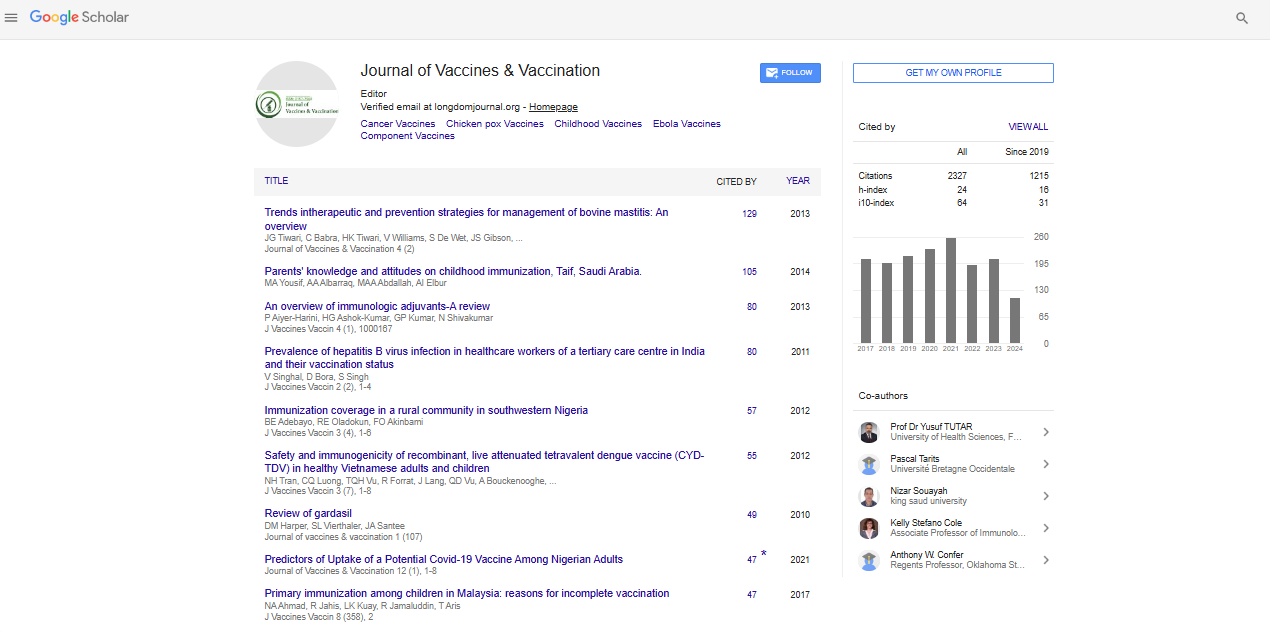
- Google Scholar
Useful Links
Share This Page
Open Access Journals
- Agri and Aquaculture
- Biochemistry
- Bioinformatics & Systems Biology
- Business & Management
- Chemistry
- Clinical Sciences
- Engineering
- Food & Nutrition
- General Science
- Genetics & Molecular Biology
- Immunology & Microbiology
- Medical Sciences
- Neuroscience & Psychology
- Nursing & Health Care
- Pharmaceutical Sciences
Short Communication - (2025) Volume 16, Issue 8
Factors Influencing Vaccine Immunogenicity and Their Role in Protective Immune Responses
Sen Marin*Received: 30-Jul-2025, Manuscript No. JVV-25-31758; Editor assigned: 01-Aug-2025, Pre QC No. JVV-25-31758 (PQ); Reviewed: 19-Aug-2025, QC No. JVV-25-31758; Revised: 22-Aug-2025, Manuscript No. JVV-25-31758 (R); Published: 29-Aug-2025, DOI: 10.35248/2157-7560.25.16.617
Description
Vaccine immunogenicity refers to the capacity of a vaccine to stimulate an immune response that can recognize and respond to a specific infectious agent. The quality and intensity of this response determine how effectively the vaccinated individual develops protection against future exposure. Immunogenicity is one of the primary considerations during vaccine development because it influences both short-term and long-term effectiveness. Scientists assess immunogenicity through measurements such as antibody production, activation of immune cells, memory cell formation, and the duration of protective responses following vaccination.
The immune system consists of interconnected cellular and molecular components that work together to identify foreign substances. When a vaccine is administered, it introduces antigens or genetic material encoding antigens into the body. These components are detected by antigen-presenting cells, which process the material and communicate with lymphocytes. This interaction initiates a sequence of events that leads to antibody production and cellular immune activity. The objective is to prepare the immune system to respond rapidly if the actual pathogen enters the body at a later time.
Different vaccine platforms generate varying levels of immunogenicity. Live attenuated vaccines contain weakened forms of microorganisms that can replicate to a limited extent without causing disease in healthy individuals. Because they closely resemble natural infection, they often induce strong and durable immune responses. Inactivated vaccines contain killed pathogens and generally require multiple doses or booster injections to maintain adequate immunity. Protein subunit vaccines use selected components of pathogens, reducing adverse reactions while focusing immune responses on specific targets. Viral vector vaccines and messenger ribonucleic acid vaccines use advanced biological methods to deliver genetic instructions that enable cells to produce antigenic proteins temporarily, leading to immune activation.
The characteristics of the antigen itself play a major role in immunogenicity. Some antigens naturally provoke stronger immune responses because they are readily recognized by immune cells. Molecular structure, size, stability, and accessibility influence how efficiently immune mechanisms identify and process vaccine components. Antigens with greater visibility to immune surveillance systems are more likely to induce substantial antibody and cellular responses.
Age is another important factor affecting vaccine immunogenicity. Infants and older adults often exhibit different immune responses compared with healthy younger adults. In newborns, the immune system is still developing, which can influence the magnitude of vaccine-induced protection. In older individuals, age-related changes in immune function may reduce responsiveness to vaccination. As a result, vaccine schedules and formulations are frequently adjusted to accommodate the biological characteristics of different age groups.
Genetic variation among individuals can also contribute to differences in vaccine responses. Certain genetic traits affect immune cell receptors, cytokine production, and antigen presentation pathways. These differences may influence how effectively an individual develops antibodies or cellular immunity following vaccination. Research examining genetic influences on immunogenicity continues to provide valuable information that may improve future vaccine design and evaluation.
Nutritional status has a significant relationship with immune competence. Adequate intake of vitamins, minerals, proteins, and other nutrients supports normal immune activity. Deficiencies in essential nutrients may reduce the body's capacity to generate optimal responses after vaccination. Public health programs often recognize the connection between nutrition and immunization outcomes, particularly in populations where dietary inadequacies are common.
Conclusion
Vaccine immunogenicity remains a central concept in preventive medicine and infectious disease control. The ability of a vaccine to stimulate appropriate immune responses determines its value in reducing illness, limiting transmission, and protecting communities. Numerous factors, including antigen design, vaccine platform, age, genetics, nutrition, administration route, adjuvant selection, and health status, contribute to the final immune outcome. Continued research in this field supports the development of vaccines capable of addressing existing diseases as well as emerging infectious threats.
References
- Zhuo K, Mou M, Li J, Huang S, Zeng Z, Li X, et al. Synergistic whole-cell Cancer vaccine combining immunogenic cell death and TLR9 agonist elicits potent prophylactic and therapeutic antitumor immunity. Int Immunopharmacol.2026;171:116152.
- Fouda GG, Singh A, Nelson A, Janes H, Martin T, Levy O, et al. Integration of Preclinical and Clinical Vaccine Safety and Immunogenicity Testing for Development of a Pediatric HIV Vaccine to Achieve Protective HIV Immunity Prior to Adolescence. Curr HIV Res. 2025.
[Crossref] [Google scholar] [Pubmed]
- Mukherjee A, Das S, Mandal S, Roy N, Sultana S, Mishra D, et al. Safety, immunogenicity and preliminary protective efficacy of a bivalent bacterial ghost vaccine against typhoid Salmonella in rabbits: a pilot study. Vaccine. 2026;72:128126.
- Dudášová J, Valenta Z, MÄ?gÄ?lie A, Nieddu GT, Sachs JR. Annual immunogenicity measurements in randomized clinical trials help reveal heterogeneity in long-term vaccine efficacy: a pooled logistic regression modelling study. Vaccine. 2026;78:128326.
- Gromer DJ, Kalash S, Tanios R, Rouphael N. The relationship between the immunogenicity and reactogenicity of vaccines: A narrative review. Vaccine. 2025;68:127892.
- Min HS, Jang E, Lee Y, min Cho S, Nam J, Lee S, et al. Hyaluronic acid–based dissolving microneedles regulate antigen release and route-dependent immunogenicity of adenovirus-based vaccines. Carbohydr Polym. 2026;380:125118.
- Bekele DA, Jima NT, Garoma A, Edao BM, Paeshuyse J. A multimodal evaluation of immunogenicity and field performance of infectious bursal disease vaccines in Ethiopian broilers. Poult.Sci.2026:107103.
- Ciabattini A, Pettini E, Fiorino F, Polvere J, Lucchesi S, Coppola C, et al. Longitudinal immunogenicity cohort study of SARS-CoV-2 mRNA vaccines across individuals with different immunocompromising conditions: heterogeneity in the immune response and crucial role of Omicron-adapted booster doses. EBioMedicine. 2025;113.
- Rawal P, Adhikari S, Kandel SP, Bhatta NP, Khanal S, Adhikari A, et al. Comparison of the safety and immunogenicity of commercial lento genic Newcastle disease vaccine strains in layer chicks in Nepal. Journal of Applied Poultry Research. 2025:100657.
- Suschak JJ, Fitzpatrick CJ, Shoemaker CJ, Shamblin JD, White LE, Cline CR, et al. CCHFV-M based DNA vaccine is highly immunogenic in multiple species and protects against challenge in cynomolgus macaques. Antiviral Res. 2025:106282.
[Crossref] [Google scholar] [Pubmed]
Citation: Marin S (2025) Factors Influencing Vaccine Immunogenicity and Their Role in Protective Immune Responses. J Vaccines Vaccin. 16:617.
Copyright: © 2025 Marin S. This is an open access article distributed under the terms of the Creative Commons Attribution License, which permits unrestricted use, distribution and reproduction in any medium, provided the original author and source are credited.