
Indexed In
- Academic Journals Database
- Open J Gate
- Genamics JournalSeek
- JournalTOCs
- China National Knowledge Infrastructure (CNKI)
- Scimago
- Ulrich's Periodicals Directory
- RefSeek
- Hamdard University
- EBSCO A-Z
- OCLC- WorldCat
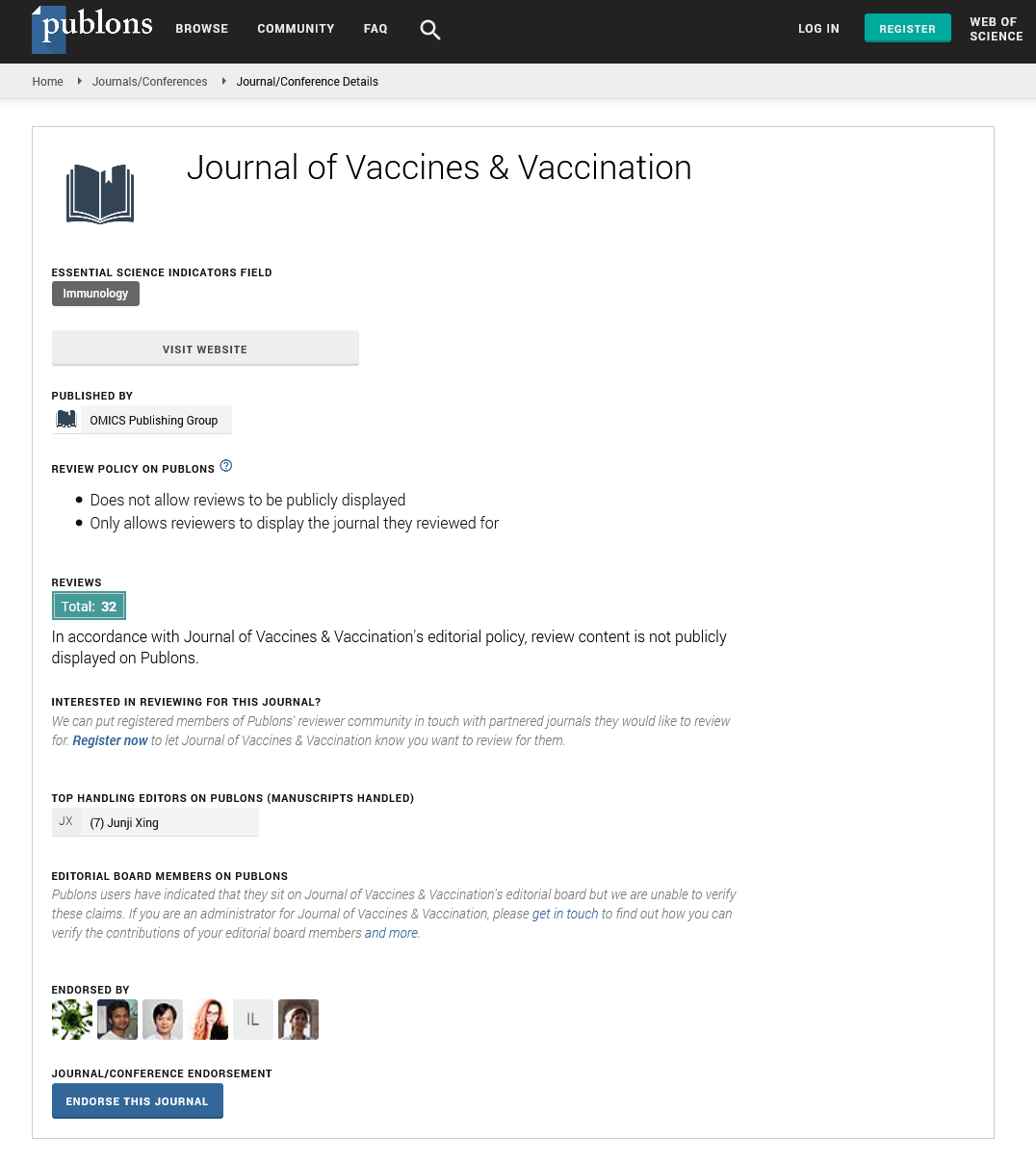
- Publons
- MIAR
- University Grants Commission
- Geneva Foundation for Medical Education and Research
- Euro Pub
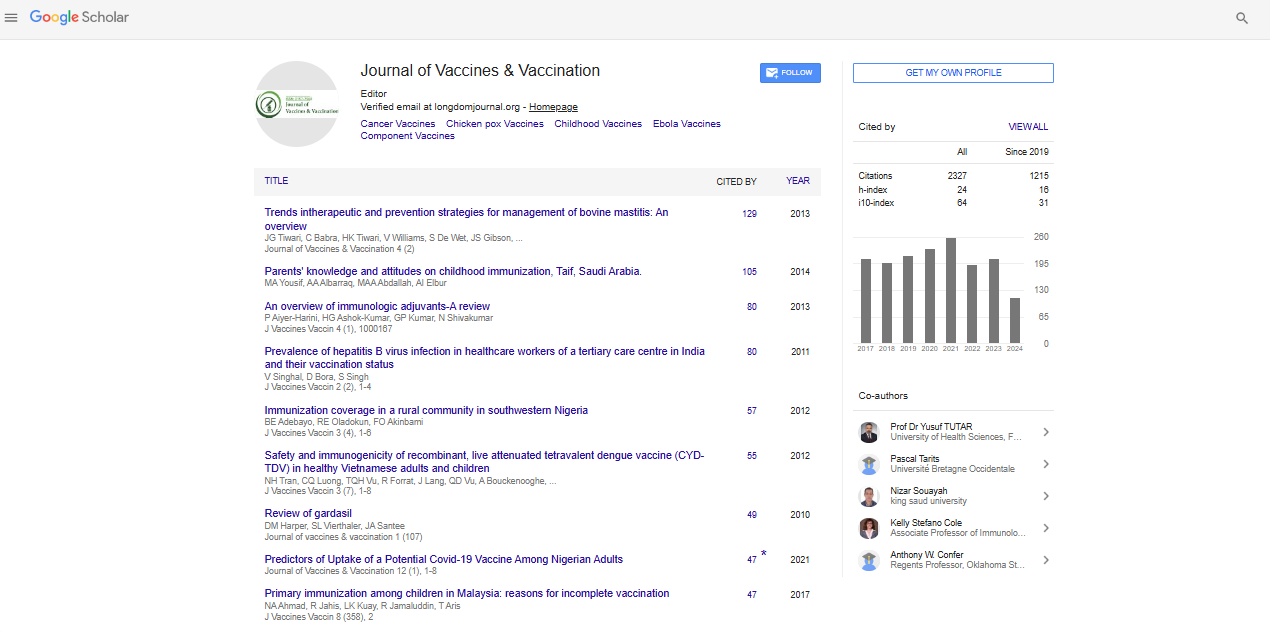
- Google Scholar
Useful Links
Share This Page
Open Access Journals
- Agri and Aquaculture
- Biochemistry
- Bioinformatics & Systems Biology
- Business & Management
- Chemistry
- Clinical Sciences
- Engineering
- Food & Nutrition
- General Science
- Genetics & Molecular Biology
- Immunology & Microbiology
- Medical Sciences
- Neuroscience & Psychology
- Nursing & Health Care
- Pharmaceutical Sciences
Short Communication - (2025) Volume 16, Issue 4
Exploring the Multifaceted Role of Vaccine Adjuvants in Enhancing Global Immunization Strategies
Laura Thompson*Received: 01-Apr-2025, Manuscript No. JVV-25-30310; Editor assigned: 03-Apr-2025, Pre QC No. JVV-25-30310; Reviewed: 17-Apr-2025, QC No. JVV-25-30310; Revised: 24-Apr-2025, Manuscript No. JVV-25-30310; Published: 01-May-2025, DOI: 10.35248/2157-7560.25.16.597
Description
Vaccine adjuvants represent one of the most significant innovations in modern immunology, serving as critical components that enhance the efficacy and longevity of immune responses induced by vaccines. They are substances formulated with vaccine antigens to improve the body’s immunological reaction, ensuring better protection against infectious diseases. Since the discovery of aluminum salts as the first adjuvant in the 1920s, research on vaccine adjuvants has evolved remarkably, integrating biochemical, immunological and molecular biology approaches to create more effective and safer vaccines. The importance of adjuvants has been particularly highlighted during global health crises, where rapid and potent immune activation has been necessary to combat emergent pathogens. The role of adjuvants extends beyond simple enhancement of antibody production. They contribute to shaping the quality of the immune response, directing it toward specific pathways such as humoral or cell-mediated immunity. By influencing antigen presentation and cytokine release, adjuvants enable vaccines to generate a stronger and more durable immune memory. This is particularly crucial for subunit and recombinant vaccines, which contain purified antigens that may otherwise be weakly immunogenic. The strategic inclusion of adjuvants ensures that even minimal antigen quantities can trigger a robust defense, thereby improving vaccine accessibility and affordability across low-resource settings [1,2].
Among the various adjuvant types, aluminum-based compounds, collectively referred to as alum, remain the most widely used in licensed vaccines. Alum primarily functions by creating a depot effect at the injection site, allowing for slow antigen release and prolonged exposure to the immune system [3]. However, newer adjuvants such as squalene-based oil-in-water emulsions like MF59 and AS03 have demonstrated the ability to recruit immune cells and stimulate stronger innate responses. These modern adjuvants have been used successfully in influenza vaccines and have paved the way for innovative designs in nextgeneration immunizations. Additionally, Toll-Like Receptor (TLR) agonists, including CpG oligodeoxynucleotides, represent a frontier in adjuvant development due to their capacity to mimic pathogen-associated molecular patterns, thereby effectively priming the innate immune system [4].
The development of adjuvants has also expanded to address specific population needs. Elderly individuals, who often exhibit immune senescence, benefit from vaccines containing potent adjuvants that compensate for reduced immune responsiveness. Similarly, in pediatric immunization, adjuvants enable lower antigen doses while maintaining protection, minimizing potential side effects [5]. This tailoring of adjuvant use underscores the importance of personalized immunization strategies that take into account age, genetic background and regional disease prevalence. Furthermore, the rise of mRNA vaccines during the COVID-19 pandemic has revived interest in adjuvant research, as scientists explore lipid nanoparticles and novel immune modulators that enhance the stability and delivery of genetic material to target cells [6].
Safety remains a central consideration in adjuvant design and approval. While the inclusion of adjuvants can significantly enhance vaccine efficacy, their potential to induce local inflammation or systemic side effects necessitates rigorous evaluation. Modern analytical techniques and clinical trials have ensured that approved adjuvants meet strict safety and biocompatibility standards. Regulatory agencies such as the World Health Organization (WHO) and national health authorities collaborate closely with researchers to assess risk-benefit profiles, promoting transparency and public confidence in vaccination programs [7].
Beyond traditional infectious diseases, adjuvants have found applications in therapeutic vaccines targeting cancer and chronic infections. In cancer immunotherapy, adjuvants help activate cytotoxic T cells that recognize and destroy tumor cells. Formulations combining tumor antigens with potent immunestimulating molecules have shown promise in preclinical and clinical trials, offering hope for vaccines that can prevent or treat malignancies. Similarly, in diseases such as hepatitis C, HIV and malaria, where immune evasion by pathogens complicates vaccine development, adjuvants are being explored as tools to amplify weak immune responses and break immune tolerance [8,9].
The global perspective on adjuvant research highlights the importance of international collaboration. Countries with advanced biotechnology sectors contribute to the discovery of novel compounds and delivery systems, while regions facing endemic diseases provide real-world testing grounds for vaccine efficacy. The equitable distribution of adjuvant technology ensures that vaccines can be optimized for diverse populations, addressing not only scientific but also ethical and logistical challenges [10].
Conclusion
In the coming years, the integration of systems biology, nanotechnology and bioinformatics will likely revolutionize adjuvant design. Predictive modeling and artificial intelligence can help identify optimal adjuvant-antigen combinations, accelerating the development of vaccines for emerging diseases. As humanity continues to face evolving microbial threats, the advancement of vaccine adjuvant research stands as a beacon of scientific progress, ensuring that future immunization strategies are not only effective but also inclusive and adaptable. Vaccine adjuvants thus embody the synergy between molecular innovation and global health, safeguarding communities through science-driven resilience.
References
- Greenwood B. The contribution of vaccination to global health: past, present and future. Biol Sci. 2014;369(1645):20130433.
[Crossref] [Google Scholar] [PubMed]
- Orenstein WA, Ahmed R. Simply put: Vaccination saves lives. Proc Natl Acad Sci. 2017;114(16):4031-3.
[Crossref] [Google Scholar] [PubMed]
- Rerks-Ngarm S, Pitisuttithum P, Nitayaphan S, etâ?¯al. Vaccination with ALVAC and AIDSVAX to prevent HIVâ??1 infection in Thailand. N Engl J Med. 2009;361(23):2209-2220.
[Crossref] [Google Scholar] [PubMed]
- Kim JH, Excler JL, Michael NL. Lessons from the RV144 Thai Phaseâ?¯III HIVâ??1 vaccine trial and the search for correlates of protection. Annu Rev Med. 2015;66:423–437.
[Crossref] [Google Scholar] [PubMed]
- Sadanand S, Suscovich TJ, Alter G. Broadly neutralizing antibodies against HIV: new insights to inform vaccine design. Annu Rev Med. 2016;67:185-200.
[Crossref] [Google Scholar] [PubMed]
- Ahmad M, Ahmed OM, Schnepp B, Johnson PR. Engineered expression of broadly neutralizing antibodies against human immunodeficiency virus. Annu Rev Virol. 2017;4:491-510.
[Crossref] [Google Scholar] [PubMed]
- McCoy LE, Burton DR. Identification and specificity of broadly neutralizing antibodies against HIV. Immunol Rev. 2017;275:11–20.
[Crossref] [Google Scholar] [PubMed]
- Gilbert PB, Juraska M, deCamp AC. Immuneâ??correlates analysis of an HIVâ??1 vaccine efficacy trial. N Engl J Med. 2012;366(14):1275-1286.
[Crossref] [Google Scholar] [PubMed]
- Kim H, Haynes BF. Broadly neutralizing macaque monoclonal antibody against the HIVâ??1 V3â??glycan patch. eLife. 2020;9:e61991.
[Crossref] [Google Scholar] [PubMed]
- Gaudinski MR, Houser KV, Doriaâ??Rose NA. Safety and pharmacokinetics of broadly neutralizing human monoclonal antibody VRC07â??623LS in healthy adults. Lancet HIV. 2019;6(10):e667-e679.
[Crossref] [Google Scholar] [PubMed]
Citation: Thompson L (2025) Exploring the Multifaceted Role of Vaccine Adjuvants in Enhancing Global Immunization Strategies. J Vaccines Vaccin. 16:597.
Copyright: © 2025 Thompson L. This is an open access article distributed under the terms of the Creative Commons Attribution License, which permits unrestricted use, distribution and reproduction in any medium, provided the original author and source are credited.