

Indexed In
- Open J Gate
- Genamics JournalSeek
- Academic Keys
- JournalTOCs
- CiteFactor
- Ulrich's Periodicals Directory
- Access to Global Online Research in Agriculture (AGORA)
- Electronic Journals Library
- Centre for Agriculture and Biosciences International (CABI)
- RefSeek
- Directory of Research Journal Indexing (DRJI)
- Hamdard University
- EBSCO A-Z
- OCLC- WorldCat
- Scholarsteer
- SWB online catalog
- Virtual Library of Biology (vifabio)
- Publons
- Geneva Foundation for Medical Education and Research
- Euro Pub
- Google Scholar
Useful Links
Share This Page
Journal Flyer

Open Access Journals
- Agri and Aquaculture
- Biochemistry
- Bioinformatics & Systems Biology
- Business & Management
- Chemistry
- Clinical Sciences
- Engineering
- Food & Nutrition
- General Science
- Genetics & Molecular Biology
- Immunology & Microbiology
- Medical Sciences
- Neuroscience & Psychology
- Nursing & Health Care
- Pharmaceutical Sciences
Research Article - (2025) Volume 15, Issue 3
Evaluation of AKU-PLUS insecticide against Tomato Leaf Miner, Tuta absoluta (Meyrick) (Gelechiidae: Lepidoptera)
Received: 22-Sep-2024, Manuscript No. JPPM-24-26978; Editor assigned: 24-Sep-2024, Pre QC No. JPPM-24-26978 (PQ); Reviewed: 08-Oct-2025, QC No. JPPM-24-26978; Revised: 15-Jun-2025, Manuscript No. JPPM-24-26978 (R); Published: 22-Jun-2025
Abstract
Tuta absoluta is a serious major economic pest of tomato all over the world which can cause up to 100% yield loss in uncontrolled situation. In study areas Tuta absoluta seriously constrained tomato fruit yield during growing periods. Field experiment was conducted to verify the effectiveness of the AKU-PLUS insecticide (Emamectin benzoate 5% +Lufenuron 12% WDG) relative to another promising standard insecticide, Focus 5% EC (Lambda-cyhalothrin 5% EC), for the management of tomato leaf miner. The experiment was conducted at around Wolaita zone in two districts (Humbo and Kokate) in Southern Ethiopia on farmers’ field in a Randomized Complete Block Design (RCBD) with five replications during 2023 cropping season. Evidence obtained from the verification trial showed that AKU-PLUS (Emamectin benzoate 5%+Lufenuron 12%) at the rate of 200 g/ha with 400 liter of water acted significantly in reducing the infestation of Tuta absoluta larva per plant and consequently increased fruit yield of tomato as compared to the standard check (Focus 5% EC) and unsprayed checks in both locations. Moreover, AKUPLUS was found to be effective and showed a long-lasting effect by controlling and minimizing Tuta absoluta larva per plant when compared with Focus 5% EC on both locations at two application rounds. During the growing periods, no foliar toxic effect was observed from the effect of any tested insecticides. The result also exhibited that plots sprayed with AKU-PLUS showed highest percent efficacy and lowest Tuta absoluta larva population as compared to the Focus 5% EC and unsprayed checks though statistically significant (p<0.05) difference. However, it needs further investigation for the interval and frequency.
Keywords
Tomato; Verification; Tuta absoluta; Insecticides; Efficacy
Introduction
Tomato is often regarded as one of the world's most significant vegetable crops. It is a fruit producing annually cultivated vegetable fruit crop under the family of Solanaceae. It is native to Western South America and use as a nutritious edible fruit throughout the planet that is grown in both greenhouse and field conditions. Tomato is an important vegetables crop of Ethiopia. It is widely used in salad as well as for the culinary purposes. The popularity of tomato and its products continue to rise as it contains a significant source of vitamins A, B and C. Tomato is rich in nutrients such as vitamins, minerals and antioxidants, which are important to well-balanced human diets. Tomato is also an important dietary component because it contains high level of lycopene, an antioxidant that reduces the risks associated with several cancers and neurodegenerative diseases. Tomato is devastating by an array of pests; however, the major damage is caused by the tomato leaf miner, Tuta absoluta Meyrick. The larvae of this insect pest reduce tomato yield 80 to 100% fruits were found to be damaged by this insect. In very recent year, in Ethiopia T. absoluta is one of the most important and serious pests of tomatoes. Not only has its intensity of attack made the pest the most devastating but also to its occurrence during all crop cycle. Frequently the tomato leaf miner, T. absoluta attack it in sufficient numbers to cause damage each year that feed on the leaves and fruits of this plant. It is an invasive pest causing severe loss for tomato production in many countries either in open field or green houses. If no control measures are taken, then the pest can cause up to 80-100% yield losses by attacking leaves, flowers, stems and especially fruits. T. absoluta introduction in Ethiopia is rather recent but became one of the major pests of tomato crop in Ethiopia. Its first report is recorded in the Eastern Shawa of Rift valley, Ethiopia in 2012 and then distributed to most parts of the country. Chemical insecticide control has been the first strategy adopted in the newly invaded areas. In the case of T. absoluta, the need for alternative control methods is strengthened by the development of resistance to insecticides by the pest as well as the side effects of pesticides on beneficial arthropods and insecticide control against T. absoluta has been developed and widely applied in different countries such as several South American, Asia and Africa including Ethiopia, using the new active ingredient which is likely to be the core of the Integrated Pest Management (IPM) programme. Many of chemical pesticides are used to control Tuta but many of do not show effective result. Pests are developing resistance against pesticides. Braham and Hajji reported that T. absoluta developed resistance against pesticides, like Abamectin, Cartap, Methamidophos and Permethrin in Brazil and against Deltamethrin and Abamectin in Argentina [1].
Thus, pests are developing resistance against pesticides in many areas of the world; there is a need for alternative and effective insecticide through the introduction of a new insecticide or different formulations of the existing insecticides with the same active ingredient that may continue to be introduced by the pesticide companies. To increase the availability of effective insecticide for the growers, the efficacy of the newly introduce insecticide on Tuta absoluta should be regularly tested and verified before introducing to the farming community. The efficacy of insecticide is highly influenced by environmental factors, insect population load, application time, and rates of insecticide. Therefore, evaluation of the insecticide across the locations is greatly important to get an insight into the effects of the insecticide. Based on the above background, Areka Agricultural Research Center has been designated by the Ministry of Agriculture through Southern Agricultural Research Institute to test the efficacy of the new insecticide, AKU-PLUS, against Tuta absoluta during the 2023 cropping season in two locations, Humbo (Ella-Kaballa) and Kokate sites of Wolaita Zone. Therefore, the objective of the verification trial was to evaluate the efficacy of the insecticide AKU-PLUS (Emamectin benzoate 5%+Lufenuron 12% WDG) relative to another promising standard insecticide, Focus 5% EC (Lambdacyhalothrin 5% EC), for the control of Tuta absoluta in tomato production for registration purpose [2].
Materials and Methods
Descriptions of the study area
The verification trial was conducted during the 2023 main cropping season in an open environment to convince the objectives of the current verification trial around Wolaita Sodo in two locations (Humbo (Ella-kaballa) and Kokate areas) in Southern Ethiopia. The two experimental sites are geographically located at 06° 85’ 28’’ N and 037° 76’ 10’’ E (at Kokate), and 06° 44’ 0’’ N and 037° 45’ 0’’ E (at Humbo (Ellakaballa). The sites are found at an elevation of 2156 (at Kokate) and 1440 (Ella-kaballa) meters above sea level. Bimodal rainfall pattern is the major characteristics of the study area, short rainy season (March and April), and the main rainy season (mid- August to mid-November). Thus, Humbo (Ella-kaballa areas receive a total annual rainfall and average temperatures during the 2020 cropping season were 152.44 mm and 20.65°C, respectively [3]. That of Kokate district receives average annual rainfall is 1200-1300 mm and mean monthly temperatures varies from 11-26°C. The soils are sandy-loam with a pH of 5.2.
Treatments, design of experiment and trial management
The trial was conducted in an open environment to assure the insect pest destiny as well as to increase the natural prevalence at the starting of the experiment. The areas are known for intended pest. The total width and length of the layout were designed at 34 × 33 m with a unit plot size of 10 × 10 m, respectively. Plots were spaced at each other by 1.5 m and blocks separated by a safeguard path of 2 m to prevent the drifts or cross-contamination. The experiment was layout in a randomized complete block design with three replications. The tomato variety, Roma VF, was used as a test crop. The tomato seedlings were transplanted on 18 August 2023 at a 10 cm interval along the rows. Urea (46% N) and NPS blended (19% N: 38% P205: 7% S) fertilizers with recommended rates (100 kg urea and 200 kg NPS) were used as the sources of Nitrogen and Phosphorus, respectively [4]. All other cultural operations like nursery raising, main field preparation, transplanting, weeding, plant protection etc. were carried out as per the recommendations in order to obtain a successful crop. A total of three treatments, including control, were comprised during the study. Insecticides such as AKU-PLUS (Emamectin benzoate 5% +Lufenuron 12%) at the rate of 200g/ha with 400 liter of water (Candidate insecticide), Focus 5% EC, at the rate of 400 ml/ha with 250 L water (Standard check), and unsprayed check were used. For the candidate insecticide, the use of the rate of insecticide per hectare and amount of water for mixing of insecticide was performed as suggested by the manufacturer. Two-time spray frequency was practiced per location. As suggested by Shiberu and Getu, when the T. absoluta population reaches 2-3 larvae per plant the first insecticide application was performed. The second insecticide application was practiced 14- days after the first application. Unsprayed plots were left for each replication as controls to allow maximum insect infestation.
Data collection
Data were collected from 12 randomly selected plants per plot before first spray and 6th and 12th day after each successive spray. Observations and data collection were made after 6th and 12th days after each spray. Data on average number of larva per plant (fruits and leaves) and marketable fruit yield data were taken.
Data analysis
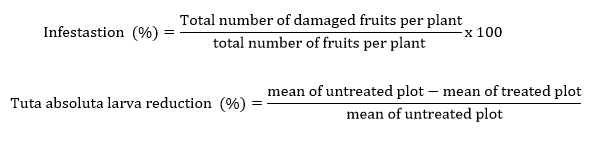
Tuta absoluta assessment data taken from randomly selected plants within the central rows mean values were used for data analysis. The treatment means were separated using the Fishers protected Least Significance Difference (LSD) test at 5% probability level [5]. The data analyses were conducted using the general linear model procedure of the SAS software version 9.2. The efficacy of the insecticide was determined following the formula suggested by Shiberu and Negeri as follows
Results and Discussion
Effect of AKU-PLUS insecticide on Tuta absoluta larva per plant and fruit yield of Tomato
The data regarding Tuta absoluta larva per plant and marketable fruit yield of tomato were affected by first and second applications of AKU-PLUS and Focus 5% EC in both locations are shown in Tables 1 and 2. No statistically significant (p>0.05) difference was observed on the pre-spray count of Tuta absoluta larva per plant in both the first applications of the two insecticides including untreated control in both locations. However, after spray all treatments were significantly different (P<0.05) from each other at both trial sites. That means insecticide treated plots were significantly different from the untreated control even though there was significant difference in effectiveness between candidate and standard check insecticides. After treatment the lowest Tuta absoluta larva per plant were recorded on AKU-PLUS and Focus 5% EC as compared to the unsprayed after 6 days and 12 days of the application in both locations. However, application of AKUPLUS
AKUPLUS and Focus 5% EC on Tuta absoluta larva showed no statistically significant difference in the mean Tuta absoluta larva per plant at 6 days of the treatment application on both sites as well as application rounds even though AKU-PLUS has highest larval reduction percentage (100, 99.8) when compared with Focus 5% EC (89.8, 91.6) but it showed statistically significant (p<0.05) difference after 12 days of treatment application in both locations. This indicates that effectiveness of these insecticides varied with time intervals (Tables 1 and 2). The long-lasting and durable effect was observed on AKU-PLUS as compared to Focus 5% EC especially after 12 days of application. Comparatively, AKU-PLUS was found to be effective and showed a long-lasting effect by controlling and minimizing Tuta absoluta larva per plant when compared with Focus 5% EC on both locations at two application rounds [6,7]. On unsprayed plots, Tuta absoluta larva per plant were progressively increased and consequently resulted in the highest Tuta absoluta larva per plant during the growing period in both locations (Tables 1 and 2).
On the other hand, marketable fruit yield of tomato significantly (P<0.05) different from each other in three treatments at both locations. At Ella-kaballa and Kokate sites highest grain yields were recorded on plots sprayed with AKUPLUS with (37.5 tone/ha, 35.8 tone/ha) while the lowest grain yields were recorded from the unsprayed control plot (6.5 tone/ha, 4.3 tone/ha) respectively [8]. The grain yield was highly affected by number of Tuta absoluta larva found in tomato plant. At Ella-kaballa and Kokate sites the results of the experiment revealed that the treatments with high Tuta absoluta larva/plant had minimum grain yield (6.5 tone/ha, 4.3); whereas the treatments with maximum protection (AKU-PLUS) give higher grain yield (37.5 tone/ha, 35.8 tone/ha) followed by Focus 5% EC (28.9, 26.9) (Tables 1 and 2) respectively [9].
| Treatment | Ella-kaballa | Kokate | ||||||
| AV. no larva before spray | AV. no larva 6 days AS | AV. no larva 12 days AS | Reduction (%) 12 days AS | AV. no larva before spray | AV. no larva 6 days AS | AV. no larva 12 days AS | Reduction (%) 12 days AS | |
| AKU-PLUS | 20.3a | 4.6b | 2.2c | 93.2 | 21.3a | 4.3b | 2.3c | 93.5 |
| Focus 5% EC | 21.1a | 5.1b | 3.3b | 89.8 | 19.9a | 5.4b | 3.0b | 91.6 |
| Unsprayed | 19.9a | 25.3a | 32.2a | 0 | 21a | 26.8a | 35.7a | 0 |
| LSD (5%) | 4.56 | 1.7 | 0.8 | - | 7.6 | 10.4 | 0.61 | - |
| CV (%) | 12.4 | 16.2 | 5.8 | - | 14.5 | 12.5 | 5.35 | - |
| Note: Means in the same column followed by the same letters are not significantly different at 5% level of significance; AS: After Spray; AV. No: Average number of larva; CV: Coefficients of Variation (%); and LSD: Least Significant Difference at p<0.05 probability level. | ||||||||
Table 1: Effect of AKU-PLUS on Tuta absoluta larva per plant (before and after spray) at first application, Wolaita in two locations during 2023 main cropping season.
| Treatment | Ella-kaballa | Kokate | ||||||||
| AV. no larva before spray | AV. no larva 6 days AS | AV. no larva 12 days AS | Reduction (%) 12 days AS | MFY (t /ha) | AV. no larva before spray | AV. no larva 6 days AS | AV. no larva 12 days AS | Reduction (%) 12 days AS | MFY (t /ha) | |
| AKU-PLUS | 4.8b | 1.8b | 0.00c | 100 | 37.5a | 4.3b | 1.6b | 0.05c | 99.8 | 35.8a |
| Focus 5% EC | 4.9b | 1.6b | 1.3b | 96.6 | 28.9b | 4b | 1.63b | 0.9b | 95.6 | 26.9b |
| Unsprayed | 36.2a | 38.5a | 38.3a | 0 | 6.5c | 37.2a | 38.8a | 42.3a | 0 | 4.3c |
| LSD (5%) | 0.8 | 4.5 | 0.5 | - | 5.4 | 1.4 | 1.92 | 0.5 | - | 4.7 |
| CV (%) | 5.8 | 11.7 | 11.4 | - | 21.4 | 11.8 | 13.2 | 13.4 | - | 19 |
| Note: Means in the same column followed by the same letters are not significantly different at 5% level of significance; AS: After Spray; AV. No: Average number of larva; CV: Coefficients of Variation (%); and LSD: Least Significant Difference at p<0.05 probability level. | ||||||||||
Table 2: Effect of AKU-PLUS on Tuta absoluta larva per plant (before and after spray) at second application, Wolaita in two locations during 2023 main cropping season.
Conclusions
Tuta absoluta is a serious major economic pest of tomato all over the world which can cause up to 100% yield loss in uncontrolled situation. It has created a serious urge for immediate control of the pest in order to reduce the loss of tomato production. In study areas Tuta absoluta seriously constrained tomato fruit yield during growing periods.
Evidence obtained from the verification trial showed that AKUPLUS (Emamectin benzoate 5%+Lufenuron 12%) at the rate of 200 g/ha with 400 liter of water acted significantly in reducing the infestation of Tuta absoluta larva per plant and consequently increased fruit yield of tomato as compared to the standard check (Focus 5% EC) and unsprayed checks in both locations. The result of this verification study also exhibited plots sprayed with AKU-PLUS (the new insecticide) showed highest percent efficacy and lowest Tuta absoluta larva population as compared to the Focus 5% EC and unsprayed checks though statistically significant (p<0.05) difference. AKU-PLUS insecticides effectiveness varied with time intervals when compared with Focus 5% EC. Comparatively, AKU-PLUS was found to be effective and showed a long-lasting effect by controlling and minimizing Tuta absoluta larva per plant when compared with Focus 5% EC on both locations at two application rounds. During the growing periods, no foliar toxic effect was observed from the effect of any tested insecticides. Generally, results showed that AKU-PLUS (Emamectin benzoate 5%+Lufenuron 12%) foliar application at the rate of 200 g/ha with 400 liter of water was highly effective in controlling Tuta absoluta pest of tomato. Therefore, it is recommended for registration to the management of leaf miner, Tuta absoluta in tomato production
References
- Arnó J, Gabarra R. Side effects of selected insecticides on the Tuta absoluta (Lepidoptera: Gelechiidae) predators Macrolophus pygmaeus and Nesidiocoris tenuis (Hemiptera: Miridae). J Pest Sci. 2011;84(4):513â??520.
- Baloch FA. Vegetable crops. In: Horticulture. 1994;502â??503.
- Biondi A, Desneux N, Siscaro G, Zappalà L. Using organic certified rather than synthetic pesticides may not be safer for biological control agents: selectivity and side effects of 14 pesticides on the predator Orius laevigatus. Chemosphere. 2012;87(7):803â??812.
[Crossref] [Google Scholar] [PubMed]
- Braham M, Glidaâ??Gnidez H, Hajji L. Management of tomato borer, Tuta absoluta in Tunisia with novel insecticides and plant extracts. EPPO Bull. 2012;42(2):291â??296.
- Cagnotti CL, Viscarret MM, Riquelme MB, Botto EN, Carabajal LZ, Segura DF, et al. Effects of Xâ??rays on Tuta absoluta for use in inherited sterility programmes. J Pest Sci. 2012;85(4):413â??421.
- Gashawbeza A, Abiy F. Occurrence of a new leaf mining and fruit boring moth of tomato, Tuta absoluta (Meyrick) (Lepidoptera: Gelechiidae) in Ethiopia. Pest Management J Ethiopia. 2012;16:57â??61.
- Gashawbeza A, Abiy F. Occurrence of a new leaf mining and fruit boring moth of tomato, Tuta absoluta (Meyrick) (Lepidoptera: Gelechiidae) in Ethiopia. Pest Management J Ethiop. 2013;16:57â??61.
- Gomez KA, Gomez AA. Statistical Procedures for Agricultural Research. 2nd ed. New York: John Wiley & Sons. 1984.
- Gontijo PC, Picanço OMC, Pereira EJG. Spatial and temporal variation in the control failure likelihood of the tomato leaf miner, Tuta absoluta. Ann Appl Biol. 2013;162(1):50â??59.
Citation: Lera ZT (2025) Evaluation of AKU-PLUS Insecticide against Tomato Leaf Miner, Tuta absoluta (Meyrick) (Gelechiidae: Lepidoptera). J Plant Pathol Microbiol. 16:764.
Copyright: © 2025 Lera ZT. This is an open-access article distributed under the terms of the Creative Commons Attribution License, which permits unrestricted use, distribution, and reproduction in any medium, provided the original author and source are credited.