
Indexed In
- Open J Gate
- Genamics JournalSeek
- Academic Keys
- ResearchBible
- Cosmos IF
- Access to Global Online Research in Agriculture (AGORA)
- Electronic Journals Library
- RefSeek
- Directory of Research Journal Indexing (DRJI)
- Hamdard University
- EBSCO A-Z
- OCLC- WorldCat
- Scholarsteer
- SWB online catalog
- Virtual Library of Biology (vifabio)
- Publons
- Geneva Foundation for Medical Education and Research
- Euro Pub
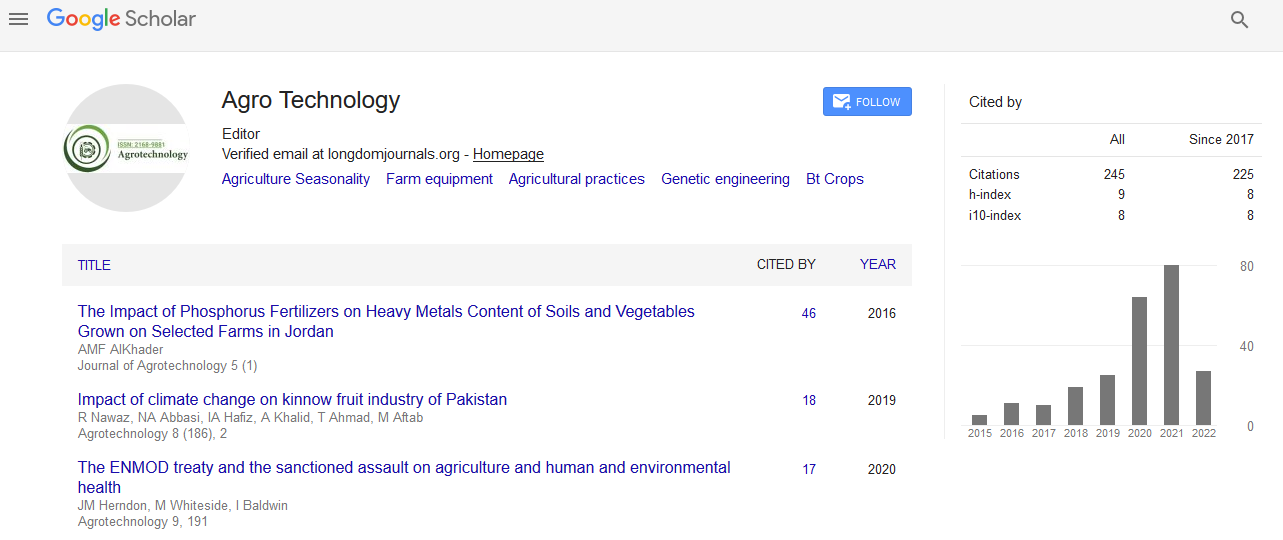
- Google Scholar
Useful Links
Share This Page
Journal Flyer
Open Access Journals
- Agri and Aquaculture
- Biochemistry
- Bioinformatics & Systems Biology
- Business & Management
- Chemistry
- Clinical Sciences
- Engineering
- Food & Nutrition
- General Science
- Genetics & Molecular Biology
- Immunology & Microbiology
- Medical Sciences
- Neuroscience & Psychology
- Nursing & Health Care
- Pharmaceutical Sciences
Commentary - (2026) Volume 15, Issue 1
Ensuring Global Food Security Amid Climate Change Through Adaptive Agricultural Systems and Resilient Food Networks
Alifdalino Rahmah*Received: 25-Feb-2026, Manuscript No. AG-26-31960; Editor assigned: 27-Feb-2026, Pre QC No. AG-26-31960 (PQ); Reviewed: 10-Mar-2026, QC No. AG-26-31960 ; Revised: 17-Mar-2026, Manuscript No. AG-26-31960 (R); Published: 24-Mar-2026, DOI: 10.35248/2168-9881.26.15.414
Abstract
Description
Agriculture has historically focused on maximizing yields through intensive cultivation practices, chemical inputs and mechanization. While these methods have significantly increased food production, they have also contributed to soil degradation, biodiversity loss, water pollution and reduced ecosystem resilience. In response to these challenges. Regenerative Agriculture has emerged as a holistic farming approach aimed at restoring soil health, enhancing biodiversity, improving water cycles and strengthening ecosystem functions while maintaining productive agricultural systems.
Regenerative Agriculture is based on the principle of restoring and improving the natural resources that agriculture depends on, rather than merely sustaining or minimizing harm. Unlike conventional sustainable agriculture, which often focuses on reducing negative impacts, regenerative systems actively seek to rebuild soil organic matter, enhance ecological diversity and improve landscape resilience over time.
Soil health is the central focus of regenerative farming systems. Healthy soils are rich in organic matter, microbial life and nutrients that support plant growth and ecosystem stability. Practices such as reduced tillage, cover cropping, compost application and crop rotation help increase soil organic carbon levels and improve soil structure. These improvements enhance water retention, reduce erosion and increase nutrient availability for crops.
Biodiversity enhancement is another core component of regenerative agriculture. Diverse cropping systems, agroforestry practices and integration of livestock within crop systems contribute to greater ecological balance. Increased biodiversity supports natural pest control, improves pollination and enhances resilience against climate variability and disease outbreaks.
Regenerative grazing practices also play a significant role in restoring degraded landscapes. Managed rotational grazing allows pasture lands to recover while improving soil fertility and carbon sequestration. Livestock integration within regenerative systems contributes to nutrient cycling and improves overall farm productivity when managed appropriately.
Water cycle restoration is a benefit of regenerative agriculture. Improved soil structure and organic matter content increase water infiltration and reduce surface runoff. This leads to better drought resilience and reduced flooding risks. Healthy soils act as natural water reservoirs, supporting crops during periods of limited rainfall.
Carbon sequestration is one of the most widely recognized environmental benefits of regenerative agriculture. By increasing soil organic matter and promoting plant growth, regenerative practices capture atmospheric carbon dioxide and store it in soils and vegetation. This contributes to climate change mitigation and reduces the overall carbon footprint of agricultural systems.
Economic benefits are also associated with regenerative agriculture. Over time, improved soil health reduces dependence on external inputs such as synthetic fertilizers and pesticides. Farmers may experience reduced production costs, improved yield stability and access to premium markets for regeneratively produced food products. However, the transition period may require investment and adaptation before economic benefits are fully realized.
Technological innovations are increasingly being integrated into regenerative systems. Soil monitoring tools, remote sensing technologies and data analytics help farmers track soil health indicators and ecosystem performance. These tools support adaptive management and enable more precise implementation of regenerative practices.
Despite its advantages, regenerative agriculture faces several challenges. Lack of standardized definitions, limited access to technical knowledge, transition costs and uncertainty in economic returns can hinder widespread adoption. Policy support, research investment and farmer education are essential for scaling regenerative practices effectively.
Conclusion
Regenerative Agriculture represents a transformative shift in how food is produced, emphasizing ecological restoration alongside agricultural productivity. By rebuilding soil health, enhancing biodiversity, restoring water cycles and improving carbon storage, regenerative systems offer a pathway toward more resilient and environmentally balanced farming landscapes. As global agricultural systems face increasing pressure from climate change and resource degradation, regenerative agriculture provides a promising framework for long-term ecological and food system sustainability.
Citation: Citation: Rahmah A (2026). Restoring Agroecosystem Health Through Regenerative Agriculture and Soil-Centered Farming Systems. Agrotechnology.15.414.
Copyright: Copyright: © 2026 Rahmah A. This is an open-access article distributed under the terms of the Creative Commons Attribution License, which permits unrestricted use, distribution and reproduction in any medium, provided the original author and source are credited.