
Indexed In
- RefSeek
- Hamdard University
- EBSCO A-Z
- Publons
- Euro Pub
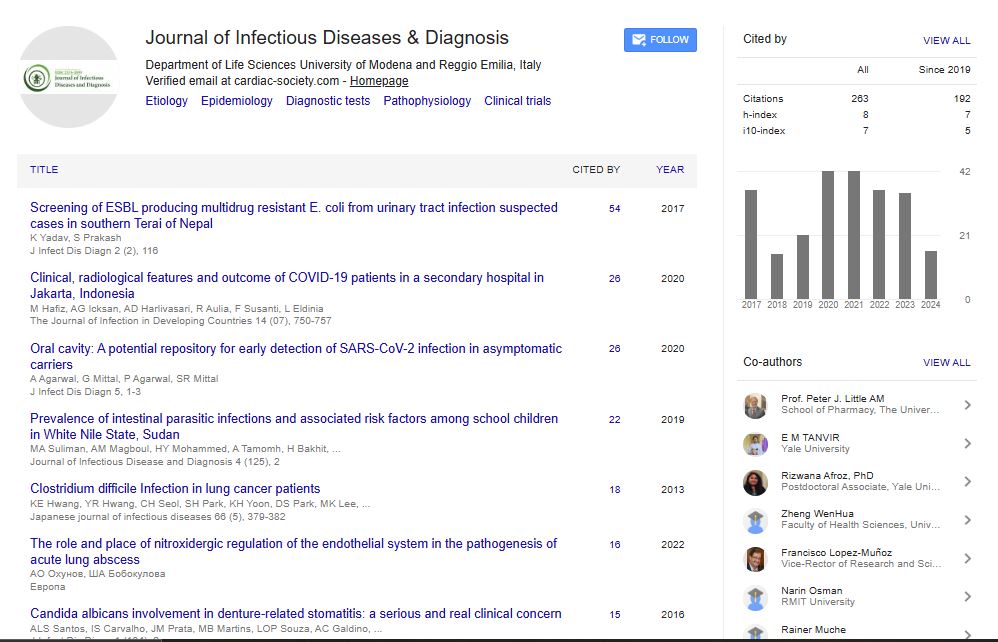
- Google Scholar
Useful Links
Share This Page
Journal Flyer

Open Access Journals
- Agri and Aquaculture
- Biochemistry
- Bioinformatics & Systems Biology
- Business & Management
- Chemistry
- Clinical Sciences
- Engineering
- Food & Nutrition
- General Science
- Genetics & Molecular Biology
- Immunology & Microbiology
- Medical Sciences
- Neuroscience & Psychology
- Nursing & Health Care
- Pharmaceutical Sciences
Opinion Article - (2025) Volume 10, Issue 6
Enhancing Syphilis Diagnosis Through Laboratory and Clinical Integration
Qingqiong Chien*Received: 29-Oct-2025, Manuscript No. JIDD-25-30659; Editor assigned: 03-Nov-2025, Pre QC No. JIDD-25-30659; Reviewed: 17-Nov-2025, QC No. JIDD-25-30659; Revised: 24-Nov-2025, Manuscript No. JIDD-25-30659; Published: 03-Dec-2025, DOI: 10.35248/2576-389X.25.10.363
Description
Syphilis, caused by the spirochete Treponema pallidum, remains a significant global public health concern despite advances in treatment and prevention. The infection progresses through distinct stages primary, secondary, latent and tertiary each presenting with varying clinical manifestations. Early detection is important for effective treatment, prevention of complications and reduction of transmission, particularly in high-risk populations such as men who have sex with men, pregnant women and individuals with HIV. Because syphilis can mimic many other diseases and is often asymptomatic, accurate laboratory diagnosis is essential. Modern diagnostic approaches combine serologic testing, molecular techniques and clinical evaluation to provide reliable identification and staging of infection.
Clinical diagnosis alone is insufficient due to the variable presentation of syphilis. Primary syphilis typically presents with a painless genital or extragenital chancre, while secondary syphilis manifests with systemic symptoms such as rash, mucocutaneous lesions, fever and lymphadenopathy. Latent syphilis is asymptomatic but serologically detectable and tertiary syphilis can affect multiple organ systems, including the cardiovascular and nervous systems. Because symptoms may be subtle or nonspecific, laboratory confirmation is important for guiding treatment decisions and public health interventions.
Serologic testing remains the cornerstone of syphilis diagnosis. Tests are generally classified into treponemal and nontreponemal assays. Non-treponemal tests, such as the Rapid Plasma Reagin (RPR) and Venereal Disease Research Laboratory (VDRL) tests, detect antibodies against cardiolipin-cholesterollecithin antigens released during infection. These tests are inexpensive, rapid and useful for initial screening and monitoring treatment response due to the correlation of titers with disease activity. However, non-treponemal tests may yield false-positive results in conditions such as autoimmune disorders, pregnancy, or other infections, necessitating confirmatory testing.
Treponemal tests, including the fluorescent Treponemal Antibody Absorption (FTA-ABS), Treponema Pallidum Particle Agglutination (TP-PA) and Enzyme Immunoassays (EIAs), detect antibodies specific to T. pallidum. These tests are more specific than non-treponemal assays and generally remain positive for life, even after successful treatment, making them unsuitable for monitoring therapeutic response but essential for confirming diagnosis. Many laboratories now employ a reverse sequence algorithm, screening initially with a treponemal test followed by non-treponemal confirmation, which can improve detection rates, particularly in latent or asymptomatic infections.
Direct detection methods, including dark-field microscopy and Polymerase Chain Reaction (PCR), allow identification of T. pallidum in lesion exudates, blood, or cerebrospinal fluid. Darkfield microscopy provides rapid identification of spirochetes in primary lesions but requires specialized expertise and is limited to patients presenting with visible chancres. PCR-based assays offer high sensitivity and specificity, especially in early or congenital infections and can detect bacterial DNA in cases where serologic responses are not yet detectable. Although currently limited by cost and laboratory infrastructure requirements, molecular diagnostics are increasingly used in research, surveillance and complex clinical cases.
Cerebrospinal Fluid (CSF) analysis is indicated when neurosyphilis is suspected. CSF examination includes VDRL testing, cell count and protein measurement. A reactive CSFVDRL is highly specific for neurosyphilis, although sensitivity is limited. Treponemal-specific tests on CSF may enhance diagnostic sensitivity but are not definitive alone. Clinical judgment, combined with serologic and CSF findings, is essential for accurate diagnosis in these cases.
Emerging diagnostic approaches focus on rapid point-of-care tests that detect treponemal antibodies, facilitating immediate diagnosis and treatment in resource-limited settings. Dual rapid tests that simultaneously detect HIV and syphilis antibodies have improved screening efficiency in high-risk populations and antenatal care programs. These tests are particularly valuable in reducing mother-to-child transmission of syphilis and improving early case identification.
Integration of clinical assessment with laboratory diagnostics ensures accurate identification of syphilis at all stages. Early detection through routine screening, particularly in high-risk populations, combined with confirmatory testing and follow-up, is essential to prevent complications such as congenital infection, neurosyphilis and cardiovascular involvement. Accurate diagnosis also supports public health measures, including contact tracing, surveillance and treatment of sexual partners, thereby reducing transmission.
In conclusion, effective diagnosis of syphilis relies on a combination of serologic testing, direct detection methods and careful clinical evaluation. Non-treponemal and treponemal assays remain the cornerstone of laboratory confirmation, while PCR and dark-field microscopy provide additional tools in specific clinical contexts. Emerging rapid and dual testing platforms further enhance timely diagnosis and intervention. Continued innovation, widespread access to reliable diagnostic tools and integration with clinical judgment are essential for controlling syphilis and reducing its impact on individual and public health.
Citation: Chien Q (2025). Enhancing Syphilis Diagnosis Through Laboratory and Clinical Integration. J Infect Dis Diagn. 10:363.
Copyright: © 2025 Chien Q. This is an open-access article distributed under the terms of the Creative Commons Attribution License, which permits unrestricted use, distribution and reproduction in any medium, provided the original author and source are credited.