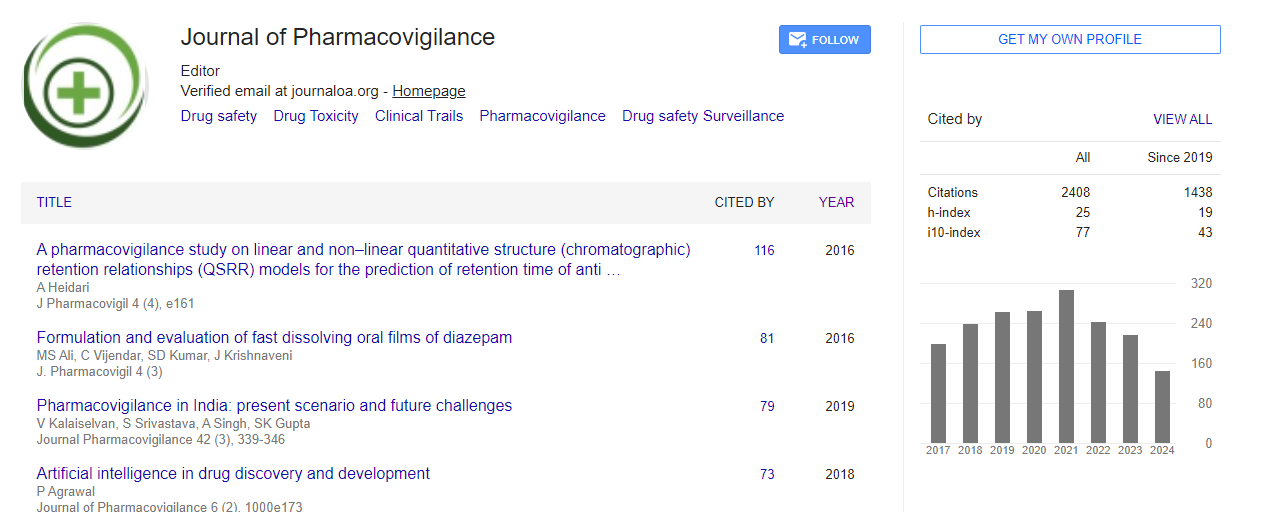

Indexed In
- Open J Gate
- JournalTOCs
- The Global Impact Factor (GIF)
- RefSeek
- Hamdard University
- EBSCO A-Z
- OCLC- WorldCat
- Publons
- Euro Pub
- Google Scholar
Useful Links
Share This Page
Journal Flyer
Open Access Journals
- Agri and Aquaculture
- Biochemistry
- Bioinformatics & Systems Biology
- Business & Management
- Chemistry
- Clinical Sciences
- Engineering
- Food & Nutrition
- General Science
- Genetics & Molecular Biology
- Immunology & Microbiology
- Medical Sciences
- Neuroscience & Psychology
- Nursing & Health Care
- Pharmaceutical Sciences
Opinion Article - (2026) Volume 14, Issue 2
Enhancing Medicine Safety Through Effective Risk Management Strategies
Victor Elmaris *Received: 19-May-2026 , Manuscript No. JP-26-32183; Editor assigned: 21-May-2026 , Pre QC No. JP-26-32183; Reviewed: 04-Jun-2026 , QC No. JP-26-32183; Revised: 11-Jun-2026 , Manuscript No. JP-26-32183; Published: 19-Jun-2026 , DOI: 10.35248/2329-6887.26.14.555
Description
Risk management is an important part of pharmacovigilance that focuses on identifying, evaluating, controlling, and communicating possible risks associated with medicine use. The main objective of risk management is to maintain a suitable balance between the therapeutic benefits of medicines and the possibility of unwanted effects. Through systematic planning and continuous evaluation, healthcare organizations can improve medicine safety and support better patient care.
Every medicine has a specific purpose in healthcare, providing benefits for disease prevention, diagnosis, or treatment. At the same time, medicines may produce unwanted effects in certain individuals due to differences in patient characteristics, medical conditions, dosage factors, or interactions with other treatments. Risk management activities help healthcare professionals understand these concerns and develop appropriate methods to reduce avoidable harm.
Risk management begins with identifying possible safety concerns associated with a medicine. Information may be collected from clinical studies, healthcare reports, scientific publications, patient experiences, and post-approval monitoring activities. This information allows researchers and healthcare professionals to understand known and possible risks related to medicine use.
Healthcare professionals play a significant role in risk management. Physicians evaluate patient conditions before selecting treatments, pharmacists review medicine-related concerns, and nurses observe patient responses during care. Their combined knowledge supports early recognition of possible problems and helps improve treatment decisions.
Patient participation is also important in risk management. Patients can provide valuable information about their treatment experiences, including unexpected symptoms or concerns. Educating patients about their medicines encourages communication with healthcare providers and supports early identification of possible safety issues.
Pharmaceutical organizations contribute to risk management by collecting safety information, conducting additional studies, and communicating important findings. Companies are responsible for maintaining medicine safety information throughout the product life cycle and cooperating with healthcare authorities to support patient protection.
Regulatory agencies establish requirements and guidelines related to risk management activities. They review safety information, evaluate proposed safety measures, and communicate important updates to healthcare professionals and the public. Their involvement supports consistent approaches to medicine safety evaluation.
Technology has improved risk management practices by providing better methods for information collection and analysis. Electronic healthcare records, digital reporting platforms, and data analysis systems allow researchers to review large amounts of information. These tools assist in identifying possible concerns and evaluating whether safety measures are effective.
Education and training are necessary components of successful risk management. Healthcare professionals require knowledge about safety reporting, medicine monitoring, and communication methods. Training programs improve awareness and support consistent implementation of safety practices across healthcare settings.
Research continues to improve risk management approaches. Studies evaluate medicine safety information, patient populations, healthcare practices, and methods for reducing medication-related harm. Research findings contribute to better planning and improved safety activities.
Conclusion
Risk management is an essential activity in medicine safety that helps identify and reduce possible risks while supporting effective treatment. Risk communication is another important element of risk management. Clear and accurate information helps healthcare professionals and patients understand medicinerelated concerns and appropriate actions. Effective communication reduces confusion and supports responsible medicine use. Successful risk management depends on accurate information collection, professional collaboration, patient involvement, and continuous evaluation. Through appropriate safety planning, communication, and monitoring, healthcare systems can improve medicine use and protect patients from preventable harm.
Citation: Elmaris V (2026). Enhancing Medicine Safety Through Effective Risk Management Strategies. J Pharmacovigil. 14:555
Copyright: © 2026 Elmaris V. This is an open-access article distributed under the terms of the Creative Commons Attribution License, which permits unrestricted use, distribution and reproduction in any medium, provided the original author and source are credited.