
Indexed In
- Open J Gate
- JournalTOCs
- The Global Impact Factor (GIF)
- RefSeek
- Hamdard University
- EBSCO A-Z
- OCLC- WorldCat
- Publons
- Euro Pub
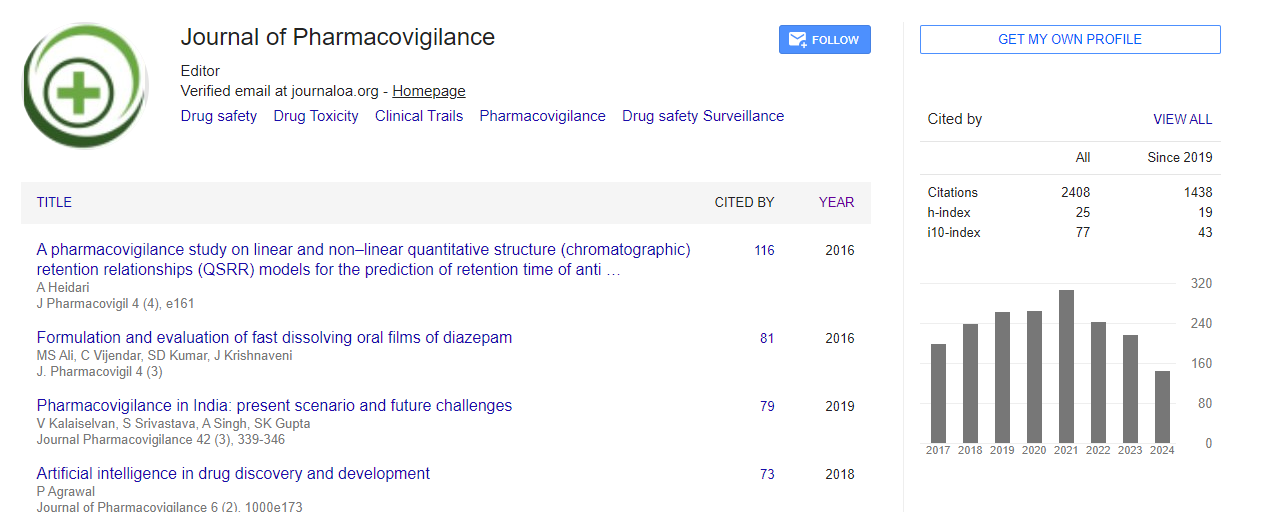
- Google Scholar
Useful Links
Share This Page
Journal Flyer
Open Access Journals
- Agri and Aquaculture
- Biochemistry
- Bioinformatics & Systems Biology
- Business & Management
- Chemistry
- Clinical Sciences
- Engineering
- Food & Nutrition
- General Science
- Genetics & Molecular Biology
- Immunology & Microbiology
- Medical Sciences
- Neuroscience & Psychology
- Nursing & Health Care
- Pharmaceutical Sciences
Perspective - (2026) Volume 14, Issue 1
Drug Monitoring as a Pillar of Safe and Effective Therapy
Daniel Hofmann*Received: 10-Feb-2026, Manuscript No. JP-26-31398; Editor assigned: 12-Feb-2026, Pre QC No. JP-26-31398; Reviewed: 26-Feb-2026, QC No. JP-26-31398; Revised: 05-Mar-2026, Manuscript No. JP-26-31398; , DOI: 10.35248/2329-6887.26.14.543
Description
Drug monitoring refers to the continuous observation and evaluation of medications to ensure their safe and effective use in patients. It involves measuring drug levels, assessing therapeutic outcomes, and identifying any adverse reactions or inefficacy during treatment. This practice is widely applied in both clinical research and routine healthcare, where it supports informed decisions regarding dosing, duration of therapy, and overall patient management.
The concept of drug monitoring is closely linked to the variability in how individuals respond to medications. Even when the same dose is administered, patients may experience different outcomes due to variations in absorption, metabolism, distribution, and elimination. Factors such as age, body composition, organ function, and genetic differences all influence these processes. As a result, monitoring helps tailor therapy to individual needs, reducing the likelihood of toxicity while maintaining therapeutic effectiveness.
One of the most common approaches within drug monitoring is therapeutic drug monitoring, which involves measuring the concentration of a drug in biological fluids, usually blood. This is particularly important for medications with a narrow therapeutic range, where the difference between an effective dose and a toxic dose is small. By regularly checking drug levels, healthcare providers can adjust dosing to keep concentrations within a target range, thereby optimizing treatment outcomes.
In addition to measuring drug levels, clinical observation plays a central role in monitoring. Healthcare providers assess signs and symptoms to determine whether a medication is achieving its intended effect or causing unwanted reactions. For example, improvement in disease-related symptoms may indicate that the therapy is working, while the appearance of new symptoms could suggest adverse effects. Combining laboratory data with clinical findings provides a more comprehensive understanding of a patient’s response to treatment.
Drug monitoring is especially important in populations that are more vulnerable to variations in drug response. Children, older adults, and patients with chronic illnesses often require closer observation. In these groups, physiological changes or coexisting conditions can alter how drugs are processed, increasing the risk of adverse outcomes. Careful monitoring allows for timely adjustments and helps prevent complications.
Another important aspect of drug monitoring is adherence assessment. Patients do not always take medications as prescribed, which can lead to reduced effectiveness or unexpected outcomes. Monitoring strategies may include patient interviews, pill counts, or measurement of drug levels to evaluate whether the medication is being taken correctly. Addressing adherence issues is essential for achieving the desired therapeutic results.
Drug interactions are also a key consideration. When multiple medications are used simultaneously, they may affect each other’s activity, leading to altered drug levels or unexpected effects. Monitoring helps detect these interactions early and allows healthcare providers to modify treatment plans accordingly. This is particularly relevant in patients with complex medical conditions who require multiple therapies.
Technological advancements have enhanced the capabilities of drug monitoring. Modern laboratory techniques allow for precise measurement of drug concentrations, while digital health tools enable remote monitoring and data collection. Electronic health records facilitate the integration of patient information, making it easier to track changes over time. These innovations contribute to more efficient and accurate monitoring processes.
Education is an essential component of effective drug monitoring. Healthcare professionals must be trained to interpret laboratory results, recognize clinical signs, and make appropriate adjustments to therapy. Patients also play an active role by reporting symptoms, following prescribed regimens, and attending scheduled follow-ups. Clear communication between patients and providers ensures that monitoring efforts are successful.
Conclusion
Drug monitoring is an essential aspect of modern healthcare that ensures medications are used safely and effectively. Drug monitoring also contributes to broader healthcare objectives. By identifying patterns in drug response and adverse effects, it provides valuable data for improving treatment guidelines and informing future research. This information can lead to safer prescribing practices and more effective use of medications across different populations. Through a combination of laboratory measurements, clinical observation, and patient engagement, it allows for individualized treatment and timely intervention when issues arise. As medical knowledge and technology continue to advance, drug monitoring remains a vital practice that supports optimal therapeutic outcomes and enhances patient safety.
Citation: Hofmann D (2026). Drug Monitoring as a Pillar of Safe and Effective Therapy. J Pharmacovigil. 14:543
Copyright: © 2026 Hofmann D. This is an open-access article distributed under the terms of the Creative Commons Attribution License, which permits unrestricted use, distribution and reproduction in any medium, provided the original author and source are credited.