
Indexed In
- Open J Gate
- Genamics JournalSeek
- Academic Keys
- JournalTOCs
- RefSeek
- Hamdard University
- EBSCO A-Z
- SWB online catalog
- Publons
- Geneva Foundation for Medical Education and Research
- Euro Pub
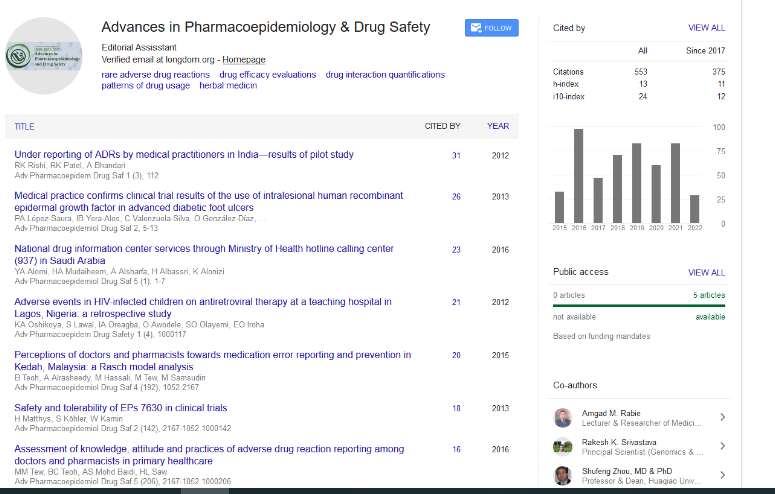
- Google Scholar
Useful Links
Share This Page
Journal Flyer
Open Access Journals
- Agri and Aquaculture
- Biochemistry
- Bioinformatics & Systems Biology
- Business & Management
- Chemistry
- Clinical Sciences
- Engineering
- Food & Nutrition
- General Science
- Genetics & Molecular Biology
- Immunology & Microbiology
- Medical Sciences
- Neuroscience & Psychology
- Nursing & Health Care
- Pharmaceutical Sciences
Editorial - (2021) Volume 10, Issue 4
Drug Safety and its Impact on Patients' Health
Andrew Zelar *Received: 22-Nov-2021 Published: 12-Dec-2021
Editorial
The concept of drug safety, also called “Medication Safety”, is not new, especially in the developed countries in the field of health. For instance, we catch in the United States of America (USA) an experience for more than a century in the field of the safety of medications, and the use of these drugs led to creation of new acts or changes to the actual ones. For example, in October 1937, the use of the antibiotic sulfanilamide caused the deaths of more than 100 people in the USA. These deaths were not due to the active additive itself; rather, they were caused by the addition of diethylene glycol (DEG), the excipient used as a solvent for the additive drug. DEG was supposed to be inert, with no therapeutic benefits however, it was the toxic substance that led to those fateful side effects. The company claimed they did not expect these side effects, which was true; as they did not commit animal studies learn before they marketed the drug. Because of that incident, the U.S. Food and Drug Administration (FDA) accepted an act to ensure the safety of any drug by control non-clinical and clinical studies before the drugs are marketed for public use.
Of course, the problems arising from drugs and their side effects did not stop arise. A severe worldwide trouble was initiated by the use of the drug thalidomide, which was used as an anti- Semitic agent for pregnant women in many countries. In the early 1960s, the use of thalidomide during the first 3 months of pregnancy led to teratogenic effects manifested by the birth of infants with severe deformities known as “Phocomelia”. Babies would be born lacking extremities (hands and legs) or with only very short ones. Many infants died because of this medication as well. Overall, more than 10k children in 46 countries were victims of thalidomide. It is important to mention that this drug was not certified or approved for use in the United States because of some concerns that arose during non-clinical studies (animal studies) due to the existence of cases of abnormality on animal embryos. Note that those animal studies were conducted according to the act that was initiated following the sulfanilamide incident in the USA; therefore the public was protected and avoided from this crisis.
Since the initial days of the past century, many acts, laws, or amendments have been created to make sure that approved drugs are first safe and then adequate. Furthermore, these regulations are enduring to change to make sure that these drugs have a positive profit –risk balance. Personalized medicine should be treated when medications are given to patients because the pharmacokinetic process inside the body varies from patient to patient and from one clear-cut disease state to another. However, adverse drug reactions can be reduce if more precautions are taken by healthcare professionals, especially counting the patient as one pillar of the therapeutic plan and providing more patients counseling, which will improve drug safety.
The drug safety thought has earned a lot of attention during the past decade due to the fact it plays a leading role in patients’ health. Recent laws stress this concept should be admitted in the process of new medications’ confirmation and continued conduct of post-marketing drug evaluations. Benefit–risk assessment should be treated by all health care professionals when they need to give clear-cut drugs to specific groups of patients. Therefore, more care should be given to some patients, such as pregnant women, children and the aging, since they are considered vulnerable populations.
Citation:
Zelar A (2021) Drug Safety and its Impact on Patientsâ?? Health. Adv Pharmacoepidemiol Drug Saf 10p:255.
Copyright: ©2021 Zelar A. This is an open-access article distributed under the terms of the Creative Commons Attribution License, which permits unrestricted use, distribution, and reproduction in any medium, provided the original author and source are credited.