
Indexed In
- Open J Gate
- JournalTOCs
- The Global Impact Factor (GIF)
- RefSeek
- Hamdard University
- EBSCO A-Z
- OCLC- WorldCat
- Publons
- Euro Pub
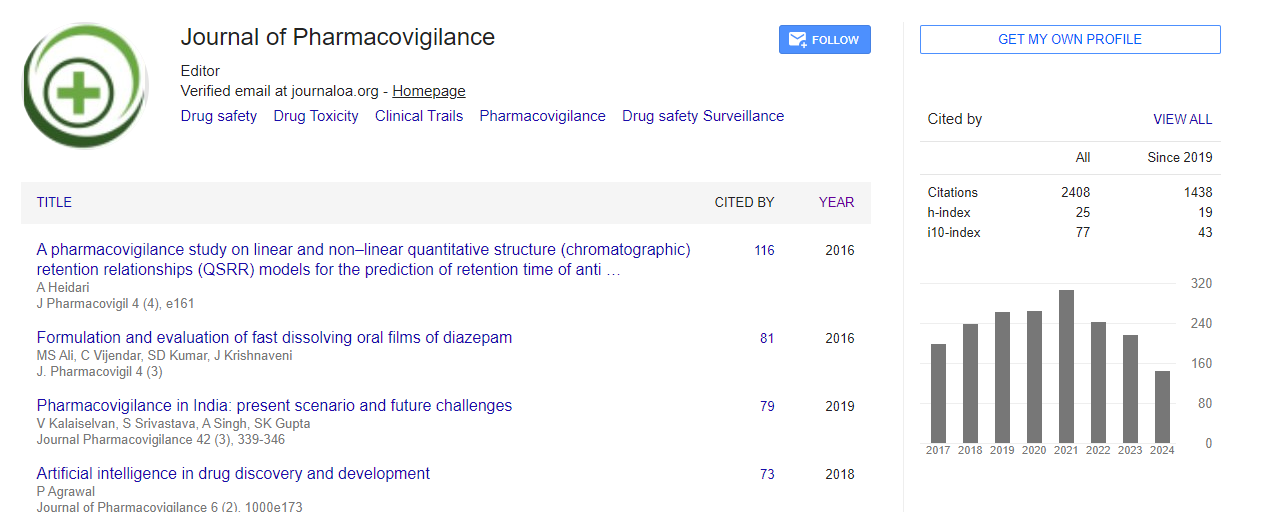
- Google Scholar
Useful Links
Share This Page
Journal Flyer
Open Access Journals
- Agri and Aquaculture
- Biochemistry
- Bioinformatics & Systems Biology
- Business & Management
- Chemistry
- Clinical Sciences
- Engineering
- Food & Nutrition
- General Science
- Genetics & Molecular Biology
- Immunology & Microbiology
- Medical Sciences
- Neuroscience & Psychology
- Nursing & Health Care
- Pharmaceutical Sciences
Opinion Article - (2025) Volume 13, Issue 4
Contribution of Patient-Reported Outcomes to Modern Pharmacovigilance Practices
Maria Fernandez*Received: 10-Nov-2025, Manuscript No. JP-26-31016; Editor assigned: 12-Nov-2025, Pre QC No. JP-26-31016 (PQ); Reviewed: 26-Nov-2025, QC No. JP-26-31016; Revised: 03-Dec-2025, Manuscript No. JP-26-31016 (R); Published: 10-Dec-2025, DOI: 10.35248/2329-6887.25.13.535
Description
Pharmacovigilance has traditionally relied on reports from healthcare professionals to identify and assess adverse drug reactions. In recent years, patient-reported outcomes have gained increasing recognition as a valuable source of safety information. These reports provide direct insight into patient experiences with medicines, offering perspectives that may differ from clinical observations. Incorporating patient input supports a more comprehensive approach to medicine safety monitoring.
Patient-reported outcomes include information on symptoms, functional changes, and quality-of-life effects experienced during medication use. Patients may notice subtle or gradual changes that are not immediately evident during clinical encounters. Such observations are particularly relevant for chronic therapies, where long-term tolerability influences adherence and overall treatment success.
Many pharmacovigilance systems now allow patients to submit adverse reaction reports directly. These reports often emphasize the impact of reactions on daily activities, emotional well-being, and social participation. While clinical detail may vary, patient narratives add context that enhances understanding of how adverse reactions affect real-world medicine use.
Comparisons between patient and healthcare professional reports suggest that patients may be more likely to report certain types of reactions, such as fatigue, mood changes, or gastrointestinal discomfort. These effects, while sometimes considered less severe from a clinical standpoint, can significantly influence treatment continuation. Recognizing these concerns supports more patient-centered risk evaluation.
Quality assessment of patient-reported data is an important consideration. Reports may lack medical terminology or precise diagnoses, making evaluation more challenging. However, structured reporting forms and guidance can improve clarity and completeness. Follow-up by pharmacovigilance professionals helps clarify details and integrate patient reports into broader safety analysis. Patient-reported outcomes also contribute to early detection of safety issues. When multiple patients report similar experiences with a medication, patterns may emerge that warrant further investigation. Combined with data from healthcare professionals and observational studies, patient input strengthens signal evaluation.
Education and awareness are essential for encouraging meaningful patient participation. Patients should understand what types of experiences to report and how their information contributes to medicine safety. Clear communication builds confidence and supports sustained engagement with reporting systems. Healthcare professionals play a supportive role by encouraging patients to discuss medication-related concerns and guiding them on reporting options. Integrating discussions of adverse effects into routine care reinforces the message that patient experiences are valued and relevant to safety monitoring.
Ethical considerations are central to the use of patient-reported outcomes. Data privacy, informed consent, and responsible use of information must be ensured. Transparency regarding how reports are analyzed and used supports trust in pharmacovigilance systems. Technological developments have facilitated patient reporting through online platforms and mobile applications. These tools improve accessibility and timeliness of reporting. However, efforts must be made to ensure inclusivity for individuals with limited digital access or health literacy.
Conclusion
Patient-reported outcomes contribute significantly to modern pharmacovigilance practices. By capturing real-world experiences and quality-of-life impacts, patient input enhances understanding of medicine safety beyond traditional clinical measures. Integrating these perspectives with established pharmacovigilance methods supports more comprehensive and patient-centered safety evaluation. Documentation and reporting of identified adverse drug reactions remain essential, even when active monitoring is in place. Submitting reports to national pharmacovigilance centers ensures that findings contribute to broader safety databases. Hospital-generated data are particularly valuable because they often involve detailed clinical information and confirmed diagnoses, strengthening signal evaluation at regional and global levels.
Citation: Fernandez M (2025). Contribution of Patient-Reported Outcomes to Modern Pharmacovigilance Practices. J Pharmacovigil. 13:535
Copyright: © 2025 Fernandez M. This is an open-access article distributed under the terms of the Creative Commons Attribution License, which permits unrestricted use, distribution and reproduction in any medium, provided the original author and source are credited.