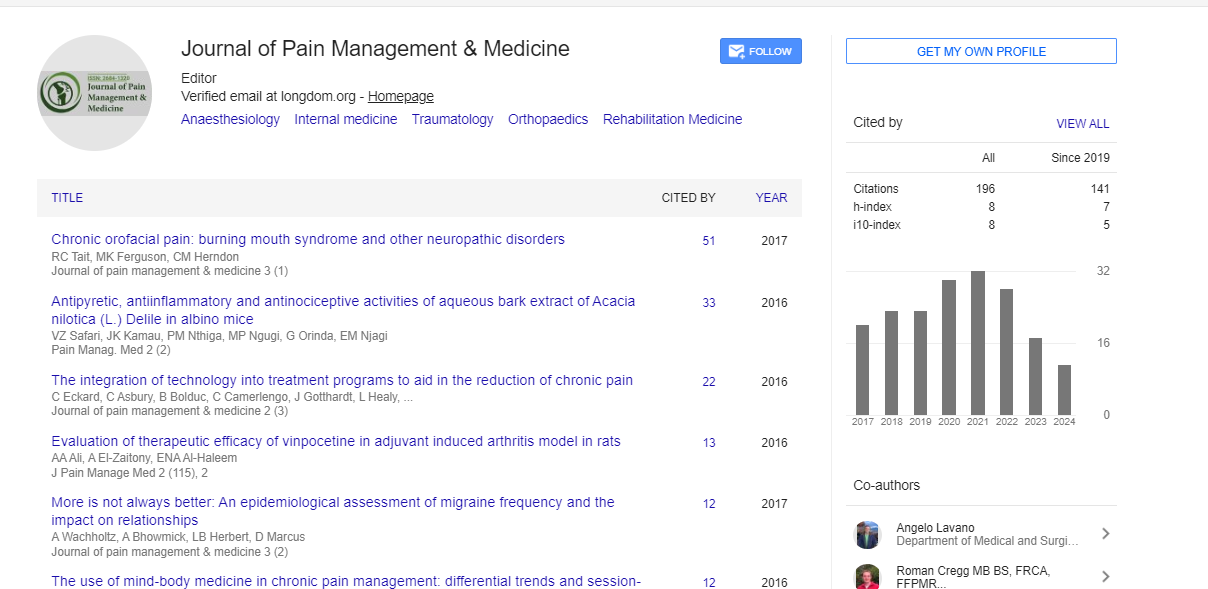

Indexed In
- RefSeek
- Hamdard University
- EBSCO A-Z
- Publons
- Euro Pub
- Google Scholar
- Quality Open Access Market
Useful Links
Share This Page
Journal Flyer

Open Access Journals
- Agri and Aquaculture
- Biochemistry
- Bioinformatics & Systems Biology
- Business & Management
- Chemistry
- Clinical Sciences
- Engineering
- Food & Nutrition
- General Science
- Genetics & Molecular Biology
- Immunology & Microbiology
- Medical Sciences
- Neuroscience & Psychology
- Nursing & Health Care
- Pharmaceutical Sciences
Opinion Article - (2025) Volume 11, Issue 6
Comprehensive Palliative Care for Enhancing Comfort Dignity and Holistic Well Being
Isabella Rossi*Received: 29-Oct-2025, Manuscript No. JPMME-25-30904; Editor assigned: 31-Oct-2025, Pre QC No. JPMME-25-30904 (PQ); Reviewed: 14-Nov-2025, QC No. JPMME-25-30904; Revised: 21-Nov-2025, Manuscript No. JPMME-25-30904 (R); Published: 28-Nov-2025, DOI: 10.35248/2684-1320.25.11.362
Description
Palliative care is a specialized medical discipline focused on improving the quality of life for patients facing serious, chronic, or life limiting illnesses. Unlike curative medicine, which primarily seeks to eliminate disease, palliative care addresses physical, emotional, social and spiritual suffering associated with complex medical conditions. It is patient centered and emphasizes comfort, dignity and holistic well-being, providing support not only to patients but also to their families. As healthcare systems worldwide confront aging populations, rising prevalence of chronic disease and increased survival from serious illnesses, the role of palliative care has grown in both relevance and necessity.
The scope of palliative care is broad and inclusive, serving patients at any stage of serious illness and in diverse care settings including hospitals, outpatient clinics, hospices and home environments. Palliative care is not limited to end of life care; it is appropriate from the time of diagnosis and can be provided alongside curative or disease modifying treatments. Conditions commonly addressed by palliative care include cancer, advanced cardiovascular disease, chronic respiratory illness, neurodegenerative disorders, kidney failure and progressive infectious diseases. The interdisciplinary approach of palliative care ensures that complex needs are addressed comprehensively, enhancing both clinical outcomes and quality of life.
A central focus of palliative care is the management of physical symptoms such as pain, dyspnea, fatigue, nausea and neurological impairments. Advanced assessment tools allow clinicians to evaluate symptom severity, track progression and tailor treatment strategies. Pharmacological interventions, including opioids, adjuvant analgesics and symptom specific medications, are used alongside non pharmacological approaches such as relaxation techniques, physical therapy and complementary therapies. The goal is to relieve suffering and maintain functional capacity to the greatest extent possible.
Palliative care also addresses the psychological and emotional challenges faced by patients. Serious illness often triggers anxiety, depression, fear and uncertainty, which can exacerbate physical symptoms and hinder recovery or adaptation. Palliative care providers offer counselling, coping strategies and support groups to help patients and families navigate these emotional burdens. Attention to psychological health is closely linked to overall wellbeing and enables patients to engage actively in decision making about their care.
Family and caregiver support is another fundamental component of palliative care. Family members frequently assume critical roles in providing care, navigating complex medical decisions and coping with the emotional stress of illness. Palliative care teams provide education, counselling, respite care and guidance on symptom management and end of life planning. By supporting caregivers, palliative care improves patient outcomes and reduces the risk of burnout among those providing daily care.
Communication is essential in palliative care, particularly regarding goals of care, prognosis and treatment preferences. Advance care planning allows patients to express values and priorities, ensuring that medical interventions align with personal wishes. Palliative care practitioners facilitate these conversations with empathy and clarity, fostering trust and shared decision making. Clear communication reduces confusion, mitigates conflict and promotes a sense of control for patients and families.
The interdisciplinary nature of palliative care integrates physicians, nurses, social workers, psychologists, chaplains and therapists into a cohesive team. Collaboration ensures that physical, emotional, social and spiritual needs are addressed concurrently. This team approach also allows seamless transitions across care settings, including hospital to home or hospice, ensuring continuity and reducing the burden of fragmented care. Evidence shows that such integrated care models improve symptom control, patient satisfaction and even survival in some chronic conditions.
Ethical considerations are intrinsic to palliative care. Issues related to autonomy, informed consent, decision making capacity and equitable access to care require careful attention. Palliative care emphasizes respect for patient dignity, cultural sensitivity and the right to make choices consistent with individual values and beliefs. These principles guide both clinical practice and policy development, ensuring that care remains humane and just.
In conclusion, palliative care is a compassionate, holistic and patient centered medical specialty that enhances quality of life for patients with serious illness and provides essential support to families. By addressing physical symptoms, psychological needs, social challenges and spiritual concerns, palliative care promotes comfort, dignity and functional well-being across the continuum of illness. Its emphasis on interdisciplinary collaboration, communication and ethical practice distinguishes it as a fundamental component of modern healthcare. As societies face growing demands from chronic and life limiting illnesses, palliative care will remain vital in ensuring that medical treatment is aligned with human values, compassion and quality of life.
Citation: Rossi I (2025). Comprehensive Palliative Care for Enhancing Comfort Dignity and Holistic Well Being. J Pain Manage Med. 11:362.
Copyright: © 2025 Rossi I. This is an open-access article distributed under the terms of the Creative Commons Attribution License, which permits unrestricted use, distribution, and reproduction in any medium, provided the original author and source are credited.