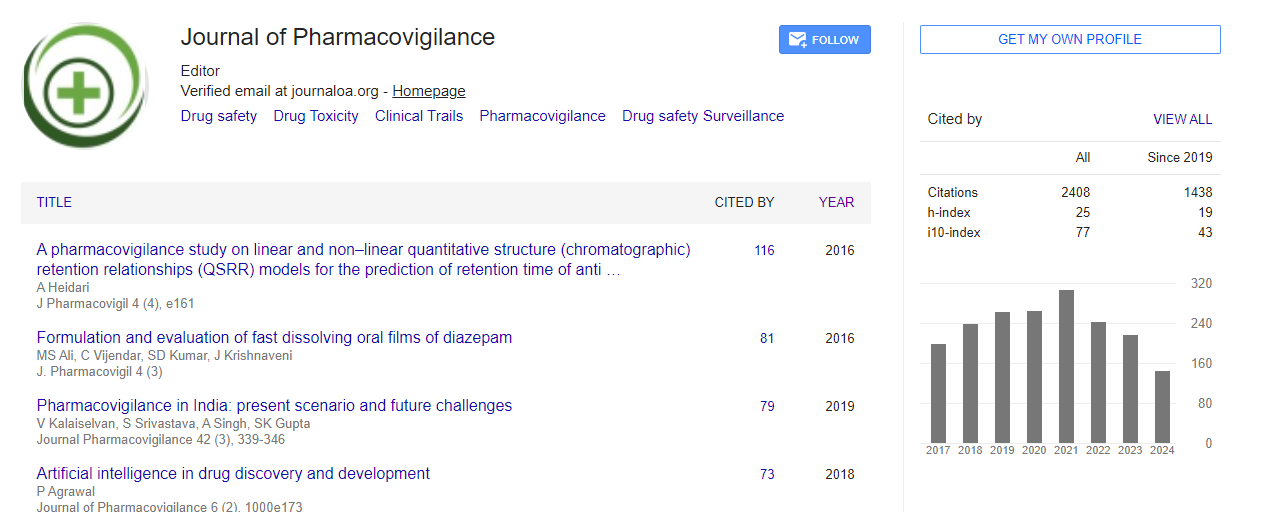

Indexed In
- Open J Gate
- JournalTOCs
- The Global Impact Factor (GIF)
- RefSeek
- Hamdard University
- EBSCO A-Z
- OCLC- WorldCat
- Publons
- Euro Pub
- Google Scholar
Useful Links
Share This Page
Journal Flyer
Open Access Journals
- Agri and Aquaculture
- Biochemistry
- Bioinformatics & Systems Biology
- Business & Management
- Chemistry
- Clinical Sciences
- Engineering
- Food & Nutrition
- General Science
- Genetics & Molecular Biology
- Immunology & Microbiology
- Medical Sciences
- Neuroscience & Psychology
- Nursing & Health Care
- Pharmaceutical Sciences
Perspective - (2026) Volume 14, Issue 2
Comprehensive Approaches for Improving Drug-Related Problem Management in Healthcare
Selena Marvick *Received: 19-May-2026 , Manuscript No. JP-26-32180; Editor assigned: 21-May-2026 , Pre QC No. JP-26-32180; Reviewed: 04-Jun-2026 , QC No. JP-26-32180; Revised: 11-Jun-2026 , Manuscript No. JP-26-32180; Published: 19-Jun-2026 , DOI: 10.35248/2329-6887.26.14.552
Description
Drug-related problems (DRPs) represent situations in which medicine therapy may not achieve the desired health outcomes or may create unnecessary concerns for patients. These problems are an important area of healthcare because appropriate medicine use directly influences treatment effectiveness, patient safety, and quality of life. With the increasing number of available medicines and the growing complexity of treatment plans, identifying and managing DRPs has become an essential responsibility within healthcare practice.
A drug-related problem may occur when a patient does not receive a medicine required for a specific health condition, receives an unsuitable medicine, uses an incorrect dose, experiences unwanted effects, or does not obtain the expected benefit from therapy. These situations may appear during any stage of medicine use, including prescribing, dispensing, administration, and follow-up monitoring. Early recognition of these concerns allows healthcare professionals to improve treatment plans and reduce possible harm.
One important category of DRPs involves problems related to medicine selection. A patient may receive a medicine that is not suitable for their medical condition, age, health status, or treatment goals. In some cases, multiple medicines with similar effects may be prescribed without a clear need. Careful review of treatment plans helps healthcare professionals determine whether each medicine has an appropriate purpose and supports patient needs.
Problems related to medicine effectiveness are another common concern. A medicine may fail to provide the expected therapeutic benefit due to incorrect selection, insufficient dosage, poor absorption, disease progression, or other factors affecting treatment response. Healthcare providers evaluate patient progress and make necessary adjustments to improve outcomes. Regular monitoring helps identify ineffective treatments early and allows healthcare professionals to choose safer and more suitable alternatives.
Safety-related DRPs occur when medicines create harmful effects or increase the risk of complications. These problems may result from unwanted reactions, interactions between medicines, incorrect dosing, or patient-specific factors. Individuals with multiple diseases or those taking several medicines may require additional attention because their treatment plans can be more complex.
Medication adherence is a significant factor associated with DRPs. Some patients may not use medicines according to healthcare instructions because of forgetfulness, misunderstanding, complicated schedules, unpleasant effects, or concerns about treatment. Poor adherence can reduce the effectiveness of therapy and may lead to worsening health conditions. Patient counseling and clear communication can improve understanding and encourage appropriate medicine use.
Healthcare professionals use different approaches to identify DRPs. Medication history review, patient interviews, prescription evaluation, laboratory information, and clinical observation provide important details about medicine use. Pharmacists often conduct medication reviews to identify concerns and communicate recommendations to physicians and other members of healthcare teams.
Community pharmacists contribute greatly to DRP management because they frequently interact with patients during medicine supply and counseling. They can identify issues such as incorrect medicine use, missed doses, possible interactions, and patient concerns. Their involvement supports early recognition of problems and promotes better treatment experiences.
Conclusion
Drug-related problems are significant concerns that can affect the effectiveness and safety of medicine therapy. Proper identification and management of these problems require active involvement from physicians, pharmacists, nurses, patients, and healthcare organizations. Regular medication review, accurate communication, patient education, and continuous monitoring help identify concerns early and support appropriate treatment decisions. Addressing drug-related problems improves medicine use, reduces preventable complications, and enhances the overall quality of healthcare services. Continued research, professional training, and improved healthcare systems will further support effective management of drug-related problems and promote safer treatment practices for patients.
Citation: Marvick S (2026). Comprehensive Approaches for Improving Drug-Related Problem Management in Healthcare. J Pharmacovigil. 14:552
Copyright: © 2026 Marvick S. This is an open-access article distributed under the terms of the Creative Commons Attribution License, which permits unrestricted use, distribution and reproduction in any medium, provided the original author and source are credited.