
Indexed In
- Academic Journals Database
- Open J Gate
- Genamics JournalSeek
- JournalTOCs
- China National Knowledge Infrastructure (CNKI)
- Scimago
- Ulrich's Periodicals Directory
- RefSeek
- Hamdard University
- EBSCO A-Z
- OCLC- WorldCat
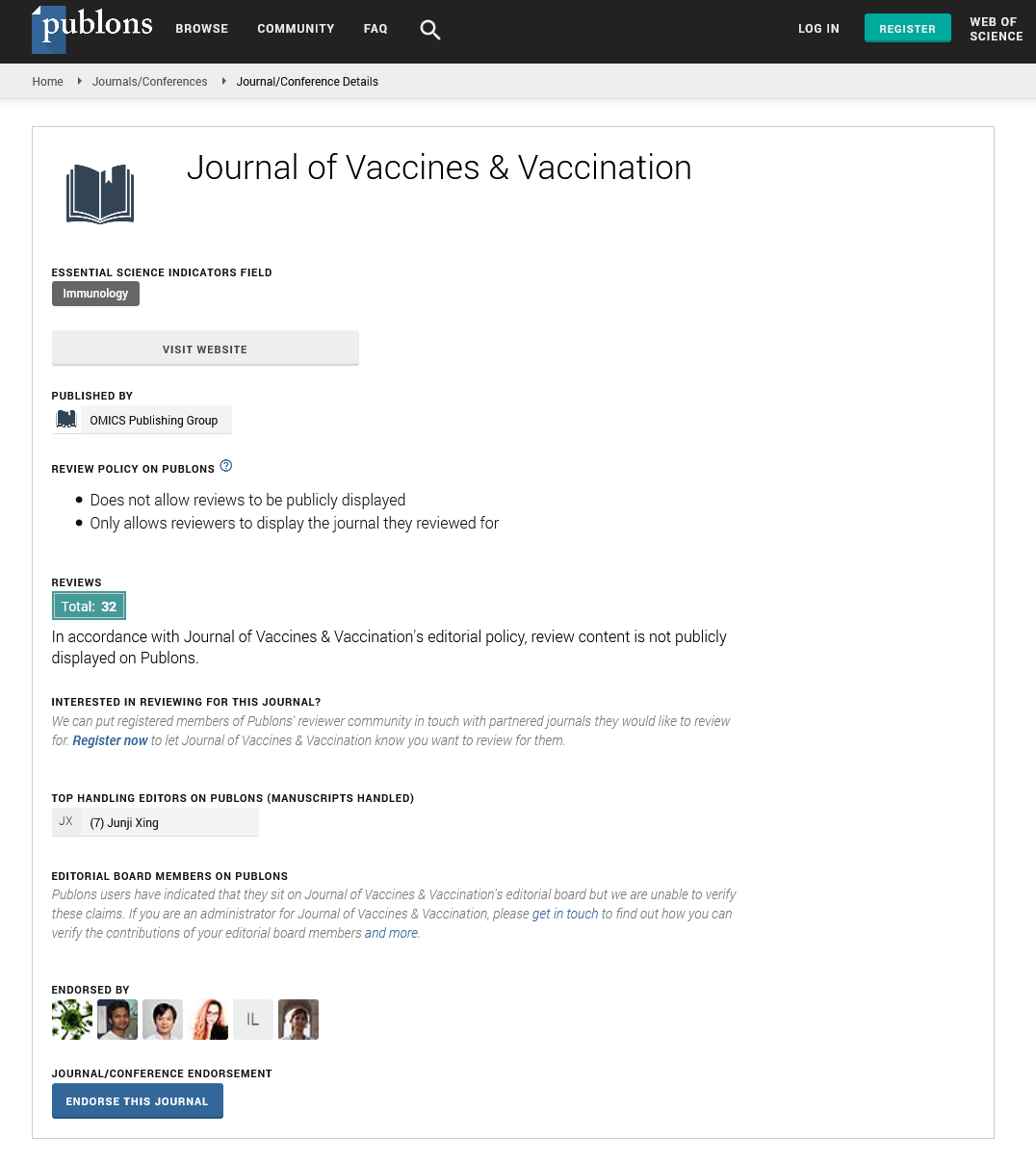
- Publons
- MIAR
- University Grants Commission
- Geneva Foundation for Medical Education and Research
- Euro Pub
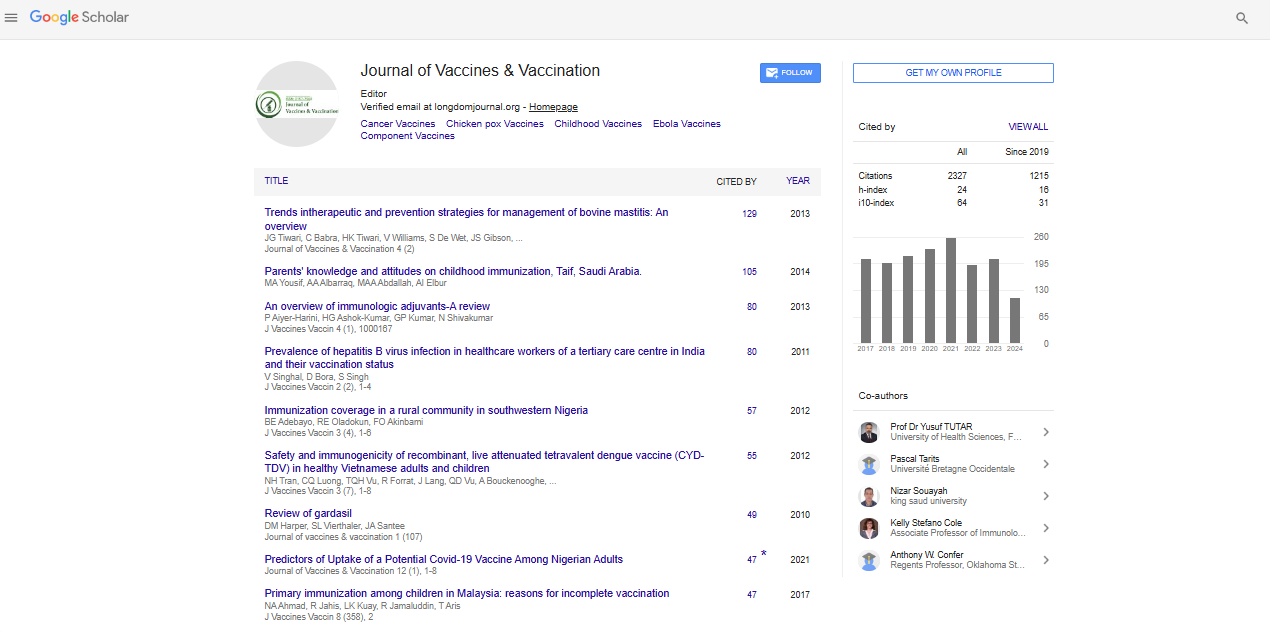
- Google Scholar
Useful Links
Share This Page
Open Access Journals
- Agri and Aquaculture
- Biochemistry
- Bioinformatics & Systems Biology
- Business & Management
- Chemistry
- Clinical Sciences
- Engineering
- Food & Nutrition
- General Science
- Genetics & Molecular Biology
- Immunology & Microbiology
- Medical Sciences
- Neuroscience & Psychology
- Nursing & Health Care
- Pharmaceutical Sciences
Opinion Article - (2025) Volume 16, Issue 7
Community-Centred Approaches for Effective Immunization Programs
Lucien Hartwell*Received: 17-Jun-2025, Manuscript No. JVV-26-31575; Editor assigned: 19-Jun-2025, Pre QC No. JVV-26-31575; Reviewed: 03-Jul-2025, QC No. JVV-26-31575; Revised: 10-Jul-2025, Manuscript No. JVV-26-31575; Published: 17-Jul-2025, DOI: 10.35248/2157-7560.26.16.613
Abstract
Description
Immunization remains one of the most effective public health measures for reducing illness and preventing avoidable deaths across all age groups. Vaccines have supported the control of diseases that once affected millions of people every year, including polio, measles, diphtheria and tetanus. Many countries have achieved significant reductions in infant and child mortality through organized vaccination campaigns, expanded healthcare access and educational activities that encourage public participation. Even with scientific progress and expanded vaccine production, unequal access, misinformation, logistical difficulties and economic barriers continue to affect immunization coverage in many regions of the world.
Successful immunization programs rely on more than vaccine availability alone. Public confidence, healthcare worker training, reliable transportation systems and accurate record management all contribute to positive outcomes. In many communities, local healthcare staff serve as trusted sources of information. Their communication skills often influence whether parents decide to vaccinate their children according to national schedules. Clear explanations regarding vaccine safety, expected side effects and disease prevention can improve acceptance among families who may feel uncertain about immunization.
Public education campaigns have become increasingly important due to the rapid spread of misleading information through online platforms. False claims about vaccine safety may create fear and hesitation among people who have limited access to scientific material. Health agencies in several countries now use social media, radio programs, school presentations and local meetings to share evidence-based information in simple language. Communication methods that respect local traditions and cultural beliefs are more likely to encourage participation. Messages delivered in regional languages by respected community members often achieve stronger public response than general national advertisements.
School-based vaccination programs have shown positive outcomes in many urban and rural settings. Schools provide direct access to children and adolescents while reducing transportation challenges for families. Such programs also support accurate record collection because teachers and healthcare teams can coordinate schedules and monitor attendance. Vaccination activities conducted within educational institutions frequently improve coverage rates for diseases such as human papillomavirus, measles and hepatitis B. In areas with low literacy levels, schools also act as centers for distributing educational material to parents and guardians.
Mobile vaccination units have gained attention as a practical method for reaching remote populations. In mountainous areas, island communities and regions affected by conflict, fixed healthcare facilities may not be easily accessible. Mobile teams equipped with portable refrigeration systems can transport vaccines safely while offering additional health services such as nutritional assessment and maternal care. These units reduce travel expenses for families and support timely immunization for children who may otherwise miss scheduled doses. Some countries have also used motorcycles, boats and solar-powered cold storage equipment to improve vaccine delivery under difficult environmental conditions.
Digital technology has changed the administration of immunization services in several healthcare systems. Electronic vaccination records reduce paperwork and assist healthcare workers in tracking missed doses. Automated reminder messages sent through mobile phones help parents remember appointment dates. Data analysis systems also support health authorities in identifying regions with low vaccine uptake and planning targeted interventions. In countries with large populations, digital platforms simplify coordination between local clinics and national health departments. Despite these advantages, privacy protection and reliable internet access remain important concerns that require careful management.
Conclusion
Research continues to improve vaccine development and delivery methods. Scientists are studying temperature-stable vaccines, needle-free administration systems and faster production techniques that may simplify distribution during public health emergencies. International scientific collaboration has accelerated vaccine research for emerging infectious diseases, allowing faster responses during outbreaks. Continued investment in laboratory research, manufacturing infrastructure and public health systems may improve global preparedness for future disease threats. Immunization programs represent a shared responsibility involving governments, healthcare professionals, educators, community organizations and families. High vaccination coverage not only protects individuals but also reduces disease spread within entire populations.
Citation: Hartwell L (2025). Community-Centred Approaches for Effective Immunization Programs. J Vaccines Vaccin. 16:613.
Copyright: © 2025 Hartwell L. This is an open access article distributed under the terms of the Creative Commons Attribution License, which permits unrestricted use, distribution and reproduction in any medium, provided the original author and source are credited.