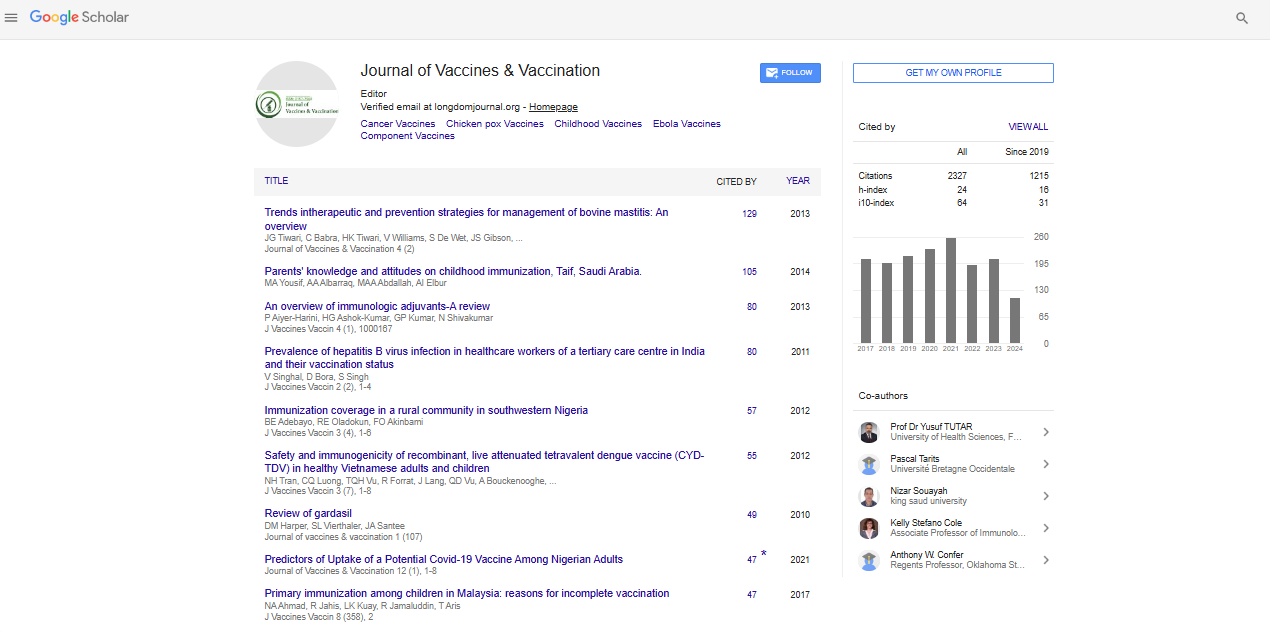

Indexed In
- Academic Journals Database
- Open J Gate
- Genamics JournalSeek
- JournalTOCs
- China National Knowledge Infrastructure (CNKI)
- Scimago
- Ulrich's Periodicals Directory
- RefSeek
- Hamdard University
- EBSCO A-Z
- OCLC- WorldCat
- Publons
- MIAR
- University Grants Commission
- Geneva Foundation for Medical Education and Research
- Euro Pub
- Google Scholar
Useful Links
Share This Page
Open Access Journals
- Agri and Aquaculture
- Biochemistry
- Bioinformatics & Systems Biology
- Business & Management
- Chemistry
- Clinical Sciences
- Engineering
- Food & Nutrition
- General Science
- Genetics & Molecular Biology
- Immunology & Microbiology
- Medical Sciences
- Neuroscience & Psychology
- Nursing & Health Care
- Pharmaceutical Sciences
Commentry - (2026) Volume 17, Issue 2
Building Community Health Through Effective Vaccination Guidelines
Victoria Disma*Received: 28-Jan-2026, Manuscript No. JVV-26-31904; Editor assigned: 30-Jan-2026, Pre QC No. JVV-26-31904; Reviewed: 09-Feb-2026, QC No. JVV-26-31904; Revised: 16-Feb-2026, Manuscript No. JVV-26-31904; Published: 23-Feb-2026, DOI: 10.35248/2157-7560.26.17.651
Description
Vaccination remains one of the most significant public health measures developed to reduce the spread of infectious diseases. Across many regions of the world, immunization programs have contributed to lower rates of illness, disability, and death associated with numerous bacterial and viral infections. Vaccination guidelines provide structured recommendations that help healthcare professionals, policymakers, and the public understand when vaccines should be administered, who should receive them, and how immunization schedules can be implemented safely and efficiently.
The primary objective of vaccination guidelines is to protect individuals and communities from preventable diseases. These recommendations are based on scientific evidence collected through clinical studies, epidemiological surveillance, and safety monitoring systems. Health authorities regularly review available data to update vaccination schedules according to changing disease patterns, population demographics, and advances in vaccine development. Such updates help maintain the effectiveness of immunization programs while ensuring public confidence in vaccine safety.
Vaccination schedules often begin shortly after birth and continue throughout childhood, adolescence, adulthood, and older age. Infants are particularly vulnerable to infectious diseases because their immune systems are still developing. Early immunization can provide protection against serious conditions such as measles, polio, diphtheria, tetanus, pertussis, hepatitis B, and several other infections. Childhood vaccination schedules are carefully organized so that vaccines are administered at ages when they can produce a strong immune response while offering protection during periods of increased susceptibility.
As children grow older, additional doses or booster vaccinations may be recommended. Booster doses help maintain immunity that may decrease over time. For example, vaccines protecting against tetanus and pertussis may require periodic boosters during adolescence and adulthood. Educational institutions, healthcare facilities, and public agencies frequently encourage adherence to recommended schedules because consistent immunization coverage can reduce disease transmission within communities.
Adult vaccination is another important aspect of public health recommendations. Many adults assume that vaccines are only necessary during childhood; however, immunity can decline over time, and new health risks may emerge with age or occupational exposure. Vaccines against influenza, pneumococcal disease, shingles, hepatitis, and other infections may be recommended depending on age, health status, lifestyle, and travel plans. Healthcare workers, laboratory personnel, and individuals who interact with vulnerable populations may require additional immunizations to reduce the likelihood of disease spread.
Vaccination guidelines also address the needs of special populations. Pregnant women, for instance, may be advised to receive certain vaccines that protect both the mother and the developing infant. Immunization during pregnancy can reduce the risk of severe illness and may provide temporary protection to new borns during the first months of life.
Travel-related vaccination guidance is another component of immunization policies. International travel can expose individuals to diseases that are uncommon in their home countries. Depending on destination, duration of stay, and planned activities, travellers may be advised to receive vaccines against yellow fever, typhoid, rabies, meningococcal disease, or other infections. Compliance with destination-specific vaccination requirements not only protects travellers but also reduces the possibility of introducing diseases into new regions.
Safety remains a central consideration in all vaccination recommendations. Before approval, vaccines undergo extensive testing to evaluate their quality, effectiveness, and safety profile. After introduction into public immunization programs, monitoring systems continue to collect information regarding adverse events and vaccine performance. Most vaccine-related reactions are mild and temporary, such as soreness at the injection site, mild fever, or fatigue. Serious adverse reactions are uncommon, and ongoing surveillance helps health authorities identify and respond to potential concerns promptly.
Community-wide vaccination contributes to indirect protection for individuals who cannot receive certain vaccines due to medical reasons. When a large proportion of a population is immunized, opportunities for disease transmission decrease significantly. This population-level effect can help reduce outbreaks and protect vulnerable groups such as infants, older adults, and people with specific medical conditions.
Maintaining adequate vaccination coverage therefore represents a shared responsibility involving healthcare systems, governments, educational institutions, and individual citizens.
In conclusion, vaccination guidelines provide an organized framework for preventing infectious diseases across all stages of life. They support individual protection while contributing to broader public health goals. Through evidence-based recommendations, ongoing safety monitoring, and effective communication, vaccination programs continue to reduce the burden of preventable illnesses worldwide. Adherence to recommended immunization schedules remains an important component of healthcare practice and community well-being, helping populations maintain protection against both longstanding and emerging infectious threats.
Citation: Disma V (2026). Building Community Health Through Effective Vaccination Guidelines. J Vaccines Vaccin. 17:651
Copyright: © 2026 Disma V. This is an open access article distributed under the terms of the Creative Commons Attribution License, which permits unrestricted use, distribution and reproduction in any medium, provided the original author and source are credited