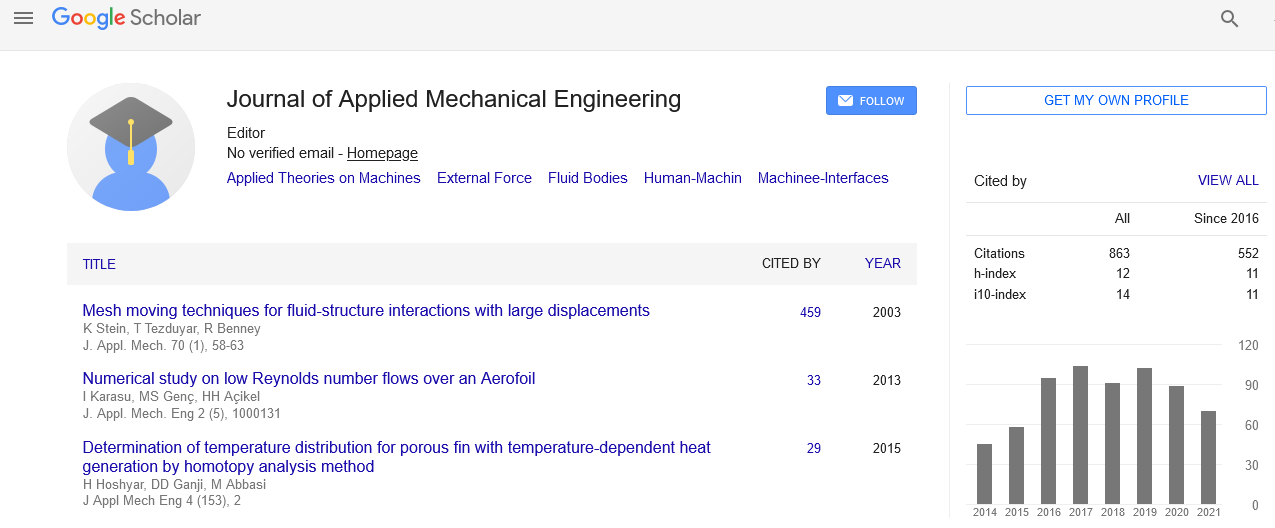

Indexed In
- Genamics JournalSeek
- JournalTOCs
- CiteFactor
- RefSeek
- Hamdard University
- EBSCO A-Z
- OCLC- WorldCat
- Publons
- Google Scholar
Useful Links
Share This Page
Journal Flyer
Open Access Journals
- Agri and Aquaculture
- Biochemistry
- Bioinformatics & Systems Biology
- Business & Management
- Chemistry
- Clinical Sciences
- Engineering
- Food & Nutrition
- General Science
- Genetics & Molecular Biology
- Immunology & Microbiology
- Medical Sciences
- Neuroscience & Psychology
- Nursing & Health Care
- Pharmaceutical Sciences
Perspective - (2026) Volume 15, Issue 1
Biological Motion Concepts in Advanced Mechanical Design Applications
Adrian Foster *Received: 27-Jan-2026 , Manuscript No. JAME-26-31557; Editor assigned: 29-Jan-2026 , Pre QC No. JAME-26-31557; Reviewed: 12-Feb-2026 , QC No. JAME-26-31557; Revised: 19-Feb-2026 , Manuscript No. JAME-26-31557; Published: 26-Feb-2026 , DOI: 10.35248/2252-5211.26.15.534
Description
Mechanical engineering has traditionally relied on mathematical analysis, material science and manufacturing methods to create machines capable of performing industrial and transportation tasks. In recent decades, engineers have increasingly examined natural biological systems to improve mechanical performance, movement efficiency and structural behavior. Living organisms demonstrate highly efficient motion patterns developed through long periods of natural adaptation. Animals, birds, insects and marine organisms display movement capabilities that often surpass conventional machines in flexibility, balance and energy efficiency. Biomechanics-inspired mechanical design applies these biological principles to engineered systems in order to improve mobility, stability, durability and functional performance.
Biomechanics combines principles from biology, physics and engineering to study how living organisms move and respond to forces. Mechanical engineers analyze muscle action, skeletal structures, joint movement and body balance to create machines with improved motion characteristics. This approach has influenced the development of robotic systems, prosthetic devices, industrial manipulators, medical equipment and advanced transportation technologies. Biological structures often achieve high strength while maintaining low weight, making them attractive models for mechanical applications where efficiency is important.
One major area influenced by biomechanics is robotic locomotion. Traditional wheeled systems perform effectively on smooth surfaces but experience difficulty on uneven terrain, stairs or soft ground. Animals, however, move efficiently through forests, rocky environments, sand and water using adaptable limb structures and coordinated body movement. Engineers study the walking patterns of mammals, reptiles and insects to improve robotic mobility. Legged robots designed using biological motion concepts can maintain balance more effectively while adapting to changing surfaces and external disturbances.
Quadruped robots inspired by dogs and horses demonstrate improved terrain adaptability compared to many conventional mobile machines. Their joint structures and movement coordination allow smoother motion across irregular surfaces. Engineers examine muscle behavior and tendon elasticity to create robotic limbs capable of absorbing shocks and storing energy during movement. Such systems reduce energy consumption and improve movement stability in rescue robots, military support equipment and exploration vehicles.
Insect-inspired mechanical systems have also attracted significant engineering attention. Insects demonstrate efficient movement despite possessing small body sizes and lightweight structures. Flying insects such as bees and dragonflies use rapid wing motion to generate lift and maneuver through confined spaces. Engineers study these flight patterns to develop micro aerial vehicles for surveillance, environmental monitoring and inspection operations. Flexible wing designs based on insect movement can improve flight control and reduce energy usage in small unmanned aircraft systems.
Marine organisms provide additional inspiration for mechanical design. Fish move through water using body flexibility and fin motion that produce highly efficient propulsion. Engineers apply these principles in underwater vehicles and aquatic robots designed for ocean research, pipeline inspection and environmental studies. Unlike conventional propeller-driven systems, fish-inspired propulsion methods often create lower noise levels and improved maneuverability. Flexible mechanical tails and fin structures allow smoother movement in underwater environments where traditional systems may experience limitations.
The human body has strongly influenced the design of prosthetic limbs and wearable mechanical devices. Modern prosthetics increasingly incorporate joint mechanisms and movement patterns that imitate natural human motion. Engineers examine walking behavior, muscle coordination and load distribution to create prosthetic systems that improve comfort and mobility for users. Advanced prosthetic legs use sensors and microprocessors to adjust movement based on walking speed and terrain conditions. This supports more natural motion while reducing physical strain during extended use.
Conclusion
Future developments in biomechanics-inspired mechanical engineering may combine advanced robotics, smart materials, artificial intelligence and biological sensing technologies. Soft robotics using flexible materials may allow machines to move safely alongside humans in healthcare and industrial environments. Improved neural interfaces could support more responsive prosthetic control systems connected directly to human muscle signals. Developments in material science and manufacturing may further improve the durability and efficiency of biologically inspired machines. Biomechanics-inspired mechanical design continues to influence modern engineering by providing alternative solutions for movement, structural efficiency and adaptive performance.
Citation: Foster A (2026). Biological Motion Concepts in Advanced Mechanical Design Applications. J Appl Mech Eng. 15:534.
Copyright: Foster A (2026). Biological Motion Concepts in Advanced Mechanical Design Applications. J Appl Mech Eng. 15:534.