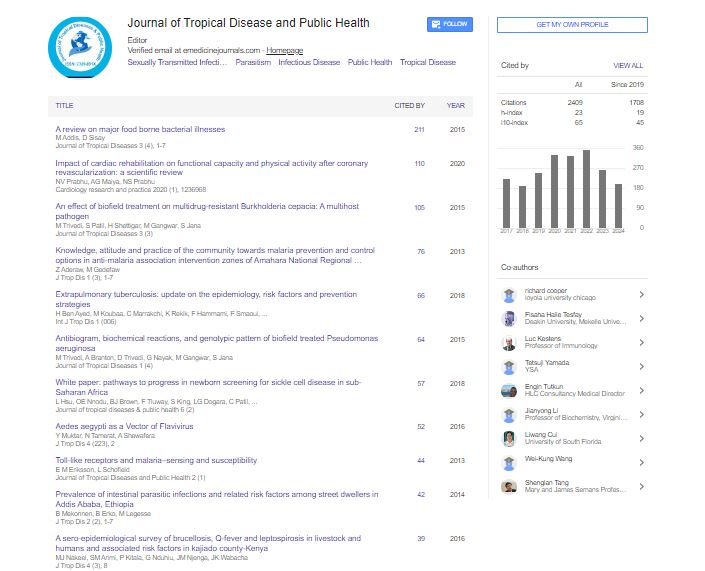

Indexed In
- Open J Gate
- Academic Keys
- ResearchBible
- China National Knowledge Infrastructure (CNKI)
- Centre for Agriculture and Biosciences International (CABI)
- RefSeek
- Hamdard University
- EBSCO A-Z
- OCLC- WorldCat
- CABI full text
- Publons
- Geneva Foundation for Medical Education and Research
- Google Scholar
Useful Links
Share This Page
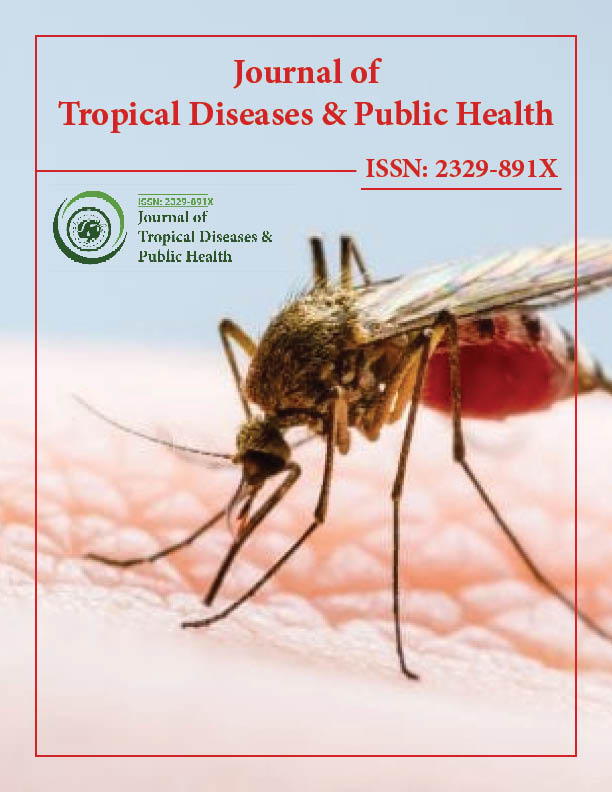
Journal Flyer
Open Access Journals
- Agri and Aquaculture
- Biochemistry
- Bioinformatics & Systems Biology
- Business & Management
- Chemistry
- Clinical Sciences
- Engineering
- Food & Nutrition
- General Science
- Genetics & Molecular Biology
- Immunology & Microbiology
- Medical Sciences
- Neuroscience & Psychology
- Nursing & Health Care
- Pharmaceutical Sciences
Opinion Article - (2026) Volume 15, Issue 2
Advancing Disease Surveillance Systems for Effective Public Health Protection and Response
Elena Maris Valdez*Received: 19-May-2026, Manuscript No. JTD-26-32191; Editor assigned: 21-May-2026, Pre QC No. JTD-26-32191; Reviewed: 04-Jun-2026, QC No. JTD-26-32191; Revised: 11-Jun-2026, Manuscript No. JTD-26-32191; Published: 19-Jun-2026, DOI: 10.35241/2329-891X.26.15.514
Description
Disease surveillance is an essential public health activity that involves the continuous collection, analysis, interpretation, and sharing of health information related to diseases and health conditions. It helps healthcare professionals and public health organizations understand disease patterns, identify changes in infection trends, and develop suitable prevention measures. Effective surveillance systems support early recognition of health threats and assist communities in reducing the effects of infectious and noninfectious diseases.
The main purpose of disease surveillance is to gather reliable information about illnesses occurring within populations. Data may include the number of cases, geographic distribution, age groups affected, symptoms observed, and factors associated with disease occurrence. This information allows health professionals to evaluate the current health situation and plan appropriate responses based on scientific evidence.
Infectious disease surveillance is especially important because many pathogens can spread quickly among individuals and communities. Diseases such as influenza, tuberculosis, malaria, dengue, and other infections require continuous monitoring to understand transmission patterns. Surveillance activities help identify increases in disease cases and support actions such as public education, vaccination programs, medical treatment services, and infection control practices.
Laboratory surveillance provides detailed information about disease-causing organisms. Laboratory testing confirms infections, identifies pathogen characteristics, and helps monitor changes that may influence treatment decisions. Modern laboratory methods allow researchers to examine disease samples and provide information that supports public health planning.
Digital technologies have improved the collection and management of disease information. Electronic health records, mobile reporting systems, and online databases allow faster communication between healthcare facilities and public health departments. These systems improve the speed of information exchange and support timely action during periods of increased disease activity.
Community-based surveillance is another important approach that involves local participation in identifying health concerns. Community members and local health workers often notice changes in disease patterns before formal systems detect them. Training local representatives to recognize symptoms and report unusual health events can improve early identification of potential outbreaks.
Environmental surveillance examines factors outside the human body that may influence disease occurrence. Monitoring water quality, climate conditions, animal populations, and environmental changes provides useful information about possible health risks. This approach is especially relevant for diseases associated with insects, contaminated resources, and animal transmission.
Disease surveillance also supports prevention programs by identifying populations that require additional healthcare support. Information from surveillance studies can guide vaccination activities, health education programs, screening services, and resource distribution. This ensures that public health actions are directed toward areas with greater health needs.
Challenges in disease surveillance include limited healthcare resources, incomplete reporting, data management difficulties, and differences in healthcare infrastructure. Some regions may experience difficulties in maintaining continuous monitoring systems due to financial or technical limitations. Strengthening healthcare facilities, improving training programs, and supporting technological development can improve surveillance capacity.
Conclusion
Disease surveillance is a fundamental component of public health that supports disease prevention, early identification, and effective response planning. Future disease surveillance systems are expected to benefit from advances in digital health, artificial intelligence, laboratory science, and communication technologies. These developments may improve the ability to detect health changes and support faster responses. Continued investment in surveillance infrastructure will help communities prepare for existing and emerging health challenges. By collecting and analyzing health information, surveillance systems provide valuable knowledge about disease patterns and population health needs. Strong collaboration among healthcare workers, laboratories, communities, and public health organizations is necessary for successful surveillance activities. Improving surveillance systems will contribute to better disease management and healthier populations worldwide.
Citation: Valdez EM (2026). Advancing Disease Surveillance Systems for Effective Public Health Protection and Response. J Trop Dis. 15:514.
Copyright: © 2026 Valdez EM. This is an open-access article distributed under the terms of the Creative Commons Attribution License, which permits unrestricted use, distribution and reproduction in any medium, provided the original author and source are credited.