
Indexed In
- Academic Journals Database
- Open J Gate
- Genamics JournalSeek
- JournalTOCs
- China National Knowledge Infrastructure (CNKI)
- Scimago
- Ulrich's Periodicals Directory
- RefSeek
- Hamdard University
- EBSCO A-Z
- OCLC- WorldCat
- Publons
- MIAR
- University Grants Commission
- Geneva Foundation for Medical Education and Research
- Euro Pub
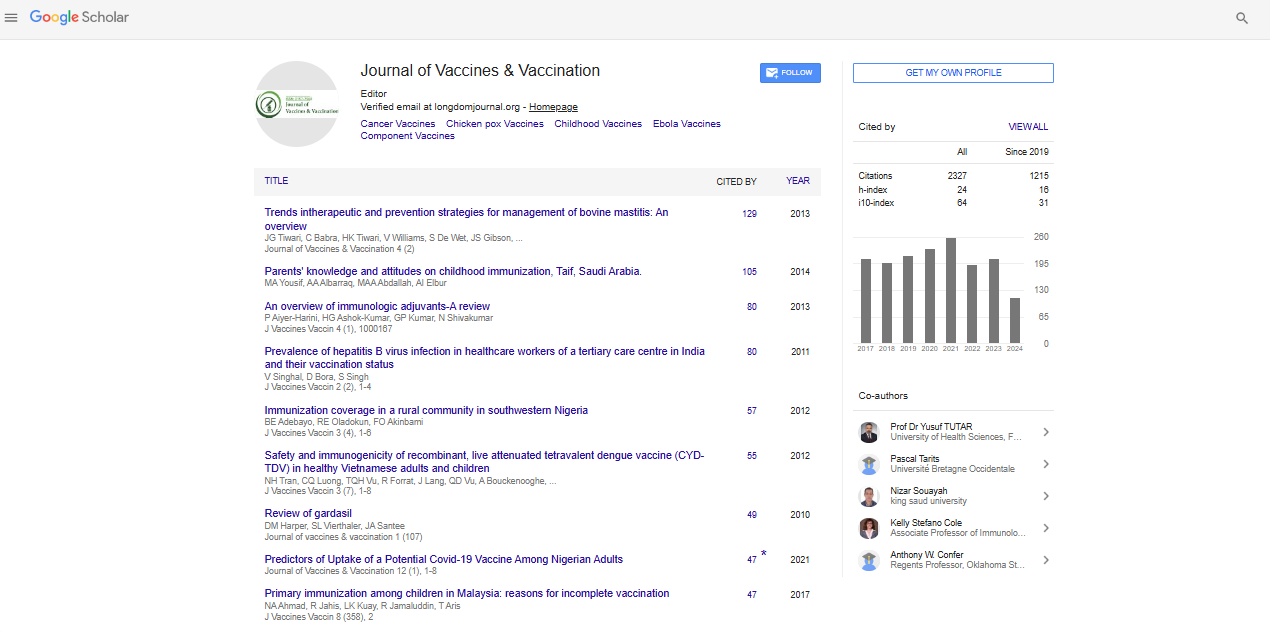
- Google Scholar
Useful Links
Share This Page
Open Access Journals
- Agri and Aquaculture
- Biochemistry
- Bioinformatics & Systems Biology
- Business & Management
- Chemistry
- Clinical Sciences
- Engineering
- Food & Nutrition
- General Science
- Genetics & Molecular Biology
- Immunology & Microbiology
- Medical Sciences
- Neuroscience & Psychology
- Nursing & Health Care
- Pharmaceutical Sciences
Commentary - (2025) Volume 16, Issue 7
Advances in Therapeutic Vaccines for Modern Disease Management
Alaric Fontaine*Received: 17-Jun-2025, Manuscript No. JVV-26-31577; Editor assigned: 19-Jun-2025, Pre QC No. JVV-26-31577; Reviewed: 03-Jul-2025, QC No. JVV-26-31577; Revised: 10-Jul-2025, Manuscript No. JVV-26-31577; Published: 17-Jul-2025, DOI: 10.35248/2157-7560.26.17.615
Abstract
Description
Therapeutic vaccines represent an important area of medical research focused on treating existing diseases rather than preventing future infections. Unlike preventive vaccines, which are administered before exposure to harmful microorganisms, therapeutic vaccines are designed to stimulate the immune system after a disease has already developed. These vaccines aim to strengthen the body’s natural defense mechanisms so that immune cells can identify and attack diseased tissues more effectively. Scientists have explored therapeutic vaccination for conditions such as cancer, chronic viral infections, autoimmune disorders and allergies. Continued research in this field has expanded understanding of immune responses and created new possibilities for disease management.
The immune system protects the human body by detecting harmful organisms and abnormal cells. In some illnesses, however, immune responses become weak, inactive or unable to identify dangerous cells correctly. Therapeutic vaccines attempt to correct this problem by presenting specific disease-related antigens to the immune system. These antigens encourage immune cells to recognize targets that may have previously escaped detection. Once activated, immune cells can attack infected or abnormal tissues more efficiently. This process may slow disease progression, reduce symptoms or improve treatment outcomes when combined with standard medical care.
Cancer treatment has become one of the most widely studied areas for therapeutic vaccine development. Cancer cells often avoid immune destruction because they develop methods to hide from immune surveillance. Therapeutic cancer vaccines attempt to train the immune system to recognize proteins found on tumor cells. Some vaccines use material collected directly from a patient’s tumor, while others rely on laboratory-produced antigens associated with specific cancers. Researchers have investigated therapeutic vaccines for melanoma, prostate cancer, cervical cancer, lung cancer and several other malignancies. In some patients, these vaccines have supported longer survival periods and improved immune activity against tumors.
One of the important features of therapeutic cancer vaccines is their ability to work alongside other medical treatments. Chemotherapy, radiation therapy and immunotherapy may be combined with vaccination strategies to improve patient outcomes. Combination treatment may help reduce tumor growth while stimulating immune responses at the same time. Scientists continue studying the most effective timing and dosage schedules for these combined approaches. Although therapeutic vaccines may not replace traditional cancer treatments completely, they may contribute valuable support in selected cases.
Chronic viral infections also represent a major target for therapeutic vaccine research. Diseases such as hepatitis B, hepatitis C and human immunodeficiency virus can remain in the body for long periods because the immune system struggles to eliminate infected cells completely. Therapeutic vaccines for these infections aim to strengthen antiviral immune activity and reduce viral replication. In some studies, vaccinated patients have shown improved immune responses and lower viral levels. Researchers are investigating whether such vaccines may reduce dependence on long-term antiviral medication in the future.
Another area of investigation involves therapeutic vaccines for autoimmune disorders. In autoimmune diseases, the immune system mistakenly attacks healthy tissues within the body. Conditions such as multiple sclerosis, rheumatoid arthritis and type 1 diabetes result from abnormal immune activity directed against normal organs or cells. Therapeutic vaccines for autoimmune disorders are designed to reduce harmful immune reactions while preserving normal immune protection against infections. Scientists are studying methods that encourage immune tolerance, allowing the body to become less reactive toward its own tissues. This approach differs from traditional vaccines because the goal is immune regulation rather than immune activation.
Conclusion
Therapeutic vaccines continue to represent an active and expanding area of medical science. Research in cancer immunology, chronic infections, autoimmune disease regulation and allergy treatment has demonstrated the potential of immune-based therapies to support disease management. Although challenges remain in development, manufacturing and patient response variability, scientific progress continues to improve understanding of therapeutic vaccination strategies. Continued investment in research, healthcare infrastructure and clinical collaboration may support broader use of therapeutic vaccines in future medical practice. Public understanding of therapeutic vaccines is still developing because many people associate vaccines primarily with disease prevention. Educational efforts from healthcare professionals and researchers can help explain the differences between preventive and therapeutic vaccination.
Citation: Fontaine A (2025). Advances in Therapeutic Vaccines for Modern Disease Management. J Vaccines Vaccin. 16:615
Copyright: © 2025 Fontaine A. This is an open access article distributed under the terms of the Creative Commons Attribution License, which permits unrestricted use, distribution and reproduction in any medium, provided the original author and source are credited.