
Indexed In
- Academic Journals Database
- Open J Gate
- Genamics JournalSeek
- JournalTOCs
- China National Knowledge Infrastructure (CNKI)
- Scimago
- Ulrich's Periodicals Directory
- RefSeek
- Hamdard University
- EBSCO A-Z
- OCLC- WorldCat
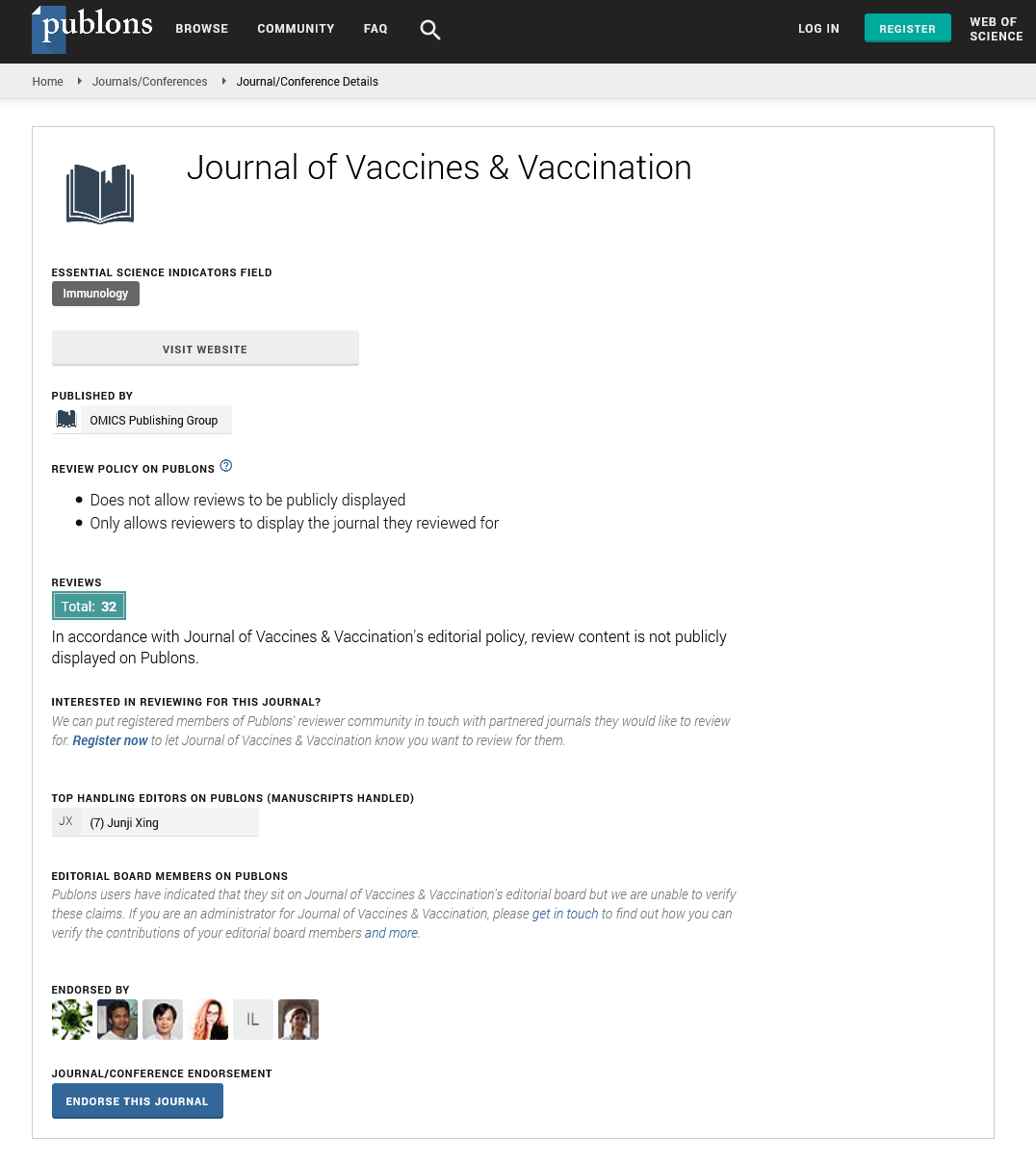
- Publons
- MIAR
- University Grants Commission
- Geneva Foundation for Medical Education and Research
- Euro Pub
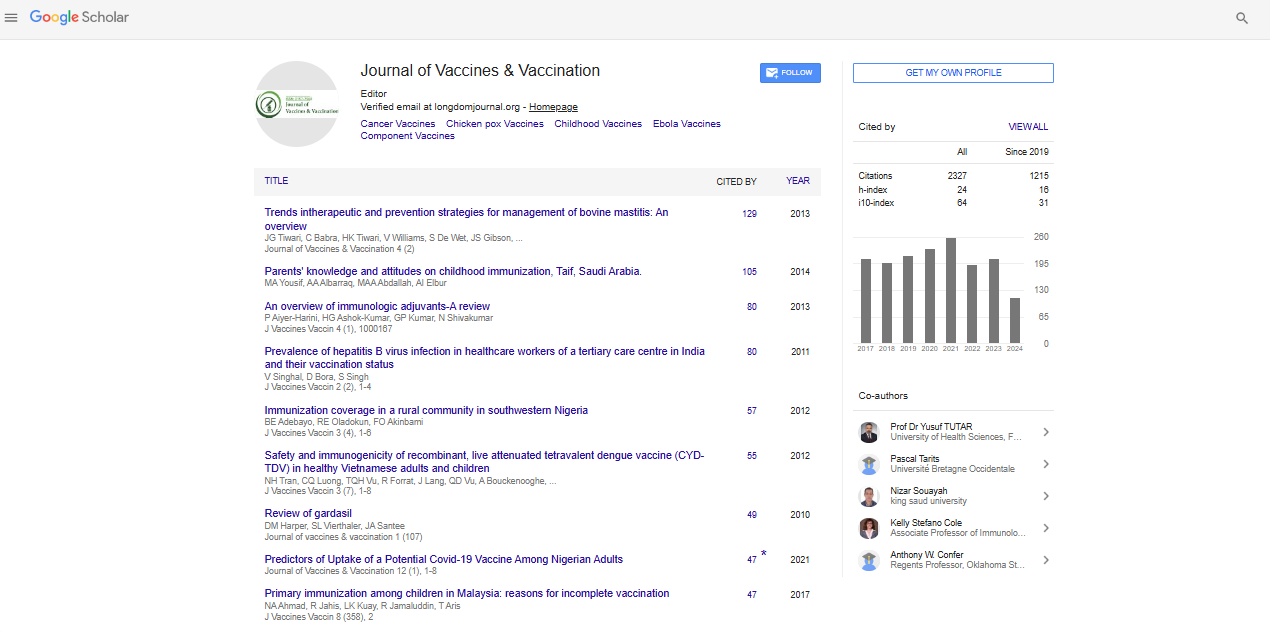
- Google Scholar
Useful Links
Share This Page
Open Access Journals
- Agri and Aquaculture
- Biochemistry
- Bioinformatics & Systems Biology
- Business & Management
- Chemistry
- Clinical Sciences
- Engineering
- Food & Nutrition
- General Science
- Genetics & Molecular Biology
- Immunology & Microbiology
- Medical Sciences
- Neuroscience & Psychology
- Nursing & Health Care
- Pharmaceutical Sciences
Commentary - (2025) Volume 16, Issue 4
Addressing Global Challenges and Developments in Vaccine Regulatory Issues for Public Health
Sophia Müller*Received: 01-Apr-2025, Manuscript No. JVV-25-30312; Editor assigned: 03-Apr-2025, Pre QC No. JVV-25-30312; Reviewed: 17-Apr-2025, QC No. JVV-25-30312; Revised: 24-Apr-2025, Manuscript No. JVV-25-30312; Published: 01-May-2025, DOI: 10.35248/2157-7560.25.16.599
Description
Vaccine regulatory issues represent a critical intersection between science, ethics and public policy, ensuring that vaccines are safe, effective and accessible for global populations. Regulatory frameworks provide the foundation upon which vaccine development, evaluation, approval and post-marketing surveillance are built. These frameworks are guided by rigorous scientific evidence and ethical principles to protect public health while fostering innovation. As vaccines continue to play a central role in disease prevention and outbreak control, the importance of effective regulatory oversight has become more pronounced than ever before, especially in an era marked by rapid technological advances and global health emergencies.
The regulation of vaccines involves multiple stages, beginning with preclinical research and extending through clinical trials, licensing, distribution and post-marketing monitoring. Each phase is subject to strict review processes conducted by national and international regulatory authorities. Agencies such as the U.S. Food and Drug Administration (FDA), the European Medicines Agency (EMA) and the World Health Organization (WHO) set the global benchmarks for vaccine evaluation. These institutions assess data on vaccine safety, efficacy, quality and manufacturing consistency before granting approval for public use. In developing countries, regional and national authorities adapt these standards to local health needs and infrastructure, often with support from WHO prequalification programs to ensure that vaccines meet global safety standards.
One of the most challenging aspects of vaccine regulation lies in balancing speed with safety. The COVID-19 pandemic demonstrated how urgent global health crises can pressure regulatory systems to accelerate vaccine approval without compromising public trust. Emergency Use Authorizations (EUAs) and conditional marketing approvals became essential tools to expedite vaccine deployment while maintaining ongoing data collection for long-term safety assessment. These mechanisms, though effective, have sparked debates on regulatory flexibility, data transparency and ethical obligations. The challenge for regulatory agencies remains to strike the right balance between rapid response and rigorous scientific validation, ensuring that expedited pathways do not erode public confidence in vaccines.
Vaccine regulatory issues also encompass the complexity of manufacturing and quality control. Vaccines are biological products with inherent variability and maintaining consistency across production batches is a formidable task. Regulatory agencies enforce Good Manufacturing Practices (GMP) to ensure that facilities adhere to strict quality assurance standards. Continuous monitoring through lot release testing, site inspections and audits helps detect potential deviations that may compromise vaccine integrity. Furthermore, globalization of vaccine supply chains introduces additional layers of complexity, as raw materials and production sites are often distributed across multiple countries. Harmonization of international regulatory standards through organizations such as the International Council for Harmonisation (ICH) and WHO helps address these challenges, promoting global collaboration and mutual recognition of regulatory decisions.
Post-marketing surveillance forms another vital component of vaccine regulation. After a vaccine is introduced into the market, continuous monitoring systems track its performance and detect adverse events following immunization. Regulatory authorities rely on both passive and active surveillance mechanisms, such as the Vaccine Adverse Event Reporting System (VAERS) in the United States and the Eudra Vigilance database in Europe. These data are analyzed to identify safety signals that might not have emerged during clinical trials. Transparency in reporting and timely risk communication are crucial in maintaining public trust, especially when rare adverse events are identified. The implementation of pharmacovigilance systems in low- and middle-income countries remains a major regulatory priority, as many of these regions still lack adequate reporting infrastructure.
Ethical and legal considerations also play a significant role in vaccine regulation. Issues such as informed consent, data privacy and equitable access must be addressed throughout the vaccine lifecycle. The regulatory environment must ensure that clinical trials are conducted ethically, with participation based on voluntary consent and proper risk disclosure. Moreover, global equity in vaccine access remains a persistent concern. During the COVID-19 pandemic, disparities in vaccine distribution exposed deep inequities in global health governance. Regulatory frameworks need to adapt to these challenges by supporting fair licensing agreements, encouraging technology transfer and facilitating local production in underserved regions. Initiatives like the WHO’s COVAX program illustrate how regulatory cooperation can promote more equitable vaccine availability worldwide.
The regulation of novel vaccine platforms presents additional complexities. The emergence of mRNA, vector-based and DNA vaccines has transformed the landscape of immunization, but these innovations require new regulatory paradigms. Traditional frameworks designed for inactivated or protein-based vaccines may not fully capture the scientific and safety considerations of next-generation technologies. Regulators must develop adaptive guidelines that account for platform-specific risks, such as genetic stability, immunogenicity and long-term effects. At the same time, harmonized international guidance is essential to prevent regulatory fragmentation that could slow global access to life-saving vaccines. The use of real-world evidence and digital data analytics is increasingly becoming a valuable tool for regulators to make evidence-based decisions more efficiently.
Public communication and transparency are integral to addressing vaccine regulatory issues. The credibility of regulatory agencies depends largely on their ability to communicate decisions clearly and justify the scientific rationale behind them. Misinformation and conspiracy theories about vaccines can spread rapidly, undermining immunization efforts. Regulatory authorities must therefore engage with communities, healthcare professionals and the media to provide accurate, timely and accessible information. The trust that the public places in vaccination programs is ultimately rooted in the integrity, independence and accountability of regulatory institutions.
Conclusion
In conclusion, vaccine regulatory issues embody the complex interplay between science, law, ethics and global cooperation. Strong and transparent regulatory systems are indispensable for safeguarding public health while encouraging scientific innovation. As global health challenges evolve, regulators must remain adaptable, embracing new technologies and methodologies that enhance vaccine safety and accessibility. The collective effort of international organizations, national authorities and the scientific community will determine how effectively humanity continues to manage vaccine development and deployment. By addressing regulatory challenges with rigor and fairness, the world can ensure that vaccines remain one of the most powerful tools in preventing disease and saving lives across all nations.
Citation: Müller S (2025) Addressing Global Challenges and Developments in Vaccine Regulatory Issues for Public Health. J Vaccines Vaccin. 16:599.
Copyright: © 2025 Müller S. This is an open access article distributed under the terms of the Creative Commons Attribution License, which permits unrestricted use, distribution and reproduction in any medium, provided the original author and source are credited.