
Indexed In
- RefSeek
- Hamdard University
- EBSCO A-Z
- Publons
- Euro Pub
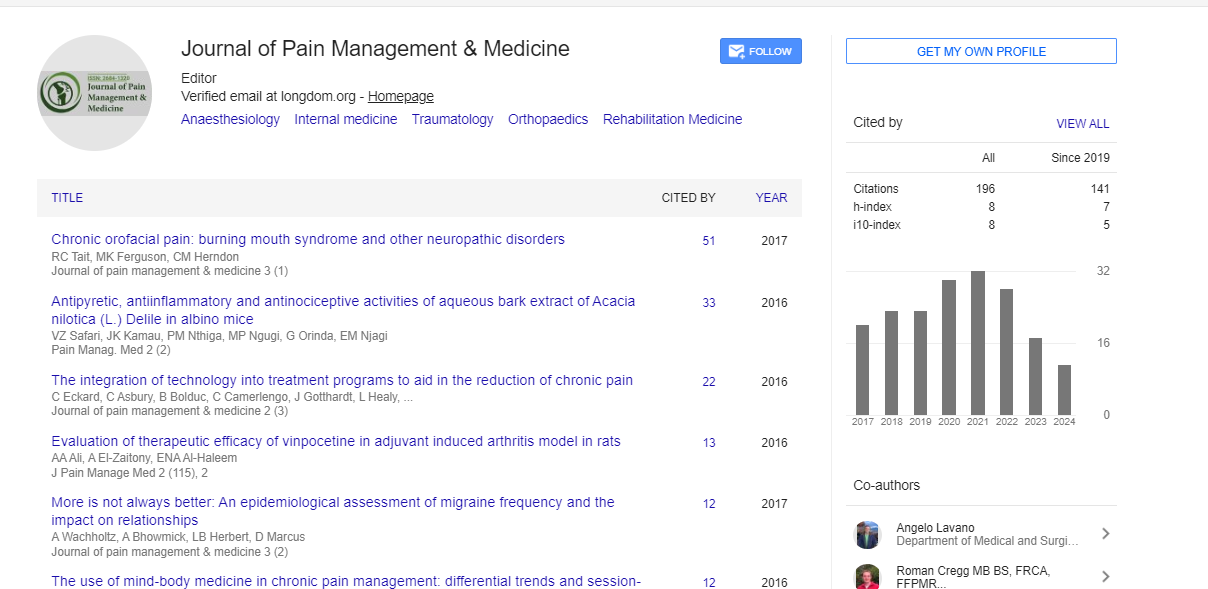
- Google Scholar
- Quality Open Access Market
Useful Links
Share This Page
Journal Flyer

Open Access Journals
- Agri and Aquaculture
- Biochemistry
- Bioinformatics & Systems Biology
- Business & Management
- Chemistry
- Clinical Sciences
- Engineering
- Food & Nutrition
- General Science
- Genetics & Molecular Biology
- Immunology & Microbiology
- Medical Sciences
- Neuroscience & Psychology
- Nursing & Health Care
- Pharmaceutical Sciences
Commentary - (2025) Volume 11, Issue 4
A Comprehensive Overview of Chronic Pain Management in Modern Clinical Practice
Luana Julia*Received: 30-Jun-2025, Manuscript No. JPMME-25-30419; Editor assigned: 02-Jul-2025, Pre QC No. JPMME-25-30419 (PQ); Reviewed: 16-Jul-2025, QC No. JPMME-25-30419; Revised: 23-Jul-2025, Manuscript No. JPMME-25-30419 (R); Published: 30-Jul-2025, DOI: 10.35248/2684-1320.25.11.337
Abstract
Description
Chronic pain remains one of the most prevalent and challenging health conditions worldwide, affecting millions of individuals and presenting a significant burden to healthcare systems. Defined as pain persisting for more than three months or beyond the expected tissue-healing period, chronic pain is no longer viewed solely as a symptom but as a complex disease in its own right. Its multidimensional nature encompassing biological, psychological, and social factors requires a comprehensive and integrated approach to management.
Contemporary understanding of chronic pain emphasizes the importance of its underlying mechanisms. While some chronic pain arises from ongoing nociceptive processes, such as arthritis or musculoskeletal injuries, other types stem from neuropathic origins involving nerve damage or dysfunction. Additionally, central sensitization a state of heightened responsiveness within the central nervous system can amplify pain perception even in the absence of active tissue damage. This growing insight into pain physiology has driven the development of more targeted and effective therapeutic strategies.
A cornerstone of chronic pain management is multimodal therapy, combining pharmacologic, interventional, psychological, and physical modalities to optimize outcomes. Pharmacologic treatment often begins with non-opioid analgesics, including NSAIDs, acetaminophen, anticonvulsants, and antidepressants, each addressing different aspects of chronic pain pathways. Although opioids may offer relief for certain patients, their long-term use remains controversial due to risks of dependence, tolerance, and adverse effects. Therefore, current guidelines promote opioid-sparing strategies and emphasize personalized treatment plans that prioritize safety while ensuring adequate pain control.
Interventional procedures play a critical role in managing chronic pain that is refractory to conservative measures. Options such as nerve blocks, epidural steroid injections, radiofrequency ablation, and various neuromodulation techniques especially spinal cord stimulation have demonstrated effectiveness in specific pain conditions, particularly neuropathic pain syndromes. These interventions not only reduce pain intensity but also help decrease reliance on long-term pharmacotherapy, enhancing overall patient functioning.
Non-pharmacologic interventions are equally essential and often foundational to effective chronic pain care. Physical therapy promotes strength, flexibility, and functional restoration while countering the deconditioning often associated with prolonged pain. Exercise-based programs, when tailored to patient capability, improve mobility and reduce disability. Psychological therapies, including Cognitive Behavioral Therapy (CBT) and mindfulness-based approaches, address the emotional and cognitive dimensions of chronic pain. These strategies help patients modify maladaptive thoughts, build resilience, and adopt healthier coping mechanisms. Integrative approaches such as acupuncture, yoga, and massage therapy have also gained acceptance due to their safety profiles and supportive evidence.
Because chronic pain affects individuals physically, emotionally, and socially, patient-centered care is vital. Effective communication, shared decision-making, and education empower patients to take an active role in managing their condition. Self-management strategies including pacing, stress reduction, and home exercise programs foster long-term independence and reduce healthcare utilization.
Special populations require additional consideration. Older adults may face polypharmacy risks and functional limitations that influence treatment choice, while individuals with comorbid mental health disorders may require integrated behavioral health support. Addressing disparities in pain assessment and treatment is also critical, as cultural, socioeconomic, and systemic factors can significantly impact patient outcomes.
Technological innovations continue to enhance chronic pain management. Telemedicine facilitates ongoing monitoring and multidisciplinary collaboration, while digital applications for pain tracking and remote therapy support patient engagement and treatment adherence. As research advances, emerging therapies including regenerative medicine, targeted biologics, and personalized neurostimulation offer promise for future treatment paradigms.
In conclusion, chronic pain management requires a comprehensive, individualized, and multidisciplinary approach that integrates pharmacologic therapies, interventional techniques, rehabilitation strategies, and psychological support. Emphasizing patient centered care, evidence-based practice, and ongoing innovation will remain essential for improving quality of life and functional outcomes for individuals living with chronic pain.
Citation: Julia L (2025). A Comprehensive Overview of Chronic Pain Management in Modern Clinical Practice. J Pain Manage Med. 11:337.
Copyright: © 2025 Julia L. This is an open-access article distributed under the terms of the Creative Commons Attribution License, which permits unrestricted use, distribution, and reproduction in any medium, provided the original author and source are credited.